

A Journey to Restore Mind and Body: Goma Training and Shojin-ryori at Takao-san Yakuo-in
Just about 1 hour by train from central Tokyo, Mt. Takao is a nature-rich place where you can encounter mountain worship and Shugendo (mountain asceticism) while still in Tokyo.
Halfway up the mountain stands Takao-san Yakuo-in, which continues to pass these traditions down to the present day.
As you walk the approach, the scent of cedars and the quiet air surround you, and you can feel how Mt. Takao has long been cherished as a place of prayer.
At Takao-san Yakuo-in, you can experience the fire prayer known as Goma training and Shojin-ryori (Buddhist vegetarian cuisine), which helps settle the mind through food.
Both are open to anyone, and by taking part with an understanding of the meanings behind the ritual and the cuisine, you can touch their spirituality.
This article introduces the appeal of Takao-san Yakuo-in, focusing on Goma training and Shojin-ryori.
Access to Takao-san Yakuo-in
The nearest station to Takao-san Yakuo-in is Takaosanguchi Station on the Keio Line.
If you take the Keio Line Limited Express from Shinjuku Station, you can get there directly in about 1 hour.
That makes it easy to enjoy as a day trip even from hotels in central Tokyo.
There are also plenty of hotels around Mt. Takao and in the Hachioji area, so staying nearby for a night is another good option.
After arriving at Takaosanguchi Station, walk about 5 minutes to Kiyotaki Station, then take the cable car (Takao Tozan Dentetsu) to Takaosan Station, and walk up the Trail 1 approach for about 6 minutes to reach the entrance to Takao-san Yakuo-in's sacred area, Joshin-mon Gate.
Along the way, there are many sights, including Bussharito (a Buddha relic stupa) dedicated to prayers for peace and happiness, and Osugihara, a place nurtured by people's wishes and prayers.
If you climb while listening to the audio guide below, you will be able to appreciate the charms of both Takao-san Yakuo-in and Mt. Takao more deeply.
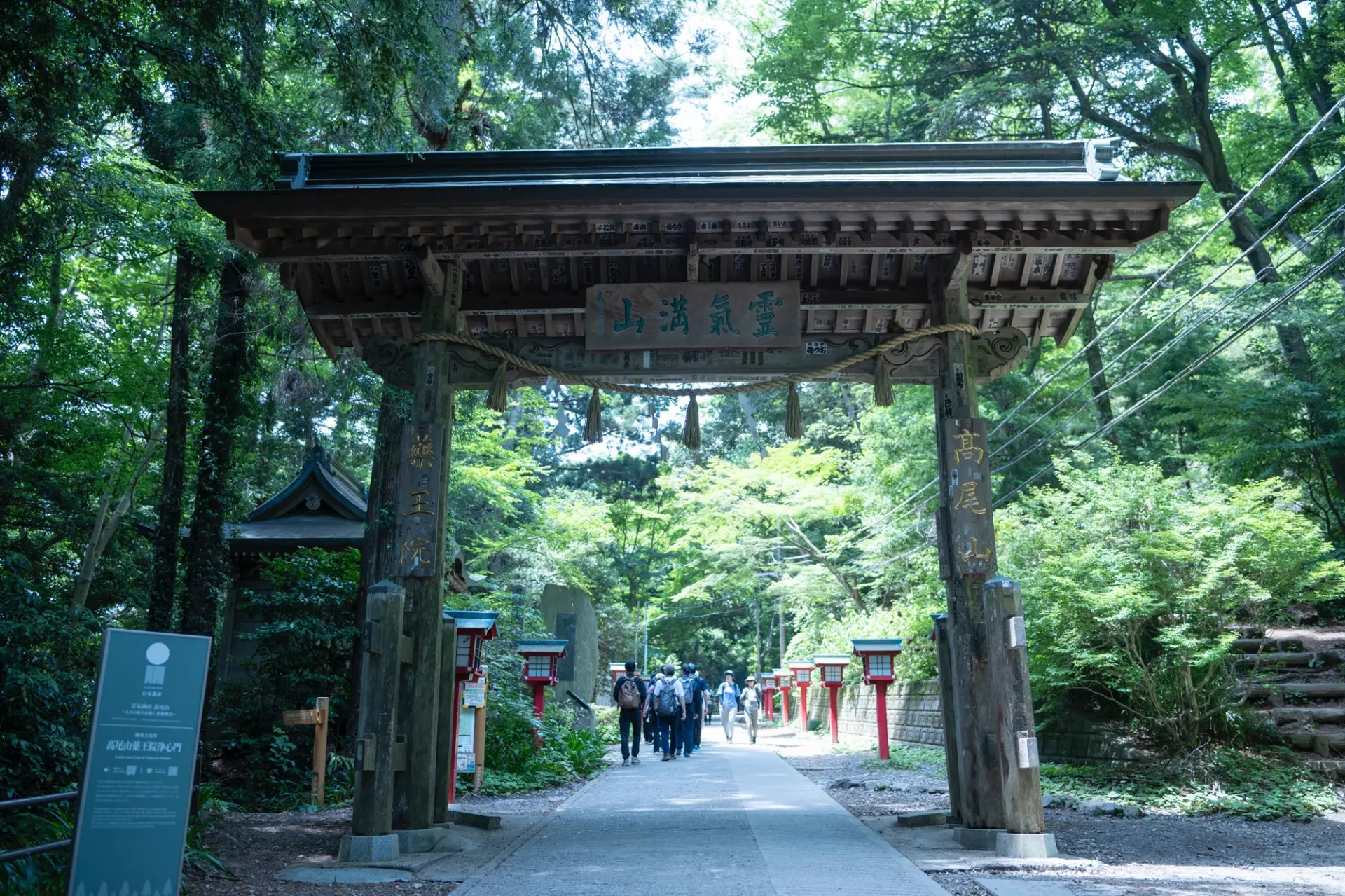
Why Takao-san Yakuo-in Draws People In
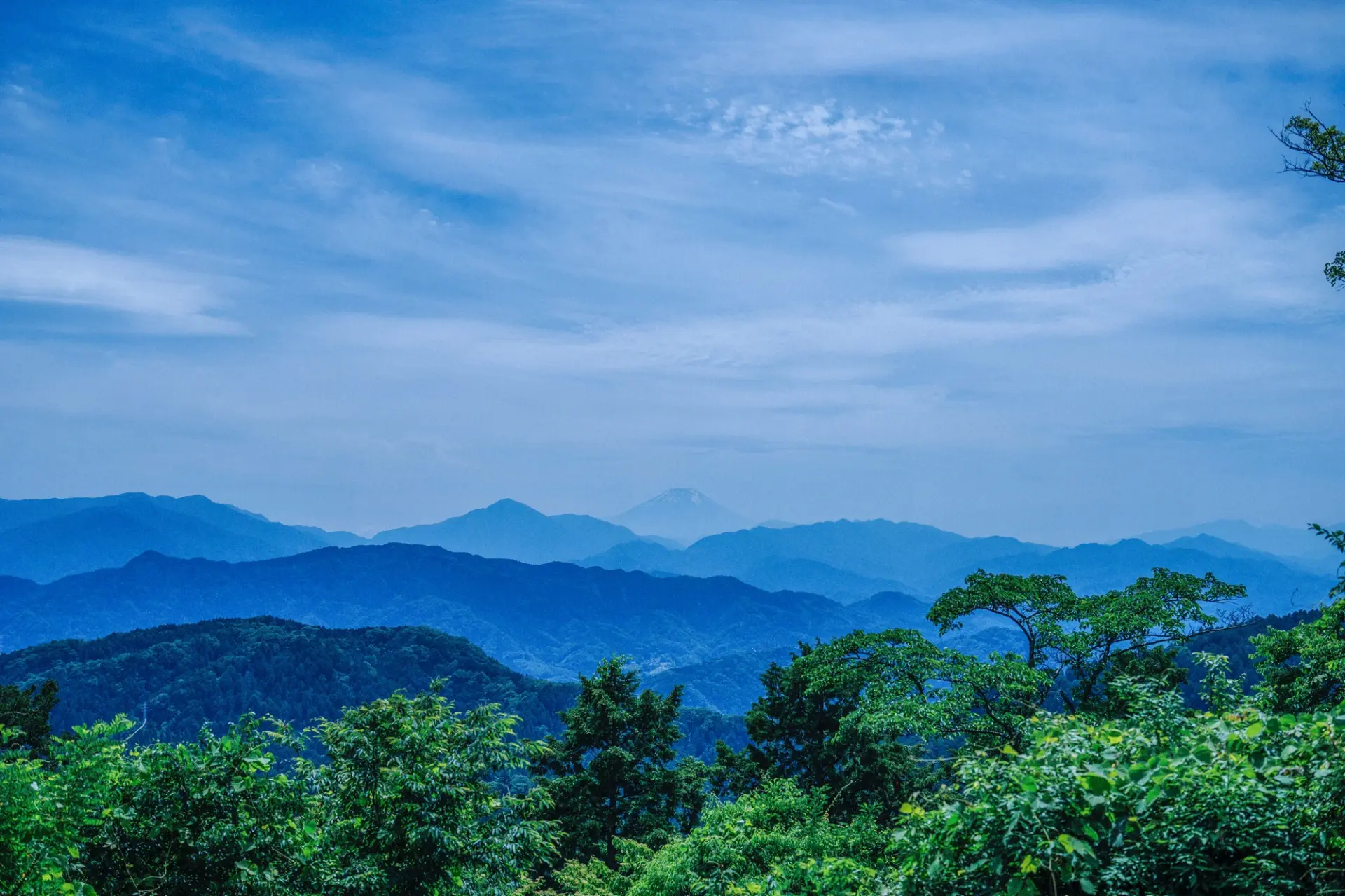
The reason Mt. Takao's nature has been so well preserved is the presence of people who have cherished this mountain as an object of faith for about 1,300 years.
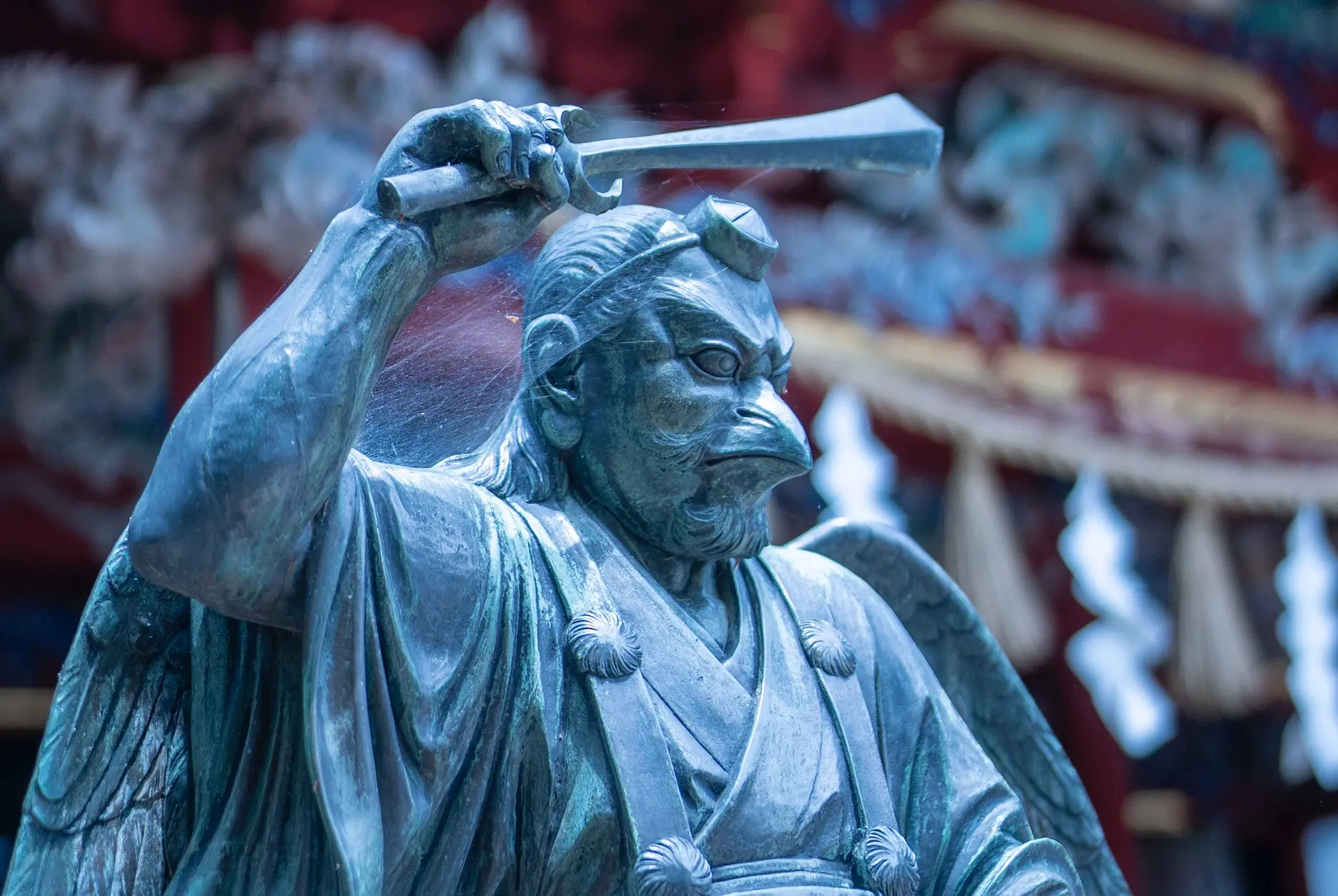
Within the precincts, tengu statues and other figures are scattered throughout the grounds, and you can learn the history of Mt. Takao being worshipped by many as a sacred mountain.
Experiences like Goma training and Shojin-ryori are appealing because they let you understand this culture of faith not only by “seeing” it but by “experiencing” it.
As a precious place where nature, culture, and experience come together as one, Takao-san Yakuo-in is visited by many travelers every day.
Shugendo and Tengu Devotion Handed Down at Takao-san Yakuo-in
Takao-san Yakuo-in is a place where the teachings of Shugendo still live on as a base of mountain worship.
Long known as a sacred mountain, Mt. Takao has a history in which yamabushi trained in the mountains and offered prayers.
The cedar-lined paths and stone monuments quietly convey that this is a mountain of faith protected over many years.
Alongside this Shugendo tradition, tengu have also long been widely cherished on Mt. Takao.
Tengu are regarded as messengers of deities and buddhas, and they have been spoken of as symbols that ward off misfortune and bring good fortune.
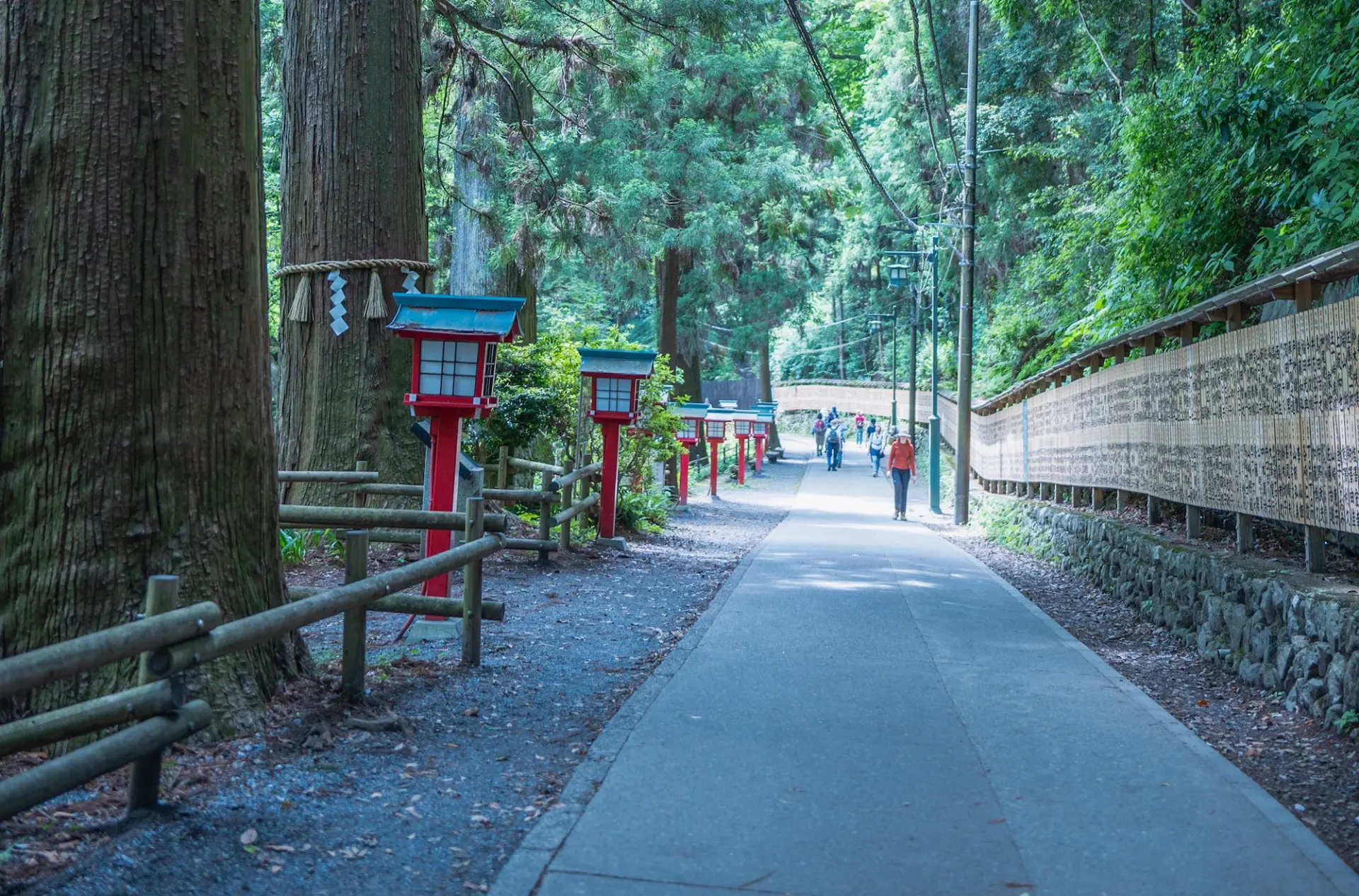
As you proceed along the approach, you will encounter an especially striking giant cedar said to be where a tengu sat, called “Tengu no Koshikake Sugi.”
Even now, it quietly watches over visitors and gives strength to worshippers.
Within the precincts, statues of Hanataka Tengu (Daitengu), with red faces and tall noses, and Karasu Tengu (Kotengu), with crow beaks, stand out and catch the eye.
By walking while touching this Shugendo tradition and tengu devotion, you will be able to feel the cultural background of Takao-san Yakuo-in more deeply.
Suginae Honno, a Sign of Prayer Handed Down on Mt. Takao
If you want to enjoy the cultural background, you should also know about Suginae Honno, one of the faith traditions handed down on Mt. Takao.
The custom of dedicating cedar saplings to Takao-san Yakuo-in as thanks when a wish has been fulfilled has continued from long ago to the present.
Each sapling took root and grew over the years into the cedar-lined approach you see today.
Among these giant trees are cedars that are more than 500 years old.
Facing the cedar-lined path, rows of Homyo-ban (name boards) display the names of those who dedicated cedar saplings.
These boards are replaced each year, and the accumulation of this history connects to the culture of prayer that has been cherished at Takao-san Yakuo-in.
Experiencing Goma training or Shojin-ryori becomes a precious opportunity to touch this spirit of prayer.
Goma Training: Quietly Facing Your Own Mind
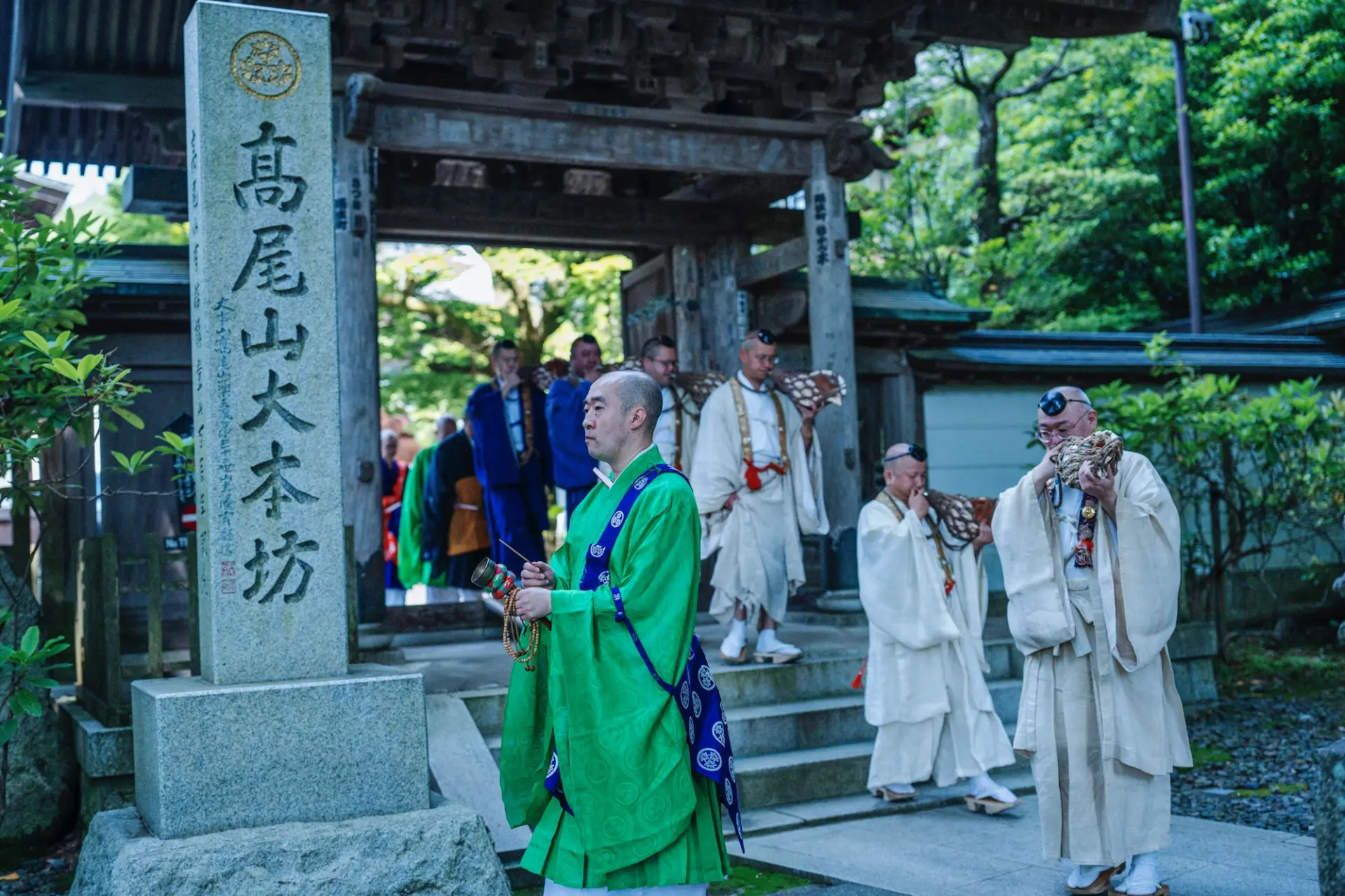
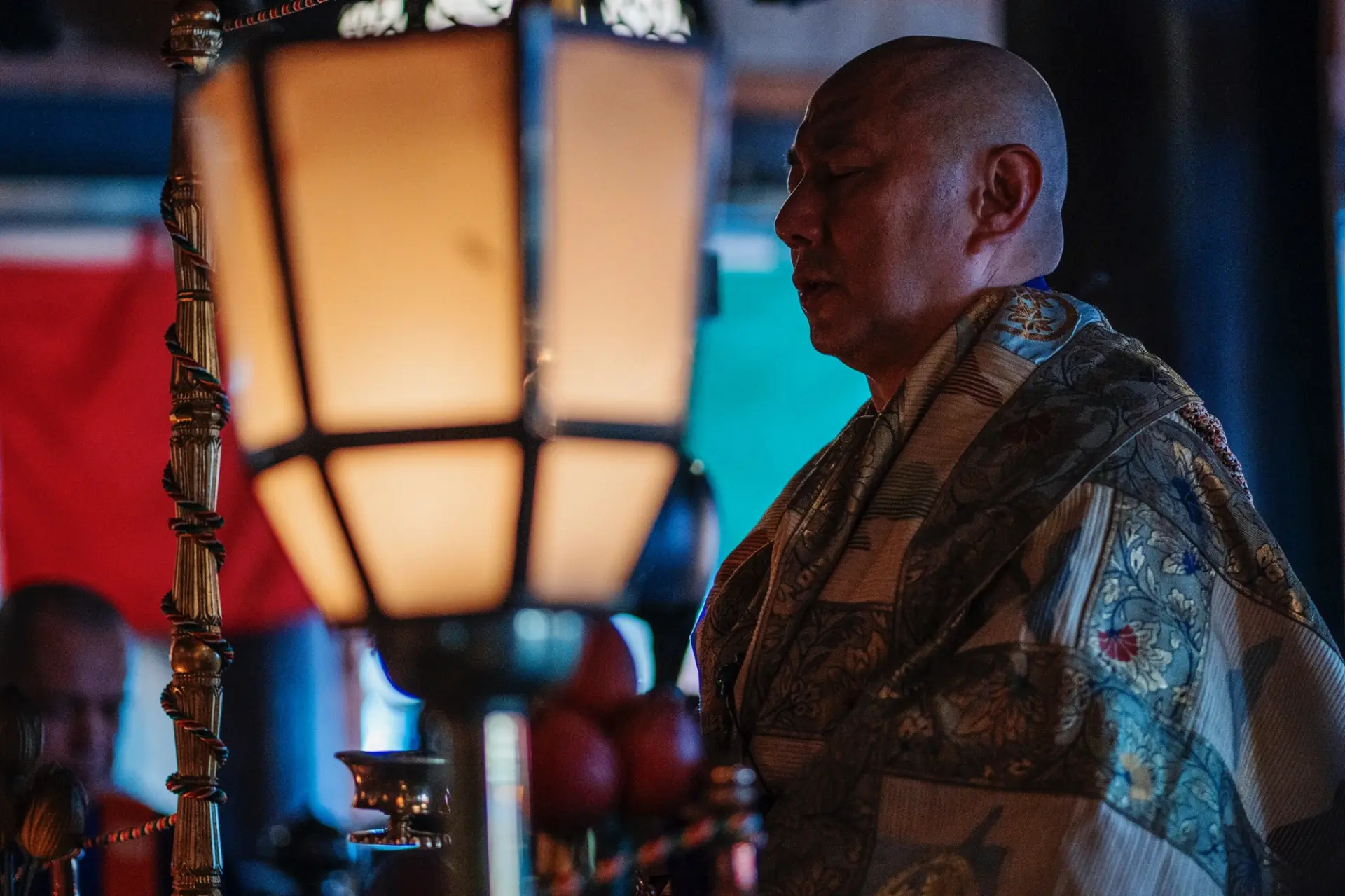
Goma training is an esoteric rite that originated in India, a ritual in which goma sticks are burned and the flames are used to burn away worldly desires and purify the mind, bringing spiritual cleansing and the fulfillment of wishes.
In Shingon esoteric Buddhism, the flames are seen as the Buddha’s wisdom, and people entrust their wishes to that light that illuminates confusion and anxiety.
At Takao-san Yakuo-in, this Goma training is held every day, and anyone can take part.
Under the teaching that you align your own “body, speech, and mind” with the power of the principal image, Izuna Daigongen, the officiating priest lights the goma sticks that represent worldly desires.
As the sound of the horagai (conch shell trumpet), sutra chanting, and the beat of drums spread through the precincts, a unique tension and stillness arise, and your mind naturally settles.
Worshippers write their name and prayer request in advance, and those wishes are entrusted to a gomafuda that is also regarded as a manifestation of the principal image.
When the flames surge upward, the prayer is said to ride the fire and be delivered to the Buddha, and after the ritual the gomafuda is bestowed.
It remains with you as a sign of a vow to yourself: “I truly prayed here, and I will continue to live while cherishing this wish.”
The Goma training audio guide also explains the background of Goma in an easy-to-understand way, including the idea of the flames as a “symbol of wisdom” and the meanings embedded in the sound of the horagai.
If you listen before and after the experience, you will better understand what each part of the ritual means, and the experience itself should feel richer.
- Main elements
- Ritual elements such as the horagai, sutra chanting, and drums
- Goma fee
- From 3,000 yen (The size of the gomafuda varies depending on the amount)
- Practice times
-
Morning: 9:30 am, 11:00 am
Afternoon: 12:30 pm, 2:00 pm, 3:30 pm - Duration
- 20-30 minutes
- Languages
- Japanese
- Audio guide
- Listen to the audio guide
Shojin-ryori: Savoring Nature's Bounty and Quiet Prayer
Shojin-ryori is a plant-based cuisine rooted in Buddhist teachings.
It developed under precepts such as avoiding animal products and gokun (pungent vegetables such as garlic and negi), based on the idea of “not taking life to eat.”
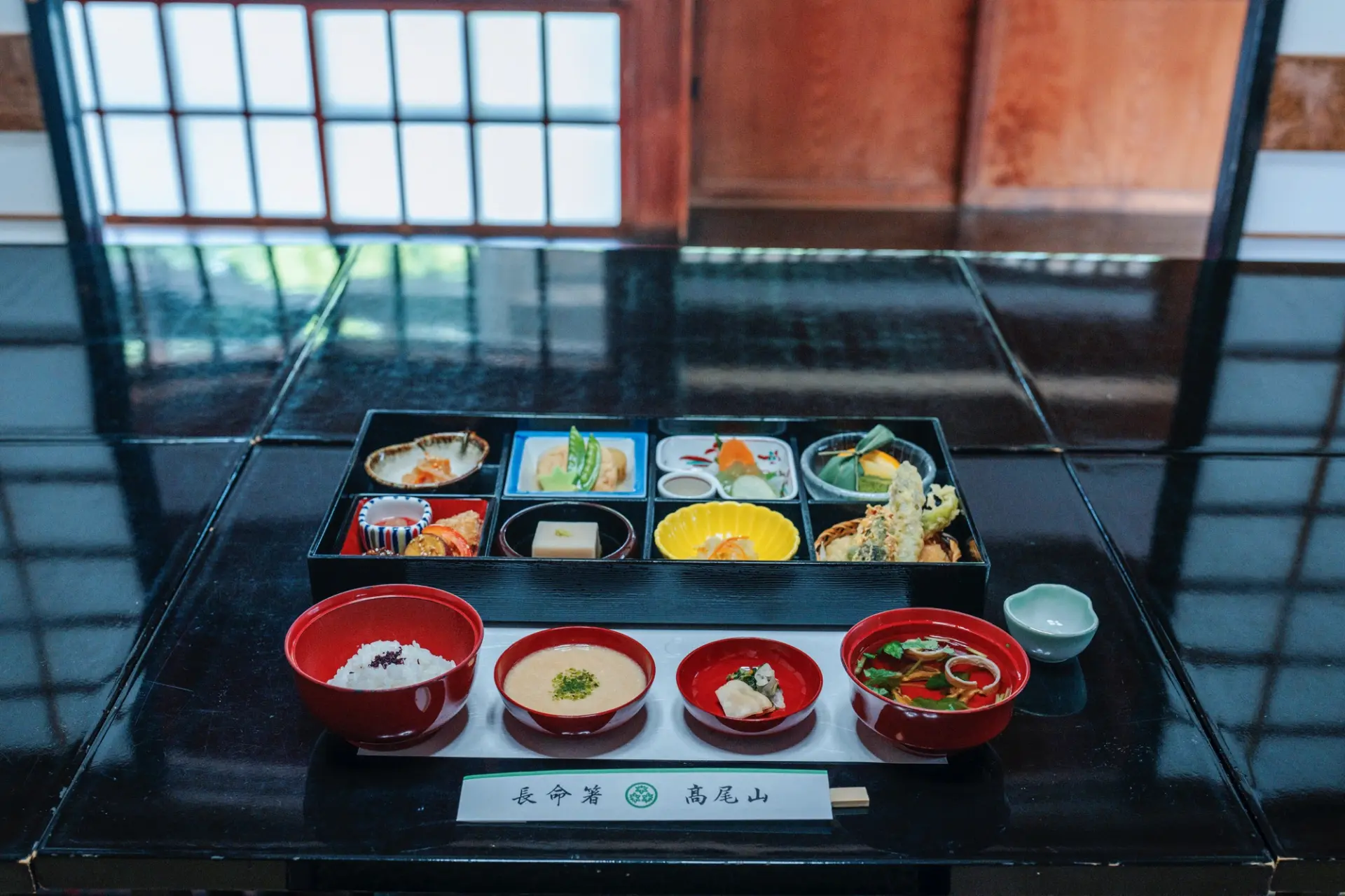
At Takao-san Yakuo-in, ingredients are used that let you savor nature's bounty, such as seasonal vegetables, beans, and root vegetables.
Seasoning is kept restrained to draw out each ingredient's aroma and sweetness, and while it is not flashy, you can feel deep richness with every bite.
When eating, people may chant shokuji no ge (a mealtime verse) in gratitude to the many people and to nature involved in bringing the meal to their table.
This is a set of prayerful words meant to honor the life of the ingredients and prepare oneself to face each meal.
After you finish and look at the tray, a quiet sense of satisfaction remains that goes beyond simply satisfying hunger.
Nature's bounty, gratitude to the cooks, and time spent facing your own mind overlap, and the meal should become a small “anchor for prayer.”
The Shojin-ryori audio guide introduces the history of Shojin-ryori and background topics such as why facing nature's bounty connects to training.
Before experiencing Shojin-ryori, be sure to listen to the audio guide as well.
- Dining location
- Takao-san Yakuo-in Daihonbo (main quarters)
- Serving hours
- 11:00 am-2:00 pm
- Dishes and prices
-
[takaozen (4,400 yen)] A lavish set beautifully arranged with seasonal vegetables, simmered tofu, soup, and more
[tenguzen (3,300 yen)] About 10 small dishes (fried items, rice, dessert, and more)
(Menu items vary by season) - Languages
- Japanese
- Dietary restrictions
-
Available: allergies, vegetarian
Not available: halal, vegan - How to apply
- Phone reservation (applications are accepted for groups of two or more)
- Audio guide
- Listen to the audio guide
Summary
Takao-san Yakuo-in is a precious place where you can encounter the culture of mountain worship and Shugendo even though it is easily accessible from hotels in central Tokyo.
The time spent walking the approach, the flames of Goma training, and a tray of Shojin-ryori all become quiet prayers that naturally turn your gaze toward nature and yourself.
With experiences you can enjoy even without deep knowledge, Takao-san Yakuo-in's appeal is that even visitors who come as sightseeing can feel “prayer” close at hand.
By experiencing the nature of Mt. Takao and its long-standing culture of prayer, you will find a small space of calm in your mind during your journey.
Without going too far from the city center, Mt. Takao lets you step into something out of the ordinary, so enjoy a journey where you listen to your own mind more slowly than usual through Goma training and Shojin-ryori.
Also, be sure to check out the feature below, which introduces various ways to enjoy Mt. Takao and the areas around it.