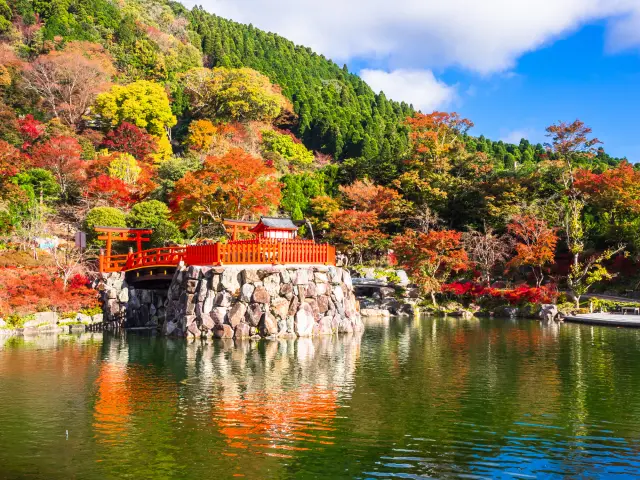
Minoyama Ryuanji Temple

Verified [Verified] denotes information that has been published with confirmation of its owing parties.

Minoyama Ryuanji Temple

A Minoh power spot embraced by spectacular nature.

Last update :
Supervised by :  Minoyama Ryuanji Temple

This historic temple sits along a walking trail in the lush Meiji no Mori Minoh Quasi-National Park, just a short distance from the scenic Minoh Falls. It is said to have been founded by En no Gyoja, the founder of Shugendo, and enshrines Japan’s oldest Benzaiten as its principal deity. Known for blessings for the performing arts and good fortune, it’s also famous as the birthplace of lotteries. Every year on October 10, the grounds come alive with worshippers for “Minoh Tomi,” believed to be the origin of the lottery.

There’s plenty to see, too. The Benzaitendo Hall, built by imperial order of Emperor Go-Mizunoo, stands out for its distinctive structure that incorporates Shinto shrine architectural styles. The temple gate is a storied building relocated from the Kyoto Imperial Palace in 1809, and the Hoo-kaku Hall, a Taisho-era masterpiece by architect Goichi Takeda, is designated as a Registered Tangible Cultural Property of Japan. The grounds also include the Kannondo Hall, which houses the Important Cultural Property statue of Nyoirin Kannon, and the Gyojado Hall connected to Shugendo—making this a place to enjoy both living faith and architectural beauty. Why not spend a peaceful moment here, where you can take in nature and history at the same time?

Highlights

  • A historic temple near Minoh Falls, nestled in the nature-rich Meiji no Mori Minoh Quasi-National Park.
  • Home to Japan’s oldest Benzaiten as its principal deity, popular with visitors seeking blessings for the performing arts and good fortune.
  • Known as the birthplace of lotteries, and hosts “Minoh Tomi” on October 10.
  • A notable collection of rare architecture, including Benzaitendo Hall and the temple gate relocated from the Kyoto Imperial Palace.
  • Also appealing as a spot where faith and culture thrive, including the Important Cultural Property statue of Nyoirin Kannon.

Photos

  • In a natural setting, the vermilion Zuiun Bridge and the Hoo-kaku Hall, registered as a Tangible Cultural Property of Japan, truly stand out

    In a natural setting, the vermilion Zuiun Bridge and the Hoo-kaku Hall, registered as a Tangible Cultural Property of Japan, truly stand out

  • Okuden (inner sanctuary) of the Gyojado Hall, which enshrines the founder En no Gyoja

    Okuden (inner sanctuary) of the Gyojado Hall, which enshrines the founder En no Gyoja

  • The Kannondo Hall, rebuilt in 2002

    The Kannondo Hall, rebuilt in 2002

  • The Kyakuden guest hall, built to welcome Shugendo practitioners who gather from across Japan

    The Kyakuden guest hall, built to welcome Shugendo practitioners who gather from across Japan

  • The all-keyaki (zelkova) temple gate, relocated from the Kyoto Imperial Palace

    The all-keyaki (zelkova) temple gate, relocated from the Kyoto Imperial Palace

Official FAQs

Frequently Asked Questions have been vetted and answered directly by each listing.

Q

Do you offer goshuin?

A

Yes

Q

Is there parking?

A

No

Q

Are there coin lockers?

A

No

Reviews

Details

Name in Japanese
箕面山瀧安寺
Postal Code
562-0002
Address
2-23 Minoh-koen, Minoh, Osaka
Closed on
None
Hours
10:00am–4:00pm (temple office reception)
Admission
Free (special viewings may be held depending on the season: Adults 500 yen, elementary, middle, and high school students 300 yen)
Access
Approx. 15 minutes on foot from “Minoh” Station (Hankyu Minoh Line)
Credit Cards
Not accepted
Official website
Official website (Japanese)