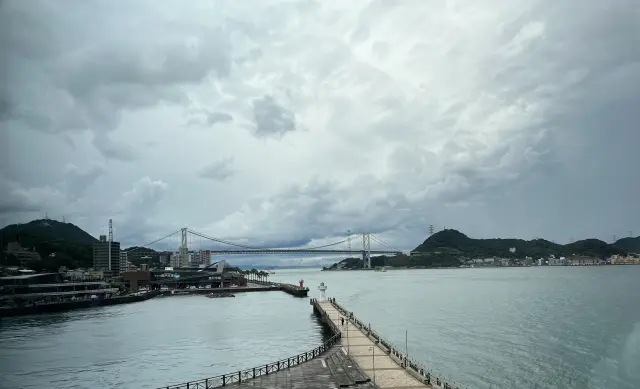
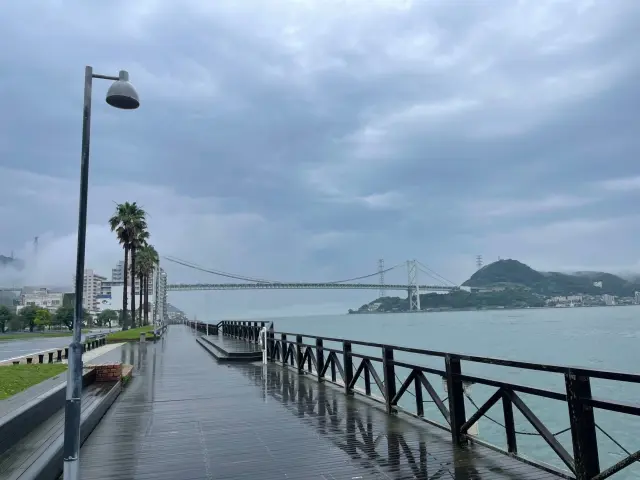
Kanmon Bridge was wrapped in clouds and mist. It's a key transportation link connecting Honshu and Kyushu, and the Kanmon Straits run below it. There's also an undersea tunnel you can walk through.
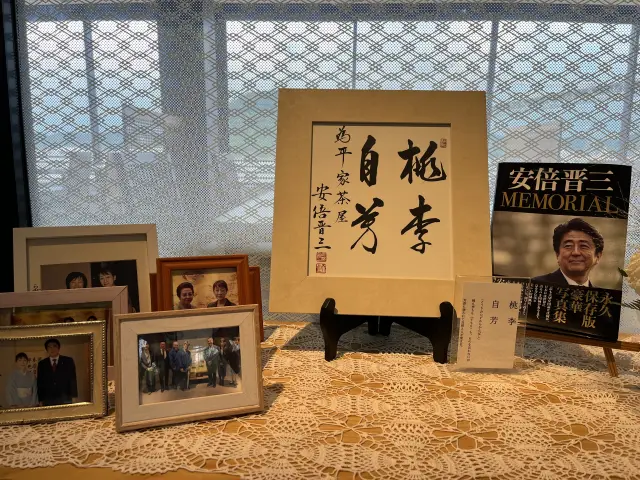
Shimonoseki is the hometown of former Prime Minister Abe, and I unexpectedly came across his authentic calligraphy while dining at a restaurant.
Kanmon Bridge | Review by 周黛西
Other Reviews by 周黛西
-
Oyu Stone Circles
Perched in a northeastern corner of Akita Prefecture at some 180 meters high sits a Jomon era archaeological site, dating back as far as 4,000 years. Designated as a UNESCO World Cultural Heritage site in July 2021, this spot remains one of 17 “Jomon Prehistoric Sites in Northern Japan”, found scattered across Hokkaido, Aomori, Akita, and Iwate Prefectures.
I love the old-fashioned charm of Oyu Onsenkyo in Akita. It preserves the character and atmosphere of traditional hot spring lodges.
After the rain shower, the stream was full, and a thick layer of mist hovered above it, like the foam on a latte. The greenery looked even fresher and more soothing after being washed by the rain.
Summer is definitely the perfect time to visit Tohoku. -
-
Sakaeda Udon Main Store
Sakaeda Udon Main Store is located behind the Kagawa Prefectural Government Office in Takamatsu. This long-established handmade udon restaurant was founded in 1963. Open from 7:00am, it draws both locals and tourists. The restaurant uses a self-service style. Customers warm up their own noodles, pour broth from a tap, and add their favorite toppings.
I tried the handmade udon experience at Nakano Udon School. The instructor teaches you everything from kneading the dough and stepping on it, to rolling it out and cutting the noodles, and in the end you cook your own authentic bowl of udon.
The activity takes about 40 minutes, and after the class you receive a hanging scroll certificate of completion to commemorate this one-of-a-kind udon experience. -
-
Former Hirosaki City Library
A Western-style building with a striking red dome roof, featuring octagonal twin towers on both sides, standing in Otemon Square near Hirosaki Castle. Built in 1906 to commemorate Japan’s victory in the Russo-Japanese War, it was used as the city library until 1931. The three-story wooden building was designed and built by master carpenter Sakichi Horie, a Hirosaki native.
While visiting the Fujita Memorial Garden in Hirosaki, Aomori, you can experience the luxury and style of a wealthy merchant’s world. This is a Western-style building designed by Kinzō Horie. In addition to the exhibition rooms, there is also a Taisho Roman Cafe where visitors can enjoy authentic apple pie.
-