
![[Tottori Sand Dunes Travel Guide] Enjoy Epic Natural Scenery and Fun Activities!](https://static.gltjp.com/glt/data/article/21000/20380/20230822_140324_5a6ff014_w1920.webp)
[Tottori Sand Dunes Travel Guide] Enjoy Epic Natural Scenery and Fun Activities!
The “Tottori Sand Dunes” are one of Japan’s largest dune areas and a symbol of Tottori Prefecture.
You may know the name, but plenty of people still aren’t sure what the main highlights are.
In this article, we’ll cover the appeal of the Tottori Sand Dunes in full—there’s enough to keep you busy all day.
What is the Tottori Sand Dunes Like?
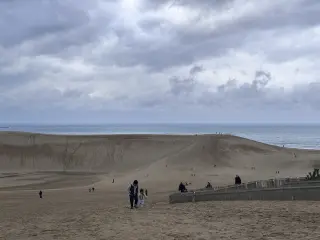
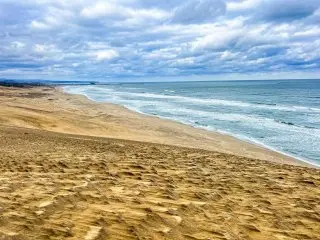
Located on the Sea of Japan side of Tottori City, Tottori Prefecture, the “Tottori Sand Dunes” stretch approx. 10 miles east to west and approx. 1.5 miles north to south, making them one of the largest dune areas in Japan.
They’re a Special Protection Zone and are also designated as a National Natural Monument.
To help you understand the Tottori Sand Dunes more deeply, let’s briefly explain the difference between sand dunes and deserts.
Sand dunes are hill-like landforms created by wind piling up sand, while deserts are areas made of rock, sand, and more where it hardly rains. Dunes do get rain, and plants can grow there.
The Tottori Sand Dunes were also formed over thousands of years as sand was carried by ocean currents and wind.
What makes the Tottori Sand Dunes so appealing is the ever-changing scenery and the natural beauty sculpted into the sand by the elements.
In particular, the sunrise and sunset views from the Tottori Sand Dunes are said to be stunning.
Another highlight is the wide range of activities, making it fun for everyone from kids to adults—not just for walking around.

Access to the Tottori Sand Dunes
From “JR Tottori Station” to the “Tottori Sand Dunes,” you can get there by local bus or the Loop Kirinji-shishi Bus.
Both take Approx. 20 minutes to “Sakyu Kaikan (Tottori Sand Dunes),” the closest bus stop to the dunes.
From the bus stop, it’s around a 5-minute walk to the dunes.
Local buses run every 15 to 30 minutes and cost 380 yen one way. The Loop Kirinji-shishi Bus runs only on Saturdays, Sundays, and holidays and costs 400 yen one way.
If you’re visiting on a Saturday, Sunday, or holiday, the Loop Kirinji-shishi Bus is recommended.
Tottori Sand Dunes Admission and Walkable Hours
Admission to the “Tottori Sand Dunes” is free, but facilities and activities have separate fees.
Since you can walk around 24 hours a day, it’s also great for enjoying early-morning or nighttime views.
What’s the Best Season to Visit the Tottori Sand Dunes?
The best seasons to visit the Tottori Sand Dunes are spring and fall.
In spring, flowers bloom and add beautiful color to the dunes, creating scenery that’s different from the typical image people have.
Fall is especially comfortable for walking. With cool breezes in the air, you can take your time exploring the Tottori Sand Dunes.
If you can choose your timing, visit in spring or fall to experience the Tottori Sand Dunes at their best.

Soak Up the Scenery and Activities! 7 Must-See Highlights at the Tottori Sand Dunes
At the “Tottori Sand Dunes,” you can enjoy not only sweeping natural scenery, but also the beautiful formations created by sand and wind,
plus activities that make the most of the great outdoors.
If you know the highlights, the “Tottori sand beach” is a sightseeing spot you can enjoy for a full day.
Here, we’ve carefully selected the must-know highlights to help you fully enjoy the “Tottori Sand Dunes.”
1. The breathtaking “Umanose” viewpoint, shaped by nature
“Umanose,” as the name suggests, is a sand hill shaped like a horse’s back.
It’s the most famous spot in the Tottori Sand Dunes, and a must-see if you’re visiting.
It stands at Approx. 154 feet high—about the same as a 15-story apartment building.
Seeing Umanose up close, its unique shape and height will leave you in awe.
The spectacular views of the sea and sky from the top also captivate visitors.

2. A dune “oasis” you might spot if you’re lucky
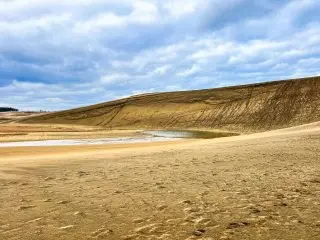
Puddles don’t form across the “Tottori Sand Dunes,” but at the bottom of the south slope of “Umanose,” an “oasis” can appear when conditions are right.
It often appears from fall to spring when rainfall is higher, and in some cases can reach a depth of 1 meter.
If you’re lucky enough to find this hard-to-see “oasis,” enjoy the unique scenery from both up close and from a distance.

3. “Camel rides” for an experience that feels like another country
With a “camel ride,” you can explore the “Tottori Sand Dunes” on the back of a real camel.
Single riders are welcome, and two-person rides are also available.
For an additional fee, you can also take commemorative photos with the camel.
Please use the following as a guide to pricing.
- Single rider
- 1,600 yen
- Two riders
- 2,600 yen
- Photos
-
, Photo of camel only: 100 yen
, Photo standing next to camel: 100 yen
, Photo while riding camel: 650 yen
*Same price for adults and children (tax included)
The camel’s relaxed pace and the beautiful dune scenery feel wonderful, making for a special experience that’s almost like being in another country.

4. A thrilling “paragliding experience” with breathtaking views from above
You can also try paragliding at the “Tottori Sand Dunes.”
Enjoy an aerial stroll while taking in the spectacular scenery of the Tottori Sand Dunes.
Even beginners can feel at ease, as instructors provide thorough training.
The most popular option is the half-day course, which takes 3 hours including training, and is held four times a day.
Equipment can be rented, so you can try paragliding empty-handed.

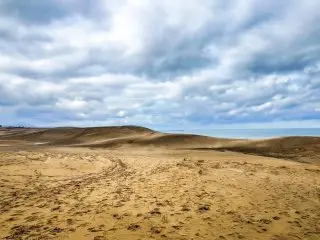
5. Beautiful natural patterns: “wind ripples” and “saren”
At the “Tottori Sand Dunes,” you can enjoy various kinds of natural beauty, but the “wind ripples” and “saren” are especially worth seeing.
“Wind ripples” are wave-like patterns formed in the sand.
They’re so iconic that photos of wind ripples are almost always used when introducing the Tottori Sand Dunes.
“Saren” are beautiful, bamboo-blind-like patterns that appear when rain-soaked sand dries.
The patterns vary depending on the weather and other conditions, so you may never see the exact same one twice.

6. Spectacular views of the Tottori Sand Dunes at sunrise and sunset
The view across the “Tottori Sand Dunes” is beautiful no matter when you visit, but the morning and evening scenery is especially stunning.
In the early morning, there are fewer people, so you can enjoy nothing but the grand natural scenery of sand, sky, and sea.
The beautiful sand beach glowing with the morning sun is also a must-see.
At dusk, the dunes are tinted orange, and watching the sun sink into the Sea of Japan is a special sight only those who visit the Tottori Sand Dunes in the evening get to experience.
Enjoy activities during the day, then come in the morning or evening for the best views of the Tottori Sand Dunes.


7. “Sakyu Center Mihara-shi no Oka,” a perfect base for sightseeing
Located across the road from the “Tottori Sand Dunes,” “Sakyu Center Mihara-shi no Oka” features an observation deck with panoramic views of the dunes and the Sea of Japan, along with a restaurant where you can enjoy Tottori cuisine, souvenir shops, and more.
There’s also a lift from “Sakyu Center Mihara-shi no Oka” to the “Tottori Sand Dunes,” so use it as a convenient sightseeing base.

3 Things to Know to Enjoy the Tottori Sand Dunes
Here are three things you’ll want to know for a comfortable visit to the “Tottori Sand Dunes.”
To fully enjoy the scenery, make sure you come prepared.
1. Average temperatures at the Tottori Sand Dunes
We’ve summarized the seasonal high and low temperatures at the Tottori Sand Dunes in the table below.
In summer, the “Tottori Sand Dunes” can feel hotter than the actual temperature, so be sure to protect yourself from UV rays and heat, and don’t forget to stay hydrated.
Also, even in spring, March often has cold days, so don’t forget warm clothing.
- Spring (March, April, May)
-
, High: 11–21°C
, Low: 6–16°C - Summer (June, July, August)
-
, High: 24–30°C
, Low: 20–25°C - Fall (September, October, November)
-
, High: 15–26°C
, Low: 10–21°C - Winter (December, January, February)
-
, High: 7–10°C
, Low: 2–5°C
2. What to wear when walking around the Tottori Sand Dunes
The “Tottori Sand Dunes” can be hard to walk on, and a lot of sand can get into your shoes.
Bring sandals you won’t mind getting sandy.
Rubber boots and sandals can also be rented at “Sakyu Kaikan,” so if you can’t bring your own, renting is also recommended.
The weather isn’t dramatically different from Tottori City, and as long as you watch out for strong winds and UV rays, there aren’t too many special clothing concerns.
That said, you’ll be walking a long distance, so be sure to wear comfortable, easy-to-move-in clothes.
3. How much time you’ll need to visit the Tottori Sand Dunes
If you’re only visiting the main highlights of the Tottori Sand Dunes, you can enjoy it in Approx. 1 hour.
If you plan to join activities like a camel ride or paragliding, allow Approx. 3–6 hours.
3 Nearby Sightseeing Spots Around the Tottori Sand Dunes
If you’re sightseeing at the “Tottori Sand Dunes,” it’s also worth visiting the nearby museum and amusement facilities.
There’s also one of Japan’s largest flower parks in the area, so you won’t run out of places to go.
Use the three spots below as the core of your itinerary and plan a trip that lets you fully enjoy Tottori.
1. Tottori Sand Dunes Sand Museum
The world’s first museum dedicated to exhibiting sand sculptures.
Produced by Mr. Katsuhiko Chaen, selected as one of the “100 Japanese People the World Respects,” the museum invites sand sculptors from around the world to create sand sculptures at the highest international level.
The theme changes every year, and when the exhibition period ends, all sculptures are returned to sand, so you can only see them during the show’s run.
With a focus on the environment, the museum’s policy is to use no solidifiers at all, carefully sculpting down to the smallest details using only sand from the Tottori Sand Dunes and water.

2. Chubu Tottori Sand Dunes Children’s Kingdom
An amusement facility next to the Tottori Sand Dunes.
Across its spacious grounds of Approx. 190,000 m², you’ll find plenty of playground equipment and rides, including the large castle-themed athletic structure Dream Castle, a cycle monorail, a rail train, and unique bikes.
There are also workshops like a woodworking studio, a sand studio, and a pottery studio where visitors can enjoy hands-on making that sparks creativity. Plus, under the theme “connect with nature,” many events are held for everyone from babies to upper-elementary kids.

3. Tottori Hanakairo Flower Park
One of Japan’s largest flower parks, where you can enjoy seasonal flowers with scenic Mt. Daisen as a backdrop.
The main flower is lilies, with over 100 varieties to see throughout the year.
The park cultivates nearly half of the world’s lily varieties and is a rare facility that exhibits all 15 Japanese native lily varieties, including “Uke-yuri,” also known as the “phantom lily.”
Peak season is from mid-May to mid-August, when Approx. 80,000 lilies bloom all at once.

3 Popular Places to Eat Near the Tottori Sand Dunes
After a full day at the Tottori Sand Dunes, take a break at a nearby restaurant.
If you’re not sure where to go, be sure to stop by one of the places we’ll introduce next.
1. Takahama Cafe
“Takahama Cafe” sits right in front of the “Tottori Sand Dunes.” It’s a cafe known for its distinctive architecture by architect Kengo Kuma.
It was created as a new landmark for the Tottori Sand Dunes.
Signature menu items include dishes made with Tottori ingredients, such as the “Tottori Wagyu Yakiniku Burger” and the “Daisen Bacon Surprise Burger.” You’ll also find sweets like cakes, bread, and soft-serve ice cream.

2. Sunaba Coffee “New” Tottori Station Front Shop
Back when Tottori Prefecture was the only prefecture in Japan without a Starbucks, Governor Shinji Hirai coined the phrase, “We don’t have Starbucks, but we do have Sunaba (sandbox).” Inspired by those words, a local company opened the first Sunaba Coffee location in 2014.
That original first shop closed once in 2019, but later that same year it reopened at a new location as the “New” Tottori Station Front Shop.

3. Sumibi-yaki Jujuan
Sumibi-yaki Jujuan is a yakiniku restaurant in Tottori City known as a “locally produced, locally consumed” spot. It carefully selects and serves fresh, high-quality ingredients nurtured by the region’s rich natural environment.
Its key principles are “natural,” “peace of mind,” “safety,” and “local seasonal ingredients,” with a lineup of dishes that bring out the full flavor of the ingredients over charcoal.

3 Recommended Ryokan Near the Tottori Sand Dunes
To fully enjoy the “Tottori Sand Dunes,” you’ll need around half a day.
That’s why, if you’re sightseeing at the “Tottori Sand Dunes,” staying one night in Tottori is recommended.
Relax in a ryokan with an open-air bath overlooking the Sea of Japan or a Japanese garden, soothe your tired body after walking, and enjoy Japan’s signature hospitality.
1. Kaike Shogetsu
North of Yonago City, Kaike Onsen is a seaside hot spring area with beautiful white-sand beaches and grand views of Mt. Daisen, drawing many visitors year-round as a resort destination.
“Kaike Shogetsu” was founded there in 1927. With just 19 guest rooms—the same number as at its opening—it’s known for heartfelt hospitality made possible by keeping the room count unchanged.
The large public bath and open-air bath let you fully enjoy the mineral-rich Kaike Onsen waters, known for warmth retention and moisturizing effects, and boast panoramic views of the Sea of Japan and Mt. Daisen.

2. Kasuitei
One of the Sanin region’s leading long-established ryokan, known for views of the Sea of Japan stretching out in front and majestic Mt. Daisen.
Throughout the property, you can enjoy the natural beauty of the Sanin area.
The only ryokan in Kaike Onsen with its own private hot spring source, it offers bathing time with views of the Sea of Japan from its large public bath, featuring a marble tub, as well as its open-air bath.
In addition to four reservable private baths, it also has guest rooms with open-air baths, perfect for families and couples to enjoy a private, relaxed stay.

3. Misasa-kan
A purely Japanese-style ryokan with white walls and a tiled roof, designed in a castle-like style.
The building faces the clear Misasa River, and you can enjoy the seasonal beauty of a Japanese garden set against magnificent natural scenery.
On the grounds, it has three private hot spring sources. With the largest volume of hot spring water in Misasa Onsen, its gentle radium spring flows abundantly.
Inside, there are 12 bathing areas, all 100% free-flowing from the source.
In particular, the rustic “Garden Bath” and “Waterfall Bath,” which blend an open-air bath with a Japanese garden spanning 1,000 tsubo, are especially popular.

Reviews of the Tottori Sand Dunes
4.18
Some reviews are AI-translated.
-
The sand dunes stretch out as far as the eye can see.
If you get the chance, you should definitely come ride a camel. -
Walking across the vast sand dunes, you can really feel the power of the wind constantly shaping new landscapes. That's what makes the dunes so unique and fascinating.
-
It's a beautiful place, but the wind can get pretty strong. Make sure to bring some lightweight shoes to change into.


FAQ about the Tottori Sand Dunes
Q
How do I get to the Tottori Sand Dunes?
A
It takes Approx. 25 minutes from JR Tottori Station by bus and on foot.
Q
When is the best season to visit the Tottori Sand Dunes?
A
Spring, when you can enjoy flowers blooming on the dunes, or fall, when the weather is comfortable for walking.
Summary
We’ve covered the highlights of the “Tottori Sand Dunes,” along with recommended places to stay and nearby sightseeing spots to help you make the most of your visit.
For even more of what Tottori has to offer beyond what we could fit here, check out the article below—especially if you want to fully explore Tottori.