

Yoshinoyama Travel Guide: Explore Historic Shrines and Temples Surrounded by Beautiful Nature
Yoshinoyama is widely known as Japan’s most famous cherry blossom destination.
In spring, of course, but also in summer, fall, and winter, you can enjoy hiking while taking in beautiful seasonal scenery.
Historic shrines, temples, and ruins scattered throughout the mountains are also major highlights.
This article takes a close look at the charms of Yoshinoyama, focusing on its most popular sightseeing spots and useful information to know before your visit.
Read on to discover why Yoshinoyama is regarded as such a popular destination.
What is Yoshinoyama Like?
Yoshinoyama is the collective name for the mountain ridge that extends from the southern bank of the Yoshino River in central Nara Prefecture to the Omine Mountain Range.
It can also refer to the area centered around Kinpusen-ji Temple, where shrines and temples are scattered throughout the region.
The UNESCO World Heritage site Sacred Sites and Pilgrimage Routes in the Kii Mountain Range includes Yoshinoyama, and the entire area of Yoshinoyama is registered as a World Heritage site.
One of Yoshinoyama’s greatest attractions is its seasonal scenery throughout the year, and its spring landscape is especially breathtaking, as it is known as Japan’s top cherry blossom destination.
Like its cherry blossoms, it is also highly regarded as a fall foliage destination, while its refreshing summer greenery and winter snowscapes are equally beautiful.
Yoshinoyama is home to many shrines, temples, and historic sites, including four shrines and temples that are registered as World Heritage sites.
Enjoy hiking through these sightseeing spots while taking in the natural scenery.
Yoshinoyama also has places for shopping and dining, as well as accommodations, making it easy to enjoy hiking at a relaxed pace.
Another of its attractions is the seasonal events held throughout the year.

The History of Yoshinoyama
The Yoshino area has a long history, with its place name even appearing in Japan’s oldest historical records, the Kojiki and the Nihon Shoki.
Because Japan’s capital was once located in Nara and Kyoto, various historical events and legends have remained in Yoshinoyama through to the present day.
As Yoshinoyama became a sacred place for Shugendo and Emperor Go-Daigo established his imperial court in Yoshino, many shrines, temples, and historic sites still remain there today.
Shugendo is a uniquely Japanese form of faith and religion that developed in ancient Japan.
It involves undergoing harsh training in the mountains to attain enlightenment, and is sometimes regarded as a branch of Buddhism.

Access to Yoshinoyama
Starting from Nara Station, a major transportation hub for sightseeing in Nara, here is how to get to the Yoshinoyama Ropeway.
The Yoshinoyama Ropeway is the starting point for sightseeing in Yoshinoyama.
- Route
-
1. Take the JR Sakurai Line from Nara Station and get off at Takadashi Station.
2. Walk for Approx. 20 minutes from Takada Station to Takadashi Station, then take the Kintetsu Minami Osaka, Yoshino Line Limited Express and get off at Yoshino Station.
3. Walk for Approx. 7 minutes from Yoshino Station to arrive at Senbonguchi Station of the Yoshinoyama Ropeway - Travel time
- Approx. 2 hours 30 minutes
When Is the Best Season to Visit Yoshinoyama?
One of Yoshinoyama’s greatest attractions is its beautiful scenery in every season, but spring and fall are especially recommended.
If possible, plan your trip for spring or fall to enjoy Yoshinoyama at its best.
Spring in Yoshinoyama, When Approx. 30,000 Cherry Trees Bloom
Yoshinoyama has long been known as a famous cherry blossom destination.
Its origins go back to En no Gyoja, the founder of Shugendo, who during his training prayed for Kongo Zao Gongen, a uniquely Japanese Buddhist deity, and carved that figure into a wild cherry tree to enshrine it.
From then on, the cherry trees of Yoshinoyama continued to be planted by worshippers as a sign of their faith in Zao Gongen and En no Gyoja.
Today, Approx. 30,000 cherry trees have been planted here, earning Yoshinoyama a reputation as Japan’s top cherry blossom destination.
The blossoms gradually open from Shimo Senbon to Naka Senbon, then from Kami Senbon to Oku Senbon, until eventually all of Yoshinoyama is beautifully covered in pink.
After sunset, the cherry blossoms are illuminated, creating a dreamlike and scenic atmosphere.
The best time to see the cherry blossoms in Yoshinoyama is from late March to around mid-April, so plan your visit to match the blooming season.


Autumn in Yoshinoyama, Colored in Rich Hues
Yoshinoyama is also famous as a fall foliage destination.
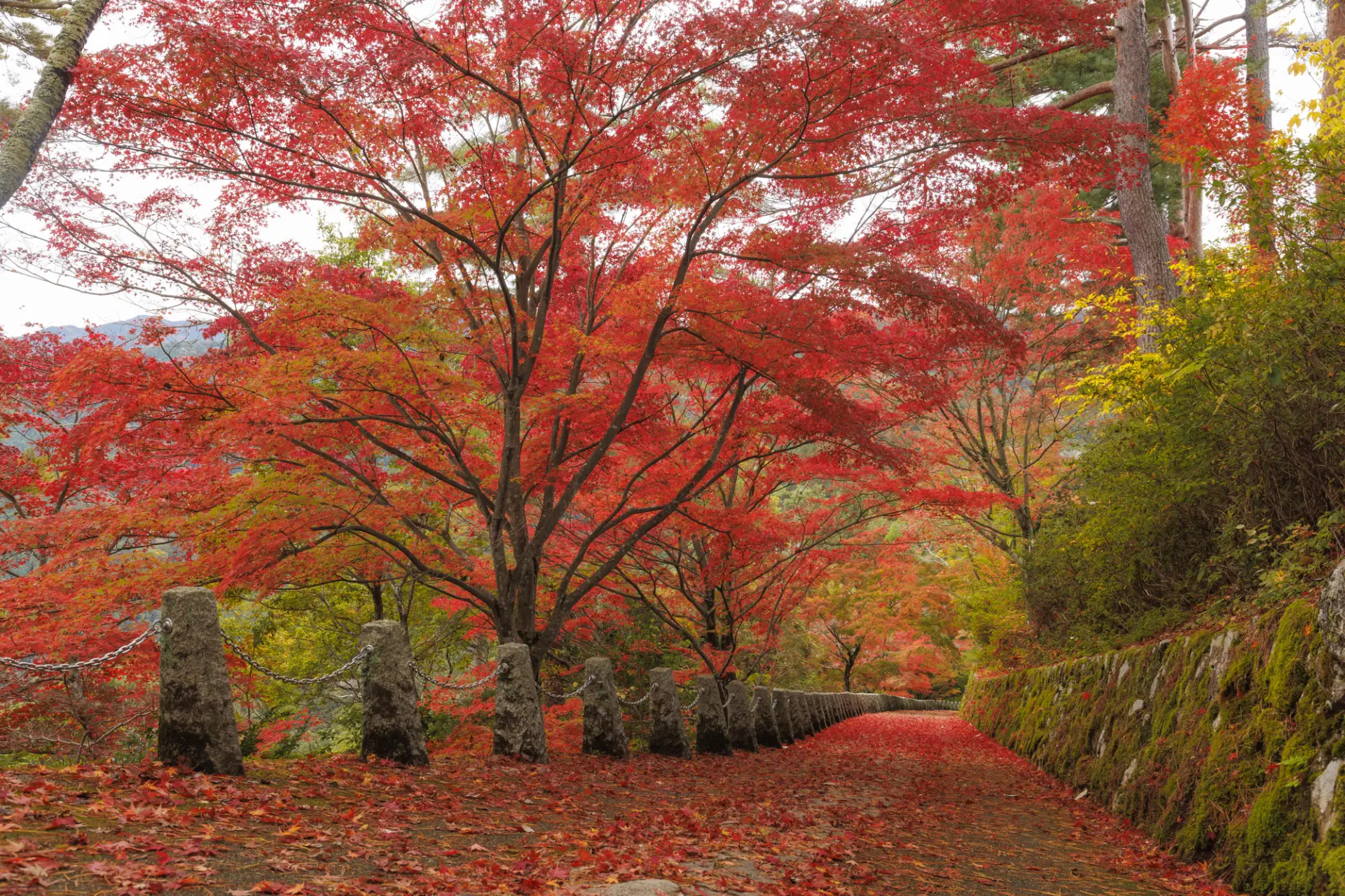
At peak season, the mountain is vividly colored in orange, crimson, and the green of evergreen trees.
The sight of the shrines and temple grounds in Yoshinoyama surrounded by autumn leaves is also beautiful.
Just like in cherry blossom season, the fall foliage is lit up as well, giving the area an elegant atmosphere different from the daytime.
Be sure to visit from around mid-October to late November, when the autumn leaves are at their best.


Yoshinoyama Is Divided into 4 Areas
Yoshinoyama is divided into four areas by elevation: Shimo Senbon, Naka Senbon, Kami Senbon, and Oku Senbon.
From here, let’s look at the features and highlights of each area.
Knowing the areas in advance should help you visit the spots you want to see more efficiently.
The Shimo Senbon Area, the Gateway to Yoshinoyama
The area between elevations of 230 m and 350 m is called Shimo Senbon, and it is the entrance to Yoshinoyama. In spring, the cherry blossoms in the Shimo Senbon area are the first to start changing color.
One of its attractions is the ease of exploring sightseeing spots on foot from the parking lot.
The biggest highlight of the Shimo Senbon area is probably Kinpusen-ji Zao-do Hall, which can be called the symbol of Yoshinoyama.
Registered as both a World Heritage site and a National Treasure, it is admired for its solemn yet refined appearance.

The Naka Senbon Area, Home to Many Shrines and Temples
The area between elevations of 350 m and 370 m is the Naka Senbon area, located around the middle of Yoshinoyama.
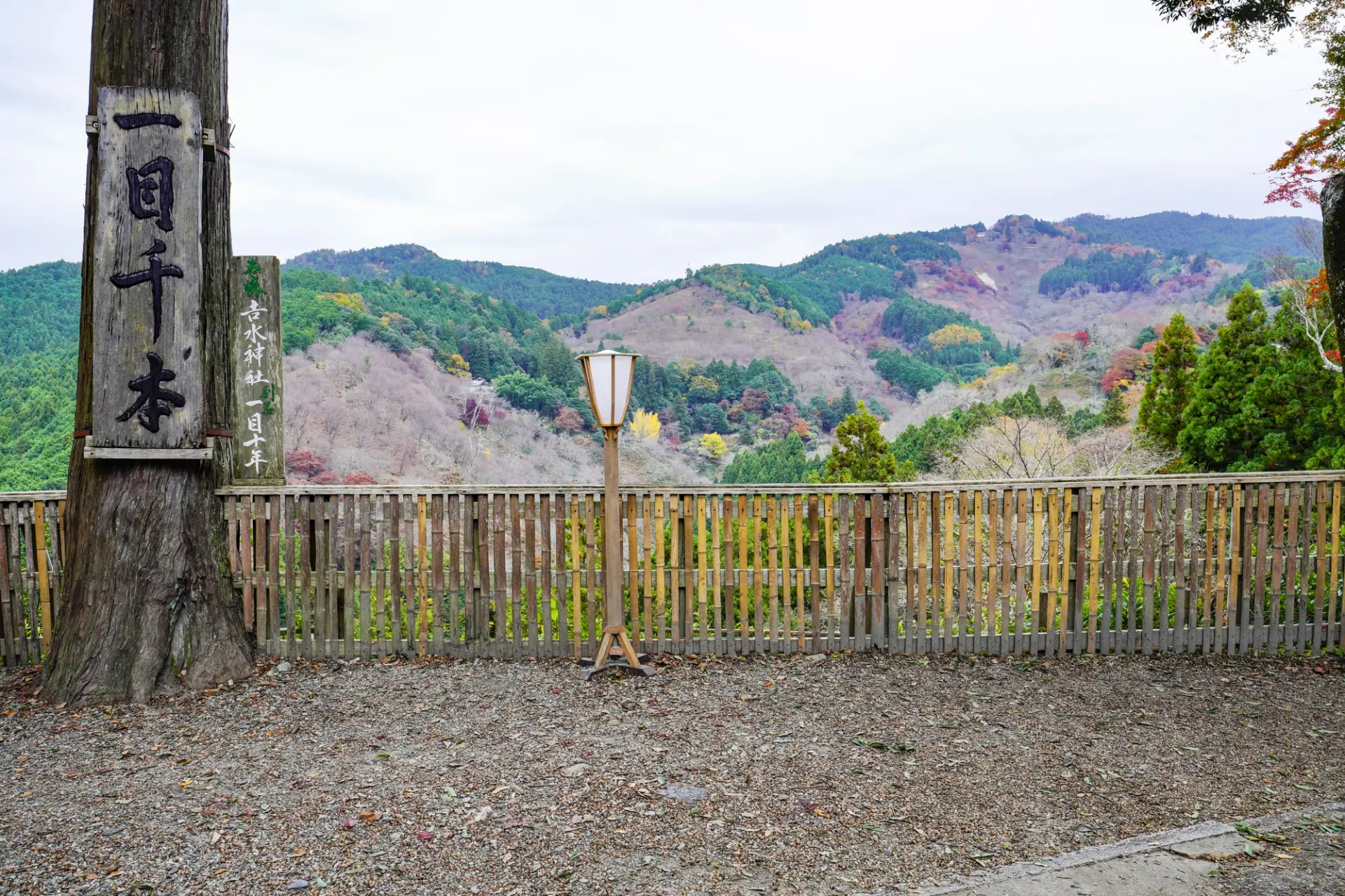
The appeal of the Naka Senbon area is the large number of shrines and temples. Among them, Yoshimizu Shrine is especially popular.
The shoin at Yoshimizu Shrine is an important structure in Yoshino and is even registered as a World Heritage site.
The shrine grounds include a spot overlooking the cherry blossoms, and it is said to have served as the main headquarters when the Sengoku-period warlord Toyotomi Hideyoshi held a cherry blossom viewing party in Yoshinoyama.
Besides Toyotomi Hideyoshi, many stories connected to Emperor Go-Daigo and Minamoto no Yoshitsune also remain here.

The Kami Senbon Area, a Must-Visit During Cherry Blossom Season
The Kami Senbon area refers to elevations from around 370 m to 600 m.
The slopes become steeper and the elevation higher, so there are many spots with wonderful views over Yoshinoyama.
One highlight in particular is Hanayagura Observatory.
It is an attractive place where you can look down over the wide expanse of cherry blossoms and enjoy sweeping views of Yoshinoyama and beyond.
If you want to fully enjoy the cherry blossoms of Yoshinoyama, this is definitely one of the places you should visit.

The Oku Senbon Area, Where You Can Enjoy Atmospheric Scenery in Peace and Quiet
The Oku Senbon area lies at elevations of Approx. 600 m to 750 m. It is the innermost part of Yoshinoyama.
Because there are fewer tourists, the area is quiet, and the many cherry trees standing in that stillness feel both mystical and atmospheric.
One of the highlights of Oku Senbon is Kinpu Shrine, which has been recognized as a World Heritage site.
It is known as the place where Minamoto no Yoshitsune hid from his pursuers.

Experience Japan’s Nature and History! 7 Popular Sightseeing Spots in Yoshinoyama
Yoshinoyama is home to many places where you can fully enjoy beautiful natural scenery, as well as shrines, temples, and historic sites with long histories.
That means you can experience Japanese history and culture from many different angles.
With so many scenic spots, Yoshinoyama is also popular for photography.
Among the many sightseeing spots in Yoshinoyama, here are some of the ones you absolutely should not miss.
1. Yoshimizu Shrine Shoin
Yoshimizu Shrine originated as Yoshimizu-in, a temple lodging said to have been founded by En no Gyoja more than 1,300 years ago.
The shrine grounds include a spot called Hitome Senbon, known for its magnificent view of Yoshinoyama’s cherry blossoms, and it is said that Toyotomi Hideyoshi once used it as his main headquarters when he hosted a cherry blossom viewing banquet in Yoshino.
The shoin standing in the grounds is the oldest shoin-style building in Japan and is renowned as a masterpiece representing early shoin architecture, which first appeared in the early Kamakura period.

2. Takagiyama Observatory
Yoshino Mikumari Shrine, a World Heritage site, is located in the Oku Senbon area, the highest part of Yoshinoyama.
About a 10-minute climb up the mountain path from there is Takagiyama Observatory, also known as the site of a castle used as a base by Imperial Prince Moriyoshi during the Genko War, when Emperor Go-Daigo fought against the Kamakura shogunate.
From the observatory, located at an elevation of Approx. 700 m, visitors can enjoy a panoramic view of Yoshinoyama below, as well as Mount Kongo and Mount Katsuragi rising side by side.

3. Saigyo-an
Saigyo was the poet with the greatest number of poems, 94, included in the Shin Kokin Wakashu.
It is said that after giving up his status as a warrior in the late Heian period and becoming a monk, he spent about three years here in Yoshino while training for Buddhist practice.
The area around the hermitage is often quiet, making it easy to understand why Saigyo devoted himself to composing poetry here.
However, many tourists visit during the cherry blossom season in spring and the fall foliage season in autumn, making it lively at those times.

4. Hanayagura Observatory
One of Yoshinoyama’s most popular scenic spots is Hanayagura Observatory, located at the top of Shishiozaka, a steep road with many curves.
It is said that Sato Tadanobu, a retainer of Minamoto no Yoshitsune, once shot arrows at enemies chasing him from the foot of the mountain around this area, allowing Yoshitsune to escape.
Located at an elevation of Approx. 600 m, this observatory is known as one of Yoshino’s finest viewpoints, offering a layered landscape with views over the cherry blossoms of Kami Senbon in the foreground, the blossoms of Naka Senbon, Kinpusen-ji’s Zao-do Hall, and even the townscape beyond.

5. Kinpusen-ji Temple
The symbol of Yoshinoyama and the head temple of Shugendo.
Shugendo is a religion that was formed and developed through the fusion of Japan’s ancient nature worship with Buddhism, Taoism, Onmyodo, and other traditions.
The National Treasure main hall, Zao-do Hall, was rebuilt in 1592 in irimoya-style architecture with a single-story mokoshi and hinoki bark roofing.
It stands Approx. 34 m tall, with each side of the mokoshi measuring 36 m, making it the second-largest wooden structure in Japan after Todai-ji Temple’s Great Buddha Hall.
The Nio Gate, considered the oldest remaining building among the temple’s halls, is also designated as a National Treasure.

6. Yoshinoyama Ropeway
In the early Showa period, the founder’s wish to create a ropeway in Yoshinoyama to carry people led to the opening of the line connecting present-day Senbonguchi Station and Yoshinoyama Station.
For more than 90 years since then, it has continued to be loved as the ropeway carrying visitors to Yoshinoyama.
Senbonguchi Station is located near Kintetsu Yoshino Station, and from there it takes Approx. 3 minutes by ropeway to reach Yoshinoyama Station on the mountain.
With cherry blossoms in spring and autumn leaves in fall, the scenery changes with the seasons, heightening the excitement as the gateway to sightseeing in Yoshinoyama.

7. Nyoirin-ji Temple
A Jodo sect temple located in Yoshinoyama.
It has deep ties to the Southern Court, including serving as an imperial prayer temple for Emperor Go-Daigo during the Nanboku-cho period (from the middle to the late 14th century), and the grounds also contain the mausoleum of Emperor Go-Daigo and the grave of Imperial Prince Yasutane.
Every year on September 27, the date of the emperor’s memorial service according to the old calendar, the Go-Daigo Emperor Memorial Service is held, and on that day visitors can worship in the main hall, which is usually closed to the public.

3 Popular Restaurants in Yoshinoyama Where You Can Enjoy Japanese Food in the Mountains
Restaurants are also scattered throughout Yoshinoyama, so you can fully enjoy local cuisine as well.
That’s why when you visit Yoshinoyama, don’t just enjoy the scenery and shrines and temples, but also make time to savor the food at the places introduced below.
One of the attractions is the chance to enjoy a variety of distinctly Japanese dishes and carefully prepared meals.
1. Yateki-an
The only soba restaurant in Yoshinoyama, famous for its cherry blossoms in full bloom in spring.
The owner, who is from the local area and trained at a famous Togakushi soba restaurant in Nagano Prefecture, one of Japan’s three great soba regions, serves carefully hand-kneaded and hand-cut soba made with Yoshinoyama’s famous water.
The soba, made from buckwheat from Yatsugatake in Shinshu and ground with a stone mill, has an outstanding aroma.
The dipping sauce is made with Yoshinoyama’s water and broth carefully prepared from selected bonito flakes, mackerel flakes, and Hidaka kelp, then combined with a seasoned base simmered from domestic whole soybean soy sauce, hon-mirin, coarse sugar, and other ingredients, making it a perfect match for the soba.

2. Tofu Chaya Hayashi Naka Branch
Tofu Chaya Hayashi Naka Branch is a place where you can enjoy tofu dishes made with carefully selected ingredients and traditional methods.
You can savor freshly handmade tofu prepared at the nearby factory shop, Hayashi Tofu Shop, while enjoying Yoshino’s seasonal scenery.
The menu is full of tofu dishes, ranging from classics like yudofu and mapo tofu to creative items such as tofu ramen and tofu pork buns.

3. Kakinoha-zushi Yakko
Located near Kinpusen-ji Zao-do Hall, Kakinoha-zushi Yakko was founded in the Taisho era (the 1910s), and today the third and fourth generations carry on the business.
Kakinoha-zushi is sushi made by placing mackerel or salmon on bite-sized vinegared rice, wrapping it in persimmon leaves, and pressing it firm with a weight or similar method. It is known nationwide as a specialty of Nara Prefecture, but it originally developed as a local dish centered around the Yoshino area.
The shop has steadfastly preserved the recipe handed down since its founding, carefully making each piece by hand.

Recommended Routes for Enjoying Cherry Blossoms and Fall Foliage in Yoshinoyama
The basic sightseeing route in Yoshinoyama is nearly the same for both cherry blossom season and fall foliage season.
The standard route is as follows:
Yoshino Station → Ropeway → Shimo Senbon → Naka Senbon → Kami Senbon → Oku Senbon
If you keep this route in mind, you can fully enjoy Yoshinoyama in either season.
However, the key difference is which areas you focus on depending on the season.
Highlights of Yoshinoyama During Cherry Blossom Season (late March to mid-April)
During cherry blossom season, when the entire mountain from Shimo Senbon to Oku Senbon is covered in wild cherry trees, every area is worth seeing.
In particular, if you want to enjoy the spectacular view known as Hitome Senbon, the observation spots in the Naka Senbon area are a must. On the other hand, the crowds are extremely heavy, and long lines for the ropeway are common.
It is best to start early in the morning and visit with a schedule that gives you plenty of time.
Highlights of Yoshinoyama During Fall Foliage Season (late October to mid-November)
Compared with cherry blossom season, fall foliage season is less crowded, making it easier to enjoy a relaxed walk in the mountains.
However, unlike the cherry blossoms, the whole mountain does not color evenly, so it is recommended to focus especially on the beautiful area from Oku Senbon to Kami Senbon.
The colors of the trees in the quiet mountains offer a charm different from that of the cherry blossoms.
Yoshinoyama Sightseeing Map
Reviews of Yoshinoyama
4.47
Some reviews are AI-translated.
-
Japan has a lot of cherry blossom spots, but Mt. Yoshino is covered with sakura and looks absolutely stunning in spring!
-
Really hoping to catch the cherry blossom season here 🌸. It must be absolutely breathtaking! 🎊
FAQ about Yoshinoyama
Q
When is the best time to see cherry blossoms in Yoshinoyama?
A
From late March to mid-April, although the timing varies slightly depending on the area.
Q
When is the best time to see fall foliage in Yoshinoyama?
A
From mid-October to late November.
Summary
This article has introduced popular sightseeing spots in Yoshinoyama, along with the highlights of each area.
The beauty of its natural scenery, together with its many shrines, temples, and historic sites with long histories, is what makes Yoshinoyama so appealing.
If you want to fully enjoy Japan’s unique natural scenery and historical culture, be sure to visit Yoshinoyama.
The article below also introduces a carefully selected list of places to visit while sightseeing in Nara.
Please take a look at that as well.