

A Travel Guide to Shirogane Blue Pond, Famous for Its Dreamlike Scenic Beauty in Every Season
Shirogane Blue Pond captivates visitors with its dreamlike blue surface.
One of Hokkaido’s most scenic spots, it is famous for the spectacular view created by its mysteriously beautiful blue water, dead larch trees standing in the pond, and the rich natural surroundings.
This article covers the basic information about Shirogane Blue Pond, including access, highlights, and recommended sightseeing spots nearby.
Read on to discover its charms and the key things to know before you visit.
What is Shirogane Blue Pond Like?
Shirogane Blue Pond is located in the town of Biei in central Hokkaido.
It is an artificial pond that was formed by chance when water collected in a small dam built to prevent mudflow damage caused by the 1988 eruption of Mt. Tokachi.
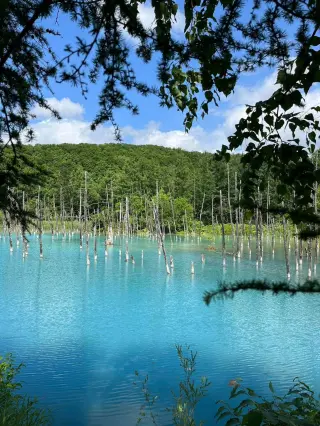
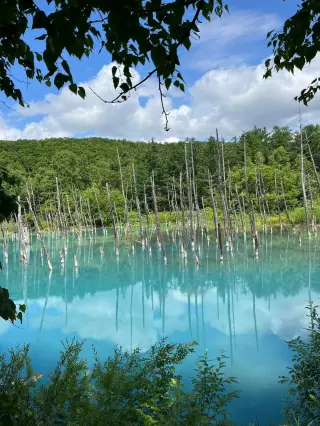
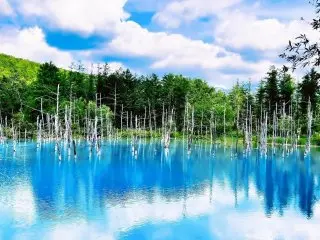
Its biggest appeal is the spectacular scenery created by the clear blue water, the dead larch trees reflected on the surface, and the lush natural landscape around it.
Another part of its charm is how the color of the water and the surrounding scenery change with the seasons.
There are several theories as to why the water looks blue, but the leading explanation points to sunlight and the pond’s water quality.
It is said that when water containing hot spring minerals mixes with the water of the Biei River, particles too small to see are created, and sunlight scatters off them, making the water appear blue.
For that reason, if you want to see Shirogane Blue Pond at its most beautiful, around midday, when the sunlight is strongest, is recommended.
From around November to April each year, Shirogane Blue Pond is illuminated at night.
Since this is also the snowy season, you can enjoy the magical and beautiful sight of the snow-covered pond lit up at night.
The illumination start time changes according to sunset, so be sure to check in advance before visiting.

Access to Shirogane Blue Pond
Here, we’ll introduce how to get to Shirogane Blue Pond starting from Asahikawa Airport, which has international flights.
There are no restrooms or shops near Shirogane Blue Pond, so it’s best to use them in advance at Asahikawa Airport or Biei Station.
- Route
-
1. Take the Furano Bus Lavender-go at Asahikawa Airport and get off at the Biei Station bus stop
2. Take the Dohoku Bus at Biei Ekimae and get off at the Shirogane Blue Pond Iriguchi bus stop
3. Approx. 5 minutes on foot from there to Shirogane Blue Pond - Travel time
- Approx. 1 hour
Shirogane Blue Pond, Where You Can Enjoy Spectacular Views in Every Season
The best time of year to see Shirogane Blue Pond at its most beautiful is May to June, when there are many clear days and little wind, but other times of year have their own charms and highlights as well.
From here, we’ll introduce the seasonal attractions and highlights so you can enjoy Shirogane Blue Pond throughout the year.
Use this article as a guide and plan your trip for the season with the scenery you want to see.
Spring at Shirogane Blue Pond, with Beautiful Fresh Greenery and Green-Blue Water
In spring, Shirogane Blue Pond offers a beautiful combination of fresh new greenery and its blue surface.
One characteristic of this season is that the water takes on a green-blue hue due to the effects of melting snow.
It is still quite cold, so be sure to dress warmly and watch out for frozen ground.

Summer at Shirogane Blue Pond, When the Water Is at Its Brightest and Most Beautiful
One of the main attractions of Shirogane Blue Pond in summer is the bright sunlight, which makes the light blue water look even more vivid.
Early summer, from May to late June, is the clearest time of year, and many visitors come during this season.

Autumn at Shirogane Blue Pond, Where You Can Also Enjoy Vibrant Fall Colors
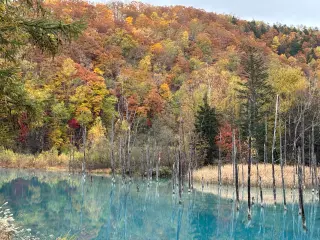
In autumn, Shirogane Blue Pond offers a beautiful combination of blue water and the fall colors around it.
At this nature-rich sightseeing spot, the contrast between the vivid autumn leaves and the bright blue surface is especially striking.
The best time for fall foliage is from late October to early November, so if possible, plan your visit for peak season.

Winter at Shirogane Blue Pond, with Its Magical Snow-Covered Scenery
One of the charms of Shirogane Blue Pond in winter is the snowy scenery covering the dead larch trees and the surrounding area.
Snow usually begins to pile up in November, and the blue water against the silvery white landscape creates a magical and beautiful scene.
From December to around early April, the pond may freeze over completely, so keep in mind that there are times when you cannot see the blue surface.

Winter Illuminations Make the Snowy Scenery and Shirogane Blue Pond Even More Beautiful and Magical
At Shirogane Blue Pond, a winter-only illumination event is held each year from November to April.
In midwinter, the pond freezes and the blue water cannot be seen, but the illuminated Shirogane Blue Pond and the snow-covered natural scenery around it create a magical and dramatic view.
The illumination features several lighting patterns, and each story can be enjoyed in Approx. 10 minutes.
Hokkaido’s sky is also known for its clear air and beautiful stars, so be sure to enjoy the magical night view together with the illumination.
If you visit Shirogane Blue Pond, be sure to also stop by nearby Shirahige Falls, which is illuminated year-round.
At Shirahige Falls, groundwater seeping out from between the rocks flows down the mountainside for Approx. 30m, making it a sightseeing spot where you can feel the power of nature.
It is also famous for scenery that changes with the seasons, but winter is especially beautiful, with icicles hanging from the rocky surface and snow-covered nature all around, made even more appealing by the illumination.


3 Scenic Spots in Northern Hokkaido to Visit Along with Shirogane Blue Pond
After enjoying Shirogane Blue Pond, head out to some scenic spots in the relatively easy-to-reach northern Hokkaido area.
The northern Hokkaido area refers to the region from Wakkanai to around Asahikawa and Furano, where Hokkaido-like landscapes surrounded by beautiful nature still remain.
Be sure to explore the sightseeing spots introduced below, where you can fully enjoy the great outdoors.
1. Farm Tomita
A tourist farm in Nakafurano, Hokkaido, famous for its graceful lavender fields stretching out on a grand scale.
In addition to its vast lavender fields, one of its signature sights is the Irodori no Hata, where bands of vivid flowers such as purple lavender, white baby’s breath, and red poppies paint a gently sloping canvas.
There are also various other flower fields throughout the grounds, such as the Hanabito no Hata, where colorful flowers including violas and marigolds bloom, and the Hanabito Garden, where nearly 120 kinds of plants coexist in a small garden, delighting visitors.

2. Daisetsuzan Sounkyo, Kurodake Ropeway
Located in central Hokkaido, Daisetsuzan is known as the “playground of the gods” and consists of eight volcanic groups.
One of them is Mt. Kurodake, which stands 1,984m above sea level. From spring to summer, it is a great place for alpine plant viewing, wildlife watching such as Ezo chipmunks, and hiking; in autumn, it offers beautiful fall foliage; and in winter, skiing and snowshoe hiking can be enjoyed.

3. Hoshino Resorts TOMAMU Unkai Terrace
An observation facility proudly offered by Hoshino Resorts TOMAMU, where you can view a dynamic sea of clouds up close.
It is open only in the early morning from May to October, when seas of clouds usually form.
When the weather conditions are right, the magnificent sea of clouds flowing over the mountains creates a truly sky-high spectacular view.
From the deck, which feels as if it is floating in the air, you can enjoy the sensation of setting out onto a sea of clouds as though aboard a ship.

Reviews
4.30
Some reviews are AI-translated.
-
The color changes when the sunlight hits it—so dreamy.
Photos look amazing even without filters.
That view of the dead trees standing in the water is really unique, with this quiet, mysterious vibe. -
The dead trees against the blue water make for a really distinctive scene. The color changes depending on the weather—on a cloudy day, the blue isn’t as intense.
-
The beauty of the Shirogane Blue Pond is beyond imagination. Surrounded by forest, whether it's summer or autumn, the reflections of trees and sky on the water give this place a peaceful and mysterious vibe.
FAQ about Shirogane Blue Pond
Q
Why is the water at Shirogane Blue Pond blue?
A
Invisible particles created when water from nearby hot springs mixes with the Biei River reflect sunlight, making the water appear blue.
Q
What month is recommended for seeing the best scenery at Shirogane Blue Pond?
A
May to late June is recommended. You can enjoy the clearest and bluest water of the year during this time.
Summary
We’ve introduced ways to enjoy Shirogane Blue Pond, one of Biei’s signature sightseeing spots, as well as nearby attractions.
Why not take some photogenic pictures along with the pond’s magical and beautiful scenery?
Hokkaido, with its vast expanse of land, is also home to many other appealing sightseeing spots, cities with an exotic atmosphere, and outstanding local gourmet food.
If you want to enjoy sightseeing in Hokkaido even more, be sure to check out the article below as well.