

A Sightseeing Guide to Miho no Matsubara, a Scenic Spot That Inspired Ukiyo-e
Miho no Matsubara is a scenic spot where you can enjoy beautiful views of Mt. Fuji.
Known for its quintessentially Japanese landscape, Miho no Matsubara is a popular sightseeing destination.
The Mt. Fuji often seen in Japanese public bathhouses is frequently painted with this place as its motif.
This article introduces ways to enjoy the spectacular scenery of Miho no Matsubara, the best seasons to visit, and must-stop spots nearby.
What is Miho no Matsubara Like?
Located in the eastern part of the Miho Peninsula in Shimizu Ward, Shizuoka City, Shizuoka Prefecture, Miho no Matsubara is one of Japan’s three most famous pine groves.
Approx. 30,000 pine trees grow along its Approx. 5 km coastline, and it is also counted among the New Three Views of Japan.
It is a scenic spot where you can see Mt. Fuji across Suruga Bay, and it is also registered as part of the Fujisan World Cultural Heritage site.
The scenery of Miho no Matsubara, created by Mt. Fuji, pine trees, and white waves, conveys a beauty that feels distinctly Japanese.
Many artists, including the Edo-period ukiyo-e master Utagawa Hiroshige, have taken the scenery of Miho no Matsubara as a theme and expressed its appeal through paintings and waka poetry.
You can stroll here 24 hours a day, and admission is free, which makes it easy to visit casually.

Access to Miho no Matsubara
Here is how to get there from JR Shizuoka Station, a major transportation hub for sightseeing in Shizuoka.
You can reach JR Shimizu Station by taking any train bound for Numazu, Mishima, or Atami.
Bus destinations vary depending on the day of the week, but any of the following signs will be fine.
- Weekdays (bound for Miho Shako-mae or Tokai University Marine Science Museum)
- Weekends and holidays (bound for World Heritage Miho no Matsubara)
From the bus stop, you will walk through a residential area, so please follow the signs as you go.
- Route
-
1. Take the JR Tokaido Main Line and get off at JR Shimizu Station
2. Take the Shizutetsu Justline bus (Miho Yamanote Line) and get off at Miho no Matsubara Iriguchi
3. Approx. 15 minutes on foot from the bus stop - Time required
- Approx. 1 hour
What Is the Best Season to Visit Miho no Matsubara?
The best seasons to visit Miho no Matsubara are autumn and winter.
From early October in autumn, you can see snow-capped Mt. Fuji.
In winter, be sure to enjoy the contrast of green pine trees and snow-covered Mt. Fuji.
From autumn to winter, there are many clear days, and clouds and fog are less likely to form.
If you want to see the spectacular view of Mt. Fuji, visit in autumn or winter, when the weather is less likely to get in the way.
3 Ways to Enjoy Miho no Matsubara to the Fullest
Miho no Matsubara has spectacular viewpoints everywhere you go.
With a short walk, you will likely find plenty of photo-worthy spots for social media.
Still, aside from the coastal scenery, you may not know what else to see or how to enjoy the area.
If so, use the following ideas as a guide.
1. The spectacular view from the beach that symbolizes Miho no Matsubara
From the beach at Miho no Matsubara, be sure to take in the majestic view of Mt. Fuji.
The sight of Mt. Fuji rising beyond the pine grove and the white waves of Suruga Bay creates an atmosphere that feels truly symbolic of Japan.
This is also the scene that has inspired works of art, and it is one of the signature views of Miho no Matsubara.

2. Hagoromo no Matsu, where you can feel an age-old legend
Hagoromo no Matsu, the setting of the Hagoromo legend, stands in the center of Miho no Matsubara.
Here is a brief introduction to the Hagoromo legend passed down in this area.
A fisherman discovers a celestial robe hanging on a pine tree and tries to take it home, when he encounters a heavenly maiden.
The maiden asks him to return the robe, and in exchange, the fisherman requests to see a heavenly dance. After receiving the robe back, the maiden flies up into the sky.
The pine tree on which the maiden hung her robe in the legend is called Hagoromo no Matsu.
Hagoromo no Matsu has been replaced over generations due to Mt. Fuji’s eruptions and the decline of the trees, and the current tree is the third generation.
Hagoromo no Matsu is also the sacred object of worship of Miho Shrine. Miho Shrine stands a 7-minute walk from Miho no Matsubara.
The enshrined deities are Okuninushi no Mikoto and Mihotsuhime no Mikoto.
Haguruma Shrine, next to the pine tree, is an auxiliary shrine of Miho Shrine.
It is said that if you write your wish on a stone and dedicate it there, it will come true, so be sure to give it a try.

3. Walk through the pine grove that shapes the scenic view
Miho no Matsubara is home to Approx. 30,000 Japanese black pine trees.
For Japanese people, pine trees are familiar yet sacred, used in New Year’s decorations and kadomatsu arrangements.
At the same time, they also appear at weddings and celebrations, and are seen as a symbol of dignity.
During the Edo period, this area was regarded as the land of Miho Shrine, and the pine grove was protected by successive shoguns, who prohibited logging there.
Be sure to walk not only along the coast but also through the pine grove itself.
Enjoy not just the beauty of the coast and Mt. Fuji peeking through the trees, but also the sacred atmosphere of the grove.
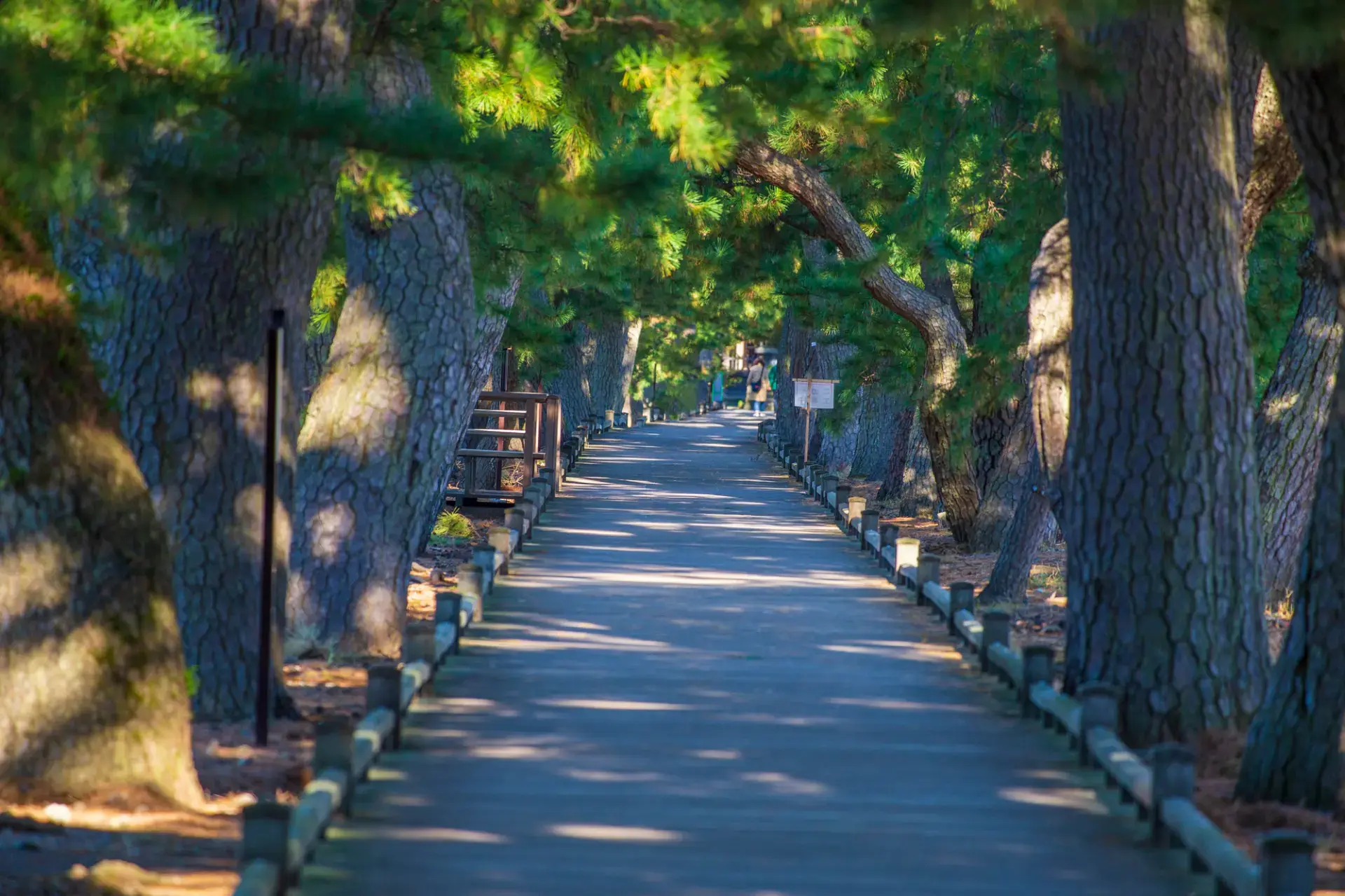
The approach known as Kami no Michi, lined with pine trees for 480 m from the entrance of Miho no Matsubara to Miho Shrine, is also beautiful and well worth a visit.

Miho Shirube, a Must-Stop Spot When Visiting Miho no Matsubara
This facility shares the value and charm of Miho no Matsubara, as well as the importance of preserving the pine grove.
Through exhibition rooms organized around six themes, you can deepen your understanding of Miho no Matsubara.
The earthen-floored passage lined with ukiyo-e posters related to Miho no Matsubara has benches, and free coin lockers are also available inside.
On weekends and holidays in winter only, you can enjoy a footbath made with pine bath salts, making it a useful place to take a break during your walk around Miho no Matsubara.
There is also a museum shop with a wide selection of cute original items inspired by Miho no Matsubara. Take home a memory from your trip.

3 Popular Places to Eat Near Miho no Matsubara
After walking around Miho no Matsubara, you will probably want a bite to eat. Here are some popular dining spots that are perfect for that.
Of course, there are also hearty menu options, so no worries there.
There are many appealing sightseeing spots around Miho no Matsubara as well, so fuel up at one of the places introduced below.
1. Kawamura Farm CAFÉ
Kawamura Farm in the Miho area mainly grows tomatoes, melons, and edamame in greenhouses.
At the café, which is open on weekends only and run by the current owner couple, the 12th generation of the family, you can enjoy menu items made with vegetables and fruits harvested on the farm.
The current shop relocated and reopened in 2016. Its organic-feeling interior makes generous use of wood, and even the tables and chairs are said to be handmade by the owner.

2. Shoan Shimizu Miho Sohonten
Located along Miho Kaido near the World Heritage site Miho no Matsubara, this is the first branch of a classic Shizuoka soba chain with more than 50 locations mainly in Shizuoka and Aichi.
The signature menu item is sakura shrimp kakiage. The restaurant is especially particular about the quality of its sakura shrimp, using specially managed and processed shrimp from Taiwan for Shoan, as well as locally caught shrimp from Suruga Bay.
It also uses high-quality tempura oil and its own original tempura flour to create a crisp, fragrant texture.

3. Casetta di Shu
This garden café stands along Kami no Michi, the Approx. 500 m pine-lined path leading from Miho no Matsubara, a component asset of the Fujisan World Cultural Heritage site, to Miho Shrine, which is known for the Hagoromo legend of the heavenly maiden’s robe.
The fully glass-walled interior is decorated with seasonal flowers and trees, creating a stylish and relaxing space.

3 Nearby Sightseeing Spots to Visit Along with Miho no Matsubara
There are many attractive spots around Miho no Matsubara as well.
From places where you can feel Japan’s culture and history to scenic viewpoints of Mt. Fuji and spots with great views of Miho no Matsubara itself, here are nearby destinations worth visiting to fully enjoy both Miho no Matsubara and Shizuoka.
1. Kunozan Toshogu Shrine
This shrine was founded in 1617 by the second shogun, Tokugawa Hidetada, to enshrine Tokugawa Ieyasu, who established the Edo shogunate.
It is said to have been built based on Ieyasu’s will that he be buried on Mount Kuno after his death.
The shrine building is in the gongen-zukuri style, with the main sanctuary and the worship hall connected by a stone passage.
Lavishly decorated with lacquer throughout, it is a representative early Edo-period structure and was designated a National Treasure building in 2010.

2. Nihondaira Yume Terrace
Nihondaira in Shizuoka City, Shizuoka Prefecture, is a hill area at an elevation of 307 m and one of Japan’s finest scenic spots, even having been ranked No. 1 in the Japan Tourist Destination Top 100 Contest.
Nihondaira Yume Terrace opened at the summit of Nihondaira in 2018.
It consists of an indoor exhibition area, lounge space, observation floor, and outdoor observation corridor, all offering sweeping views of Mt. Fuji, Suruga Bay, and Miho no Matsubara.

3. Kami no Michi
This pine-lined approach to Miho Shrine, which is associated with the Hagoromo legend, runs straight for Approx. 500 m from Miho no Matsubara to the shrine gate.
It is said to be the path the gods took when they descended near Hagoromo no Matsu and were welcomed to Miho Shrine.
Lined with old pine trees that are 200 to 400 years old, the path is wrapped in a sacred atmosphere. It is also easy to walk thanks to a boardwalk designed to protect the pine roots, and it is barrier-free for wheelchair users as well.
Reviews
4.07
Some reviews are AI-translated.
-
The scenery along Miho no Matsubara is so peaceful, with that laid-back small town vibe. It's perfect for street photography. The road in front of the bus stop goes straight toward Mt. Fuji 🗻... Absolutely stunning, just breathtaking! 👍
-
Miho no Matsubara feels like a place full of energy for travelers. The famous Miho Shrine and the 'Path of the Gods' are nearby. Walking here gave me a totally refreshed feeling.
FAQ about Miho no Matsubara
Q
What is the admission fee for Miho no Matsubara?
A
It is free.
Q
What are the highlights of Miho no Matsubara?
A
The coastal scenery, Hagoromo no Matsu, and the pine grove.
Summary
We have introduced the best seasons to visit and ways to enjoy Miho no Matsubara so that even first-time visitors can make the most of its spectacular scenery.
Be sure to visit and see this uniquely Japanese view for yourself.
Shizuoka also has many other attractive spots beyond Miho no Matsubara.
If you want to enjoy Shizuoka even more, use the article below as a reference when planning your trip.