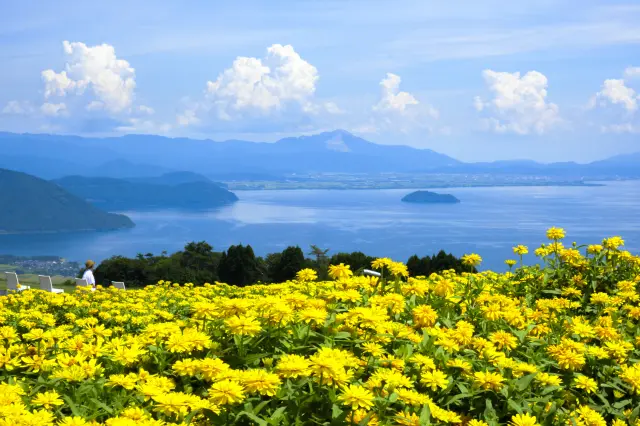
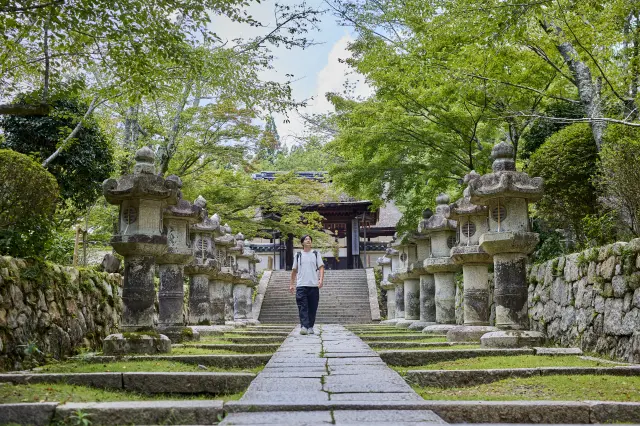
This vast temple complex encompasses all of 848-meter-high Mt. Hiei and was founded in 788 by Saicho, who established the Tendai school of Buddhism in Japan. Oda Nobunaga, who was in conflict with Mt. Hiei, burned down its halls, pagodas, and other temple buildings, as well as the monks’ residences in Sakamoto. The complex was later restored and rebuilt by Kannonji Senshun, Shiyakuin Zenso, the high priest Tenkai, and others. Serving as a comprehensive center of Buddhist learning, it became known as the “mother mountain of Japanese Buddhism” and has had a profound influence on Japanese history. It was also tasked with protecting Kyoto during the roughly 1,000 years that the city served as Japan’s capital. It was designated a UNESCO World Heritage site in 1994.
The temple complex consists of three areas—Todo, Saito, and Yokawa—with around 100 halls and pagodas scattered throughout.
Todo, the main area, is home to Konpon Chudo, Enryakuji’s main hall and a designated National Treasure. Inside, the “Inextinguishable Dharma Light,” first lit by Saicho, has continued to burn for nearly 1,200 years. The Kokuho-den museum displays numerous valuable cultural properties passed down at Enryakuji, including Buddhist statues, paintings, and calligraphy. Saito is home to Shaka-do, the area’s main hall, which is the oldest building on the mountain and a nationally designated Important Cultural Property. In Yokawa, visitors will find Yokawa Chudo, the main hall, whose design resembles a ship floating on water, and Shiki Kodo, considered the birthplace of omikuji fortune slips.
As the mountain itself serves as a place of religious training, numerous pilgrimage and worship routes run through the temple grounds. Visitors can walk amid nature while experiencing the site’s solemn religious atmosphere and deep history.
Visitors can receive goshuin seals as proof of their visit at the various temple halls. There are 11 types in total, including special versions available only on the festival day associated with each Buddhist deity.
Surrounded by abundant nature, the temple offers distinctly seasonal scenery throughout the year, including cherry blossoms in spring and colorful foliage in fall.
Highlights
-
A vast temple complex encompassing the entirety of 848-meter-high Mt. Hiei, with views of the Kyoto cityscape and Lake Biwa.
-
The complex is divided into three areas—Todo, Saito, and Yokawa—and exploring them all takes nearly a full day.
-
Visitors can collect 11 types of goshuin seals.
-
Experience Japan’s changing seasonal landscapes throughout the year.
-
The temple has produced many prominent monks in the history of Japanese religion.