

Rich Culture and Beautiful Nature: 9 Must-Visit Spots in Ishikawa
Ishikawa Prefecture is home to many places where you can feel Japan’s history, including Kenrokuen, a daimyo garden that still reflects the glory of Kaga Hyakumangoku, and Natadera Temple, which has Important Cultural Properties of Japan.
And that’s not all: there are also plenty of spots where you can enjoy seasonal scenery all year round, so the highlights never end.
If you’re sightseeing in Ishikawa, we’ll introduce must-visit attractions, recommended places to stay, great food, and more.
What is Ishikawa Like?
Ishikawa Prefecture faces the Sea of Japan and is located in the Hokuriku region.
In the Edo period, it was known as the Kaga Domain, and with the enormous wealth of “one million koku,” it built a lavish castle town and flourished as a cultural city.
Because of that prosperity, it was also called “Kaga Hyakumangoku,” and traces and influences of Edo-period wealth, both financial and cultural, can still be seen throughout Ishikawa today.
Kanazawa City, where the history and culture of Kaga Hyakumangoku remains especially strong, is one of Ishikawa’s most popular destinations.
In Kanazawa, you can enjoy sightseeing spots rich in traditional culture and history, along with cuisine featuring seafood from the Sea of Japan and local mountain ingredients.
Of course, Ishikawa’s appeal doesn’t stop there.
On the Noto Peninsula, surrounded by abundant nature, you can take in stunning scenery such as Shiroyone Senmaida, a breathtaking spot made up of terraced rice paddies and the Sea of Japan.
If you’re going all the way to Ishikawa, we hope you’ll explore not only Kanazawa but also the Noto Peninsula and other fantastic destinations.

When is the best season to visit Ishikawa?
With so many things to see, Ishikawa is a great place to visit year-round.
If you’d like to enjoy atmospheric scenery, spring and winter are recommended.
The cherry blossoms at Kenrokuen in spring and the snow-covered streets of Kanazawa in winter are must-sees.
What to wear in Ishikawa by season
- Spring (March - May): Light jacket and a thin sweater
- Summer (June - August): Light clothing, short sleeves
- Fall (September - November): Light jacket, coat
- Winter (December - February): Coat, thick sweater or jacket
How do you get to Ishikawa?
Ishikawa is also easy to reach from major cities like Tokyo and Osaka.
From Tokyo, you can take the shinkansen; from Osaka, you can take a limited express train, and either way it takes Approx. 2.5 hours.
Ishikawa also has Komatsu Airport, so it’s a 1-hour flight from Tokyo (Haneda).
There are also international flights, making it easy to access from overseas.
Main transportation for sightseeing in Ishikawa
Ishikawa has an extensive local bus network.
If you want to visit major attractions around Kanazawa City, the “Jonai-machi Kanazawa Loop Bus” is recommended.
If you’re sightseeing in Noto or Kaga, using local buses makes it easy to get around smoothly.
A Concentrated Taste of Ishikawa’s Best: 9 Handpicked Sightseeing Spots
Ishikawa Prefecture is well known for Kanazawa City, where traces of the old Kaga Hyakumangoku castle town remain.
Along with historic buildings and townscapes, there are plenty of attractions with beautiful natural scenery, so there’s no shortage of highlights.
Other draws include museums where you can experience contemporary art and hands-on workshops where you can enjoy traditional crafts in lush, green surroundings.
Here, we’ve selected some of Ishikawa’s top sightseeing spots you should definitely visit.
1. Kenrokuen Garden
A strolling-style garden counted among Japan’s Three Great Gardens, created over a long period of Approx. 180 years by successive lords of the Kaga Maeda clan.
Across its vast grounds of Approx. 34,600 tsubo, you’ll find ponds, winding streams, and artificial hills scattered throughout, with a layout designed to be enjoyed as you stop by each area.

2. 21st Century Museum of Contemporary Art, Kanazawa
Since opening in 2004 under the concept of an “open museum,” its buzzworthy exhibition approach has challenged traditional museum norms, making it one of Japan’s most popular museums—and a central hub for sharing “Kanazawa = art.”

3. Myoryuji Temple
A Nichiren Buddhist temple founded in 1643 by Maeda Toshitsune, the third lord of the Kaga Domain, by relocating and rebuilding a prayer temple near Kanazawa Castle.
It enshrines a patriarch statue created by Saint Nichizo, a descendant in the lineage of Nichiren.
Because it also served as a defensive outpost in case of emergency, the entire building has a complex structure, with hidden staircases, secret rooms, trapdoors, and other tricks designed to deceive enemies throughout.

4. Higashi Chaya District
One of Kanazawa’s signature sightseeing areas, with a streetscape of beautiful wooden lattice façades and stone-paved roads, also selected as an Important Preservation District for Groups of Traditional Buildings by the national government.
It began when Maeda Narihiro, the 12th lord of the Kaga Domain, gathered teahouses that had been scattered around the castle town and created a dedicated teahouse district in 1820.
Traditional buildings from the Edo period still line the streets today.

5. Kaga Traditional Handicrafts Village Yunokuni no Mori
On lush green grounds, 11 craft “houses” are scattered across the property, where you can try Ishikawa’s traditional crafts.
With over 50 courses—such as yuzen stencil dyeing, Wajima lacquerware, gold leaf application, glassblowing, and hand-forming—you can easily experience a wide range of Ishikawa’s traditional crafts.
There are also tea rooms, restaurants where you can enjoy local cuisine, and souvenir shops selling everything from local sweets to sake, specialties, and traditional crafts, so you can relax and enjoy a full day here.

6. Natadera Temple
A Hakusan-faith temple founded in 717 by Taicho, preserving the tradition of natural wisdom (jinenchi) to this day.
On the grounds, you’ll find the striking rock formations of Kigan Yusenkyō, where multiple caves open into towering sacred stones, along with a three-story pagoda, main hall, bell tower, goma hall, and more—many designated as Important Cultural Properties of Japan—as well as the Kaedegetsu Bridge with its memorable vermilion railings, creating a landscape like a traditional ink painting.

7. Nagamachi Samurai District: Nomura-ke Samurai Residence
The former residence of the Nomura family, who served as retainers when warlord Maeda Toshiie entered Kanazawa Castle in 1583 and held important posts in the Kaga Domain for 11 generations.
In the Nagamachi area, which has many former residences of mid- and upper-ranking samurai of the Kaga Domain, it is the only one open to the public.

8. Kanazawa Castle Park
The elegant castle of the Maeda clan of Kaga Hyakumangoku, where full-scale castle construction began after Maeda Toshiie entered Kanazawa Castle in 1583. Many structures were lost to natural disasters and fires, but today the surrounding area has been restored and maintained as “Kanazawa Castle Park.” Along with Ishikawa Gate and the Sanjikken Nagaya storehouse, which retain their Edo-period appearance, sites such as Kahoku Gate, Imori Moat, and Gyokuseninmaru Garden have been restored one after another, gradually bringing the castle back to life. Don’t miss the stone walls, which also show influences of yin-yang and five-element philosophy, such as protective designs for the northeast “demon gate” and tortoise-shell-shaped stones.

9. JR Kanazawa Station
Kanazawa Station, the gateway to Ishikawa. In 2015, the Hokuriku Shinkansen began service, connecting Tokyo and Kanazawa in Approx. 2.5 hours and making the station a key starting point for exploring Kanazawa City as well as the wider Hokuriku region.
The shinkansen platforms feature gold leaf, while corridors and columns use washi paper and Kaga yuzen textiles; the waiting room walls display over 200 craft pieces such as Wajima lacquerware and Kutani ware, turning the entire station into a spot that showcases Kanazawa’s traditional crafts.

Savor Ishikawa’s Amazing Food: 3 Popular Restaurants
If you’re sightseeing in Ishikawa, which faces the Sea of Japan, seafood is a must.
Between sightseeing stops, we also want you to enjoy dessert shops where you can try sweets made with Noto Dainagon azuki beans.
Here are three popular restaurants you should visit.
1. Omicho Market
Kanazawa’s kitchen, loved for around 300 years under the nickname “Omicho.”
Along narrow alleyways, Approx. 170 shops line the streets selling fresh seasonal seafood and vegetables, prepared foods, souvenirs, and more, creating a lively atmosphere
There are also shops that cook right in front of you and places with eat-in seating, so you can enjoy seasonal flavors on the spot.

2. Ikiikitei Omicho Branch
A sushi restaurant open from 7:00am, located just steps from Omicho Market’s Musashiguchi entrance, which many travelers also stop by.
The restaurant has only 10 counter seats, and the staff are close by, creating a warm, homey atmosphere.

3. Kintsuba Nakadaya Higashi Chaya District: Dessert Cafe Wami
A dessert cafe produced by a long-established Japanese sweets shop with over 80 years of history, beloved by locals to the point that people say, “If it’s kintsuba, it’s Nakadaya.”
Here you can enjoy sweets made with high-quality Noto Dainagon azuki beans from Oku-Noto, known as “red jewels.”

The Best Places to Shop in Ishikawa: 3 Popular Shopping Spots
From traditional crafts to shopping centers packed with the latest fashion, Ishikawa has a wide range of places to shop.
Here are three especially popular shopping spots.
1. Hakuichi Higashiyama Store
A shop operated by Hakuichi, built on the former site of the public bath “Higashiyu,” once loved in the Higashi Chaya District.
Keeping the old bathhouse’s open atrium intact, the interior feels airy and makes for a relaxed shopping experience.

2. Kanazawa FORUS
A commercial complex operated by OPA, in an excellent location just a 1-minute walk from JR Kanazawa Station.
Across its eight floors, around 190 diverse shops offer everything from fashion to interior goods, lifestyle items, cosmetics, and jewelry.
From 2021 to 2022, it carried out a major renovation over three phases under the banner “REBORN PROJECT2021-2022.”

3. Kanazawa Hyakubangai
A commercial facility directly connected to JR Kanazawa Station. It consists of three buildings: “Anto,” packed with Kanazawa-style souvenirs and food; “Rinto,” with a wide variety of shops including fashion, goods, and cafes; and “Anto Nishi,” a daily-life zone with a fresh food supermarket and even clinics.

Enjoy a Tour of Unique Hot Springs: 3 Onsen Areas in Ishikawa
When it comes to hot springs in Ishikawa, the best-known is “Kaga Onsenkyo,” made up of four onsen areas: Awazu, Yamashiro, Yamanaka, and Katayamazu.
Along with the appeal of Kaga Onsenkyo, here are three especially recommended onsen areas.
1. Awazu Onsen
A hot spring town that has attracted many therapeutic bathers since it was discovered by the monk Taicho in the Nara period. It’s the oldest onsen in Kaga Onsenkyo, with waters originating from sacred Mt. Hakusan, long cherished not only for nerve pain and muscle pain, but also for cuts, burns, and detoxifying effects.
In particular, Maeda Toshitsune, the third lord of the Kaga Domain, is said to have especially loved Awazu Onsen and helped develop its hot spring culture. Each accommodation has its own privately dug source, and the water quality and temperature differ slightly from place to place.

2. Katayamazu Onsen
One of the onsen areas in Kaga Onsenkyo, this hot spring town stretches along the lakeshore of Shibayamagata, with views of sacred Mt. Hakusan. It’s said the lake’s surface changes color seven times a day; you can soak in the hot springs while enjoying the view, or take a relaxing walk by the water.
The glass-fronted building by the lakeshore is “Katayamazu Onsen Soyu,” where you can bathe while taking in the scenery, and it also has an open-terrace cafe. In the center of the hot spring town is a relaxing space called “Sunahashiri Park,” where you can also unwind in a free footbath.

3. Kaga Onsenkyo
Kaga Onsenkyo is made up of four hot spring areas: “Katayamazu Onsen,” “Yamashiro Onsen,” “Yamanaka Onsen,” and “Awazu Onsen.”
It’s located Approx. 20 minutes from Kanazawa, the capital of Ishikawa Prefecture, by shinkansen.
The area is infused with the refined traditional culture of Kaga Hyakumangoku, and beyond hot springs there’s plenty more to enjoy, with Kutani ware kilns offering painting and wheel-throwing experiences, as well as power spots, castle towns, fishing ports, and more scattered throughout.

3 Places to Stay in Ishikawa for a Relaxing, Luxurious Getaway
After enjoying sightseeing in Ishikawa, choose a wonderful hotel to stay at, too.
Here are three recommended hotels where you can spend a relaxing, luxurious time in Ishikawa.
1. Yoshigaura Onsen Lamp no Yado
A hidden hot spring inn at the far tip of Oku-Noto, once reachable only by boat.
On its grounds, known as “Seiiki no Misaki” (Sacred Cape) due to legends that nature’s power gathers here, you’ll find spots like the Blue Cave and Power Hall scattered around, offering a stay surrounded by truly mystical scenery.

2. UAN Kanazawa
Kanazawa is known for frequent rain—so much so that there’s a saying, “You can forget your lunch, but don’t forget your umbrella.”
Named “UAN” with the hope that guests will enjoy their trip whether it’s sunny or rainy, and leave thinking, “I’m glad it rained.”

3. Hotel Torifito Kanazawa
A stylish hotel located a 4-minute walk from Kanazawa Station, your travel hub. Traditional crafts are displayed in the lounge, making it easy to casually connect with art.

Only in Ishikawa: 3 Classic Souvenirs
Ishikawa is home to many long-established confectionery shops rooted in the community, and you’ll find a wide variety of souvenirs.
Here are three classic picks.
1. Ishikawaya Honpo “Kaichin”
A long-established Japanese sweets shop founded between 1830 and 1844 (Tenpo era), with a history of over Approx. 170 years. It sells kaichin, a classic souvenir, along with handcrafted fresh sweets and baked treats made by artisans.

2. Tawaraya Ame “Tawarakko” and “Amenko”
A long-established candy shop founded in 1830, with over Approx. 190 years of history. Made only from domestically produced rice, barley, and water, its syrup candy is highly nutritious and has long been enjoyed as a natural food for helping people regain strength when sick and for promoting health.
Especially perfect as souvenirs are “Tawarakko,” made by simmering down their signature “Jiroame” syrup and removing moisture to create “Okoshiame,” then shaping it into firm bite-sized pieces, and “Amenko,” made by kneading it and forming it into small pieces.

3. Kanazawa Urata “Kaga Hachiman Okiagari Monaka”
“Kaga Hachiman Okiagari Monaka,” made by Kanazawa’s long-established Japanese sweets shop Kanazawa Urata, with over 80 years in business.
A classic souvenir in an adorable shape, inspired by the local folk toy “Kaga Hachiman Okiagari,” a doll depicting Kaga Hachiman-sama—who later became Emperor Ojin—peeking out from celebratory red baby clothes at his birth.

3 Events You Should Join in Ishikawa
Ishikawa has plenty of events where you can feel the seasons and enjoy traditional culture. If your travel dates line up, we hope you’ll join these events too.
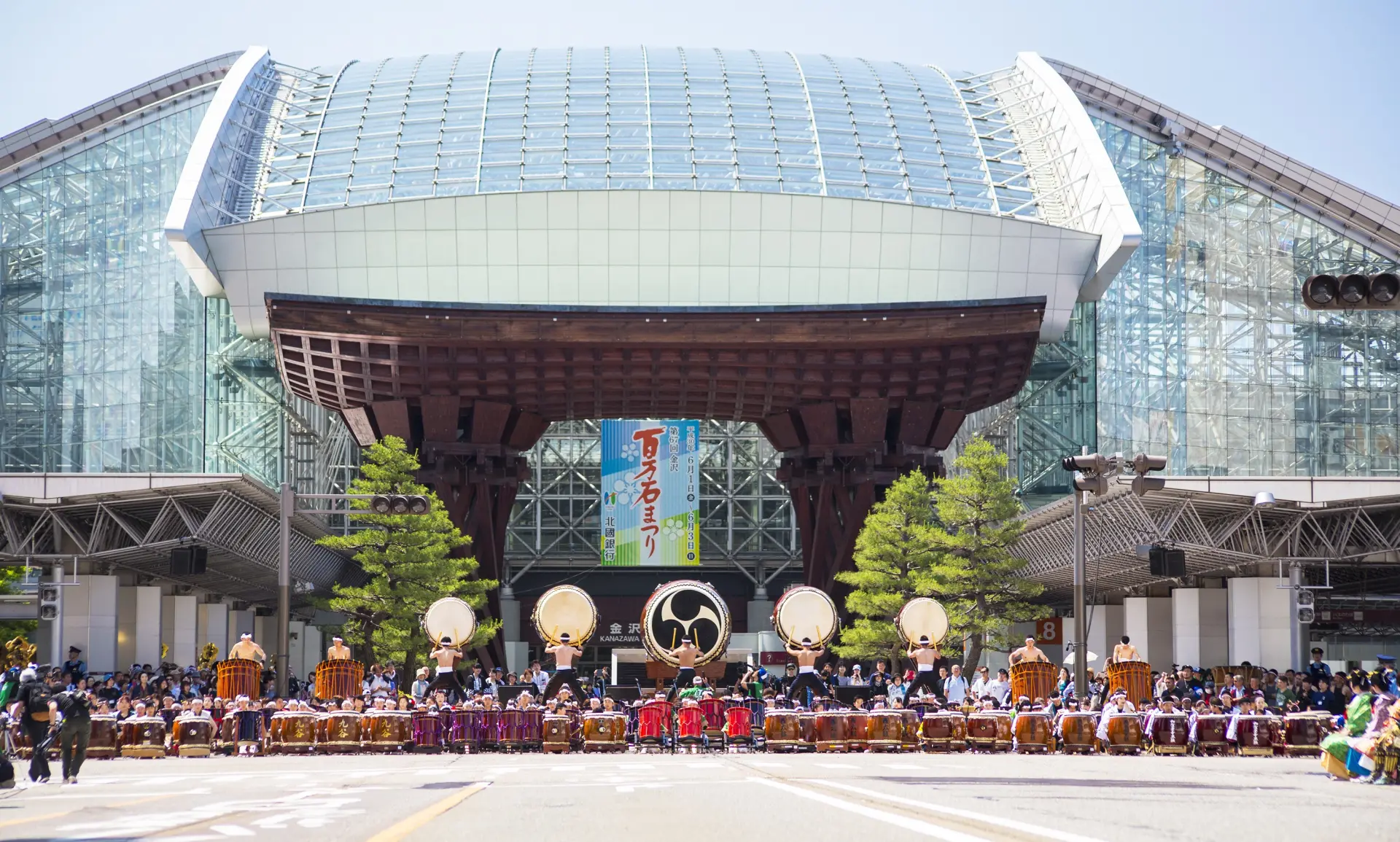
1. Kanazawa Hyakumangoku Festival
First held in 1952, the Kanazawa Hyakumangoku Festival is Kanazawa’s largest event, held in remembrance of the achievement of Maeda Toshiie, founder of the Kaga Domain, who entered Kanazawa Castle on June 14, 1583 and laid the foundation of Kanazawa.
It begins with the Omizutori water-drawing ritual at Kanazawa Shrine next to Kenrokuen, followed by organizer- and special-sponsor events held over three days.
2. Kanazawa Castle and Kenrokuen: Four Seasons Tale
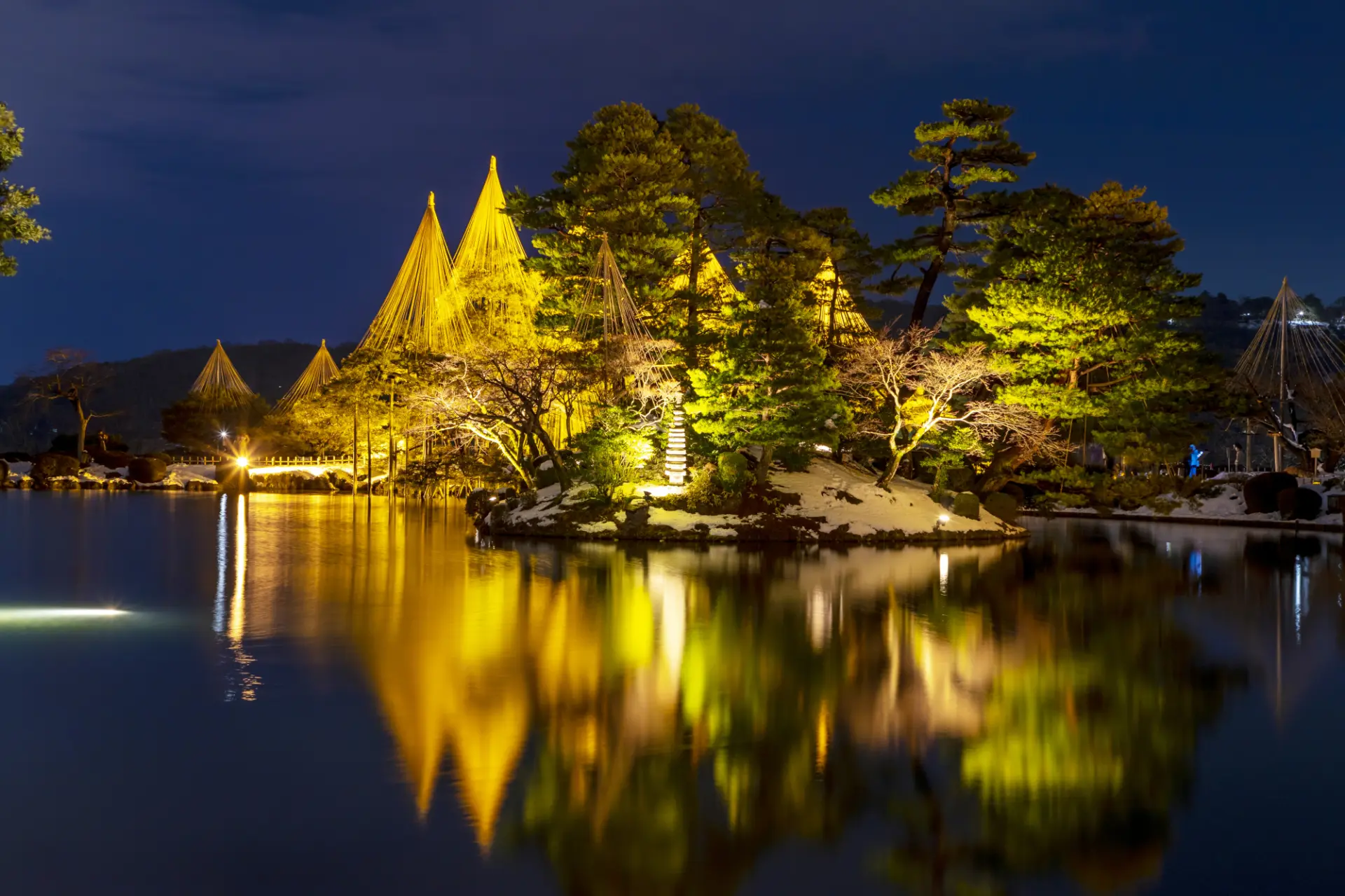
Kanazawa Castle, known as the residence of 14 generations of the Kaga Domain’s Maeda clan, and Kenrokuen, a daimyo garden built on its outer grounds, are signature sightseeing spots of Ishikawa and Kanazawa.
Kenrokuen is also famous as one of Japan’s Three Great Gardens and is designated as a Special Place of Scenic Beauty by the national government.
At Kanazawa Castle and Kenrokuen, the limited-time light-up event “Kanazawa Castle and Kenrokuen: Four Seasons Story” is held, where you can fully enjoy the beauty of each season.
3. Otabi Festival
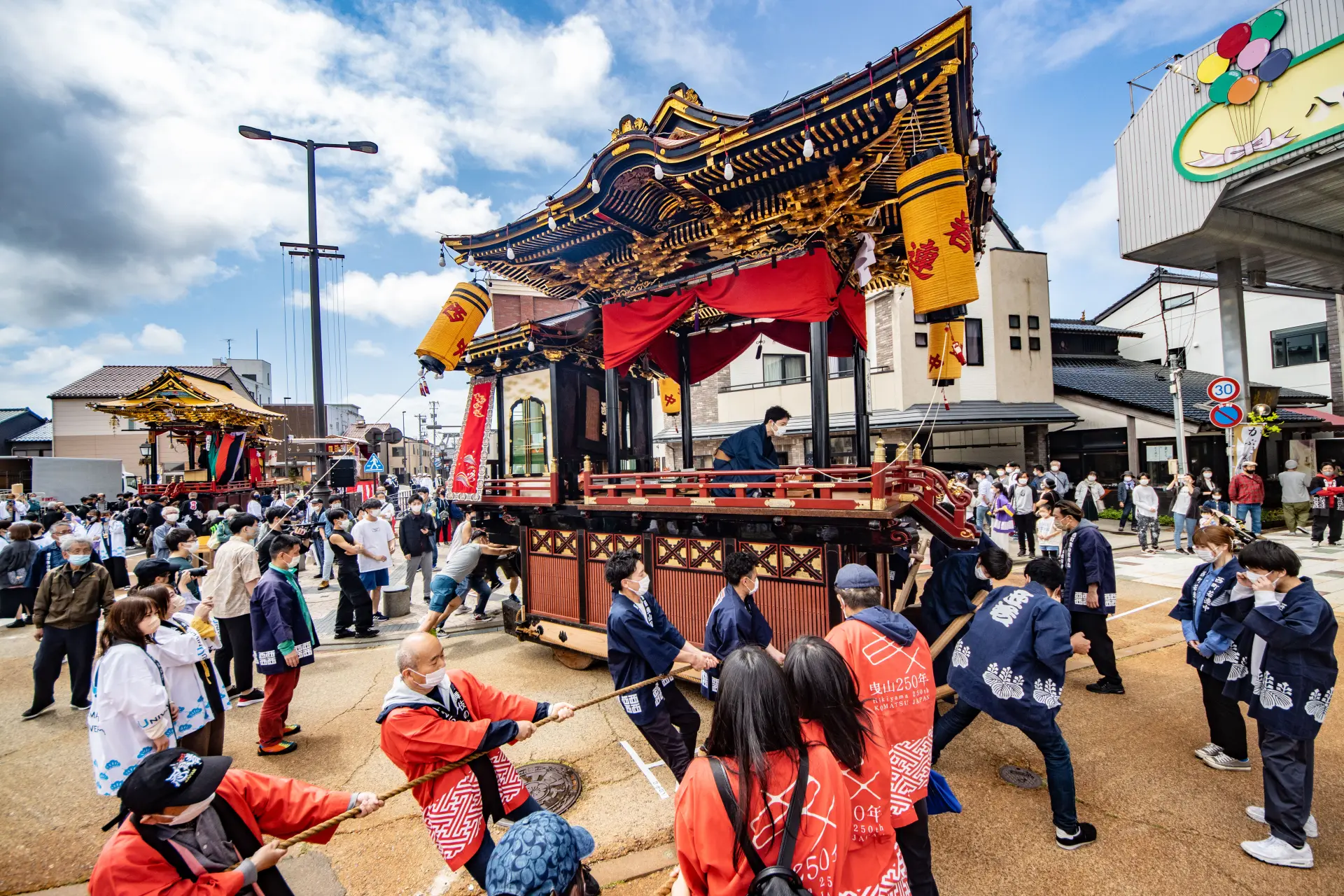
A spring festival of “Uhashi Shrine” and “Motoori Hiyoshi Shrine” in Komatsu City, Ishikawa Prefecture, held every year for three days from the second Friday in May.
The sight of parishioners pulling historic hikiyama floats decorated with gold leaf and lacquer through the streets, chanting “Yoiya Hassun,” is a seasonal tradition that has remained unchanged for over 250 years, announcing the arrival of spring in Komatsu.
Summary
To fully enjoy Ishikawa Prefecture, be sure to visit spots that still reflect the glory of the Kaga Domain, as well as places where you can take in seasonal scenery throughout the year.
If your itinerary allows, consider taking a side trip to Gifu Prefecture, Approx. 2.5 hours away by limited express train.
In Gifu, we hope you’ll experience Sengoku-era history at Gifu Castle-once a base for Oda Nobunaga’s unification efforts-and then unwind in its grand natural scenery and hot springs.