
![[Yasaka Shrine Travel Guide] A Famous Kyoto Power Spot for Beauty, Connections, and Good Fortune](https://static.gltjp.com/glt/data/article/21000/20409/20251120_221846_7cfb64b7_w1920.webp)
[Yasaka Shrine Travel Guide] A Famous Kyoto Power Spot for Beauty, Connections, and Good Fortune
Kyoto’s “Yasaka Shrine,” proud of its long history and serving as the head shrine of Yasaka Shrines and Gion Shrines across Japan.
Because it enshrines a variety of high-ranking deities, it has become a famous power spot even in Kyoto, a city known for its many temples and shrines.
Not only that, it’s also home to many historically valuable buildings and is filled with highlights.
So that you can fully enjoy “Yasaka Shrine” and receive as many blessings as possible, let’s introduce its main highlights, recommended sightseeing seasons, and events you should pay attention to.
What is Yasaka Shrine Like?
“Yasaka Shrine” is located in Gion, one of Kyoto’s leading geisha districts, in Higashiyama Ward, Kyoto City, Kyoto Prefecture.
It is the head shrine of Approx. 2,300 Yasaka Shrines and Gion Shrines found throughout Japan. Known as “Gion-san,” it has long been loved by local residents.
The main enshrined deities are Susanoo-no-Mikoto, his wife Kushinadahime-no-Mikoto, and Okuninushi-no-Kami.
Its main blessings are warding off evil, household safety, and matchmaking, but since the grounds include many subsidiary shrines with various deities enshrined, you can also receive many other blessings such as prosperity in business.
There are many highlights, including 29 structures designated as Important Cultural Properties, and the main hall is designated as a National Treasure.
The precincts also offer abundant nature and seasonal scenery, making it enjoyable even just to stroll around.
It is also known for the “Gion Festival,” one of Japan’s three great festivals, held for a full month from July 1 to 31.
Various Shinto rituals and events are held during the period, but the two-day “Yamaboko Procession” is a must-see.
With lavishly decorated floats parading through the city and brightening Kyoto’s summer, you’ll likely feel Japan’s culture in a deep way.
The Origins of Yasaka Shrine
There are various theories about the founding of “Yasaka Shrine,” but shrine tradition includes the following two theories:
1. Envoys who came from the Korean Peninsula enshrined a deity from the Korean Peninsula
2. A heavenly deity descended upon a hall built by a Nara-period monk
Even today, it is not clear which is correct.
However, it is known that its development was sparked when prayers were offered during an epidemic in 877 and the outbreak came to an end.
After that, through shinbutsu-shugo (the blending of Shinto and Buddhism into a single belief system) and the flow of history, it became a branch temple of Kofuku-ji and Enryaku-ji on Mt. Hiei.
It became independent due to Oda Nobunaga’s burning of Mt. Hiei in 1571, and fostered a faith unique to “Yasaka Shrine.”
With the 1868 policy of shinbutsu bunri (separating Shinto and Buddhism), the temple established in the Heian period was abolished, and only its role as a shrine remained.


Access to Yasaka Shrine
Here’s how to get to “Yasaka Shrine” from “JR Kyoto Station,” a major hub for getting around while sightseeing in Kyoto.
You can get there by train or bus, but since the train requires multiple transfers, the bus route below is recommended.
- Route
-
1. From “JR Kyoto Station,” take the City Bus Express Route 100 (for Kiyomizu-dera, Gion, Ginkaku-ji) and get off at “Gion.”
2. 3-minute walk from the bus stop - Travel Time
- Approx. 30 minutes
Yasaka Shrine Admission and Visiting Hours
“Yasaka Shrine” is open for worship 24 hours a day, and admission is free.
However, purchasing amulets and similar items is only available from 9am to 5pm, so please keep that in mind.
What’s the Best Season to Visit Yasaka Shrine?
The recommended seasons to visit “Yasaka Shrine” are summer and fall.
In summer, the spectacular “Gion Festival” is held, with various rituals and events, and the entire city of Kyoto comes alive.
If you want to experience Japan’s traditional culture, be sure to join the “Gion Festival” held in July.
In fall, the vermilion buildings and maple leaves turn the grounds a vivid red. Stroll through this elegant atmosphere and you’re sure to soak up the spirit of Japan.
It’s also recommended to visit during the best autumn foliage season, from late November to early December.


8 Must-See Highlights at Yasaka Shrine
“Yasaka Shrine” shows a beautiful face in every season.
The grounds are filled with many smaller shrines and Important Cultural Property buildings, enough to make you wonder where to start worshiping and sightseeing.
But don’t worry. If you tour the grounds focusing on the eight highlights introduced below, you’ll be able to visit all the main must-sees.
1. The One-of-a-Kind Architectural Style, and the Largest-Scale “Main Hall”
The “Main Hall” features “Gion-zukuri,” a unique architectural style in which the main sanctuary and worship hall are covered by a single large roof.
This style has been passed down since the Heian period.
Another feature is its complex structure, with multiple rooms partitioned around the central space called the “Nai-naijin,” where the deities reside.
With a height of 15 m and a building area of 662 m², it is the largest-scale main hall among Shinto shrines. In 2020, it was designated as a National Treasure.
Susanoo-no-Mikoto, Kushinadahime-no-Mikoto, and their children, the Yahashira no Mikogami, are enshrined here, granting a wide range of blessings from warding off evil and success in studies to matchmaking and safe childbirth.
It is said that there is a pond where the Azure Dragon lives beneath the “Main Hall,” and it is believed to be effective for good fortune.

2. Can Sacred Water and a Visit Make You More Beautiful? “Gion Shinsui”
“Gion Shinsui,” also called “Chikarimizu,” springs forth in front of Daijingu Shrine to the east of the main hall.
It is said that if you drink Gion Shinsui and then visit the adjacent “Utsukushi-gozen Shrine,” you will become more beautiful, and it is deeply revered by geiko and maiko.
However, it is not drinking water, so you must boil it to drink it.
There is also a belief that applying it to your face will make you more beautiful.

3. “Utsukushi-gozen Shrine,” Where You Can Become Beautiful in Body and Mind
“Utsukushi-gozen Shrine,” a subordinate shrine of “Yasaka Shrine,” is located to the east of the main hall.
The enshrined deities are Tagirihime-no-Mikoto, Tagitsuhime-no-Mikoto, and Ichikishimahime-no-Mikoto—three deities, all goddesses depicted as beautiful figures.
It offers blessings for beauty, and it is said that if you apply the “Beauty Water” beside the torii gate to your skin and then pray, you will become beautiful in both body and mind.


4. If You’re Praying for Prosperity in Business, Visit “Kitamuki Ebisu Shrine”
“Kitamuki Ebisu Shrine,” located west of the amulet office, enshrines Kotoshironushi-no-Kami.
Kotoshironushi-no-Kami is a deity identified with Ebisu, one of the Seven Lucky Gods, and its blessing is prosperity in business.
At “Gion no Ebessan,” held every year on January 9 and 10, lucky bamboo branches called “Fukuzasa,” said to bring prosperity in business and household safety, are bestowed—so if you have the chance, be sure to get one.

5. “Okuninushi Shrine,” Which Ties Many Kinds of Connections
At “Okuninushi Shrine,” located southwest of the main hall, Okuninushi-no-Kami, Sukunahikona-no-Mikoto, and Kotoshironushi-no-Kami are enshrined.
Its blessing is matchmaking, and the same deity is enshrined as at “Izumo Taisha” in Shimane Prefecture.
It should help tie many kinds of connections, including romance, relationships, and work.

6. The Oldest Structure in the Grounds: “Nishiromon Gate”
The “Nishiromon Gate,” a symbol of “Yasaka Shrine,” is a splendid gabled gate painted in vermilion.
On both sides stand wooden statues of officials who once served as aristocratic guards, and in front of the gate, bronze komainu guardian dogs protect “Yasaka Shrine.”
After being destroyed in the Onin War of 1467, it was rebuilt in 1497.
It is the oldest structure on the grounds and is designated as a National Important Cultural Property.
In conjunction with a road expansion project in 1912, it was moved 6 m east and 3 m north, and placed so it can be seen in the center of Shijo Street.
It is often thought to be the main gate, but it is actually not—which is another point of interest.

7. Yasaka Shrine’s Beautiful Main Gate: “Minamiromon Gate”
The “Minamiromon Gate” on the main approach is the main gate, and it connects directly to Shimogawara Street.
For that reason, the mikoshi portable shrines of the Gion Festival always depart through the Minamiromon Gate.
It is 14 m tall and 9 m wide. Like the main hall, it features forms unique to “Yasaka Shrine.”
The vermilion-painted pillars and the roof with copper plates in a reddish-brown hue are outstanding in both form and color.

8. “Maiden Hall,” a Stage for Traditional Japanese Performing Arts
The mikoshi portable shrines of the “Gion Festival” are placed here, and it is also used as a venue for weddings and Shinto rituals.
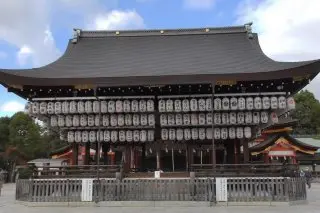
The shrine maiden dances and bunraku puppet theater performed at the “Maiden Hall” are a must-see.
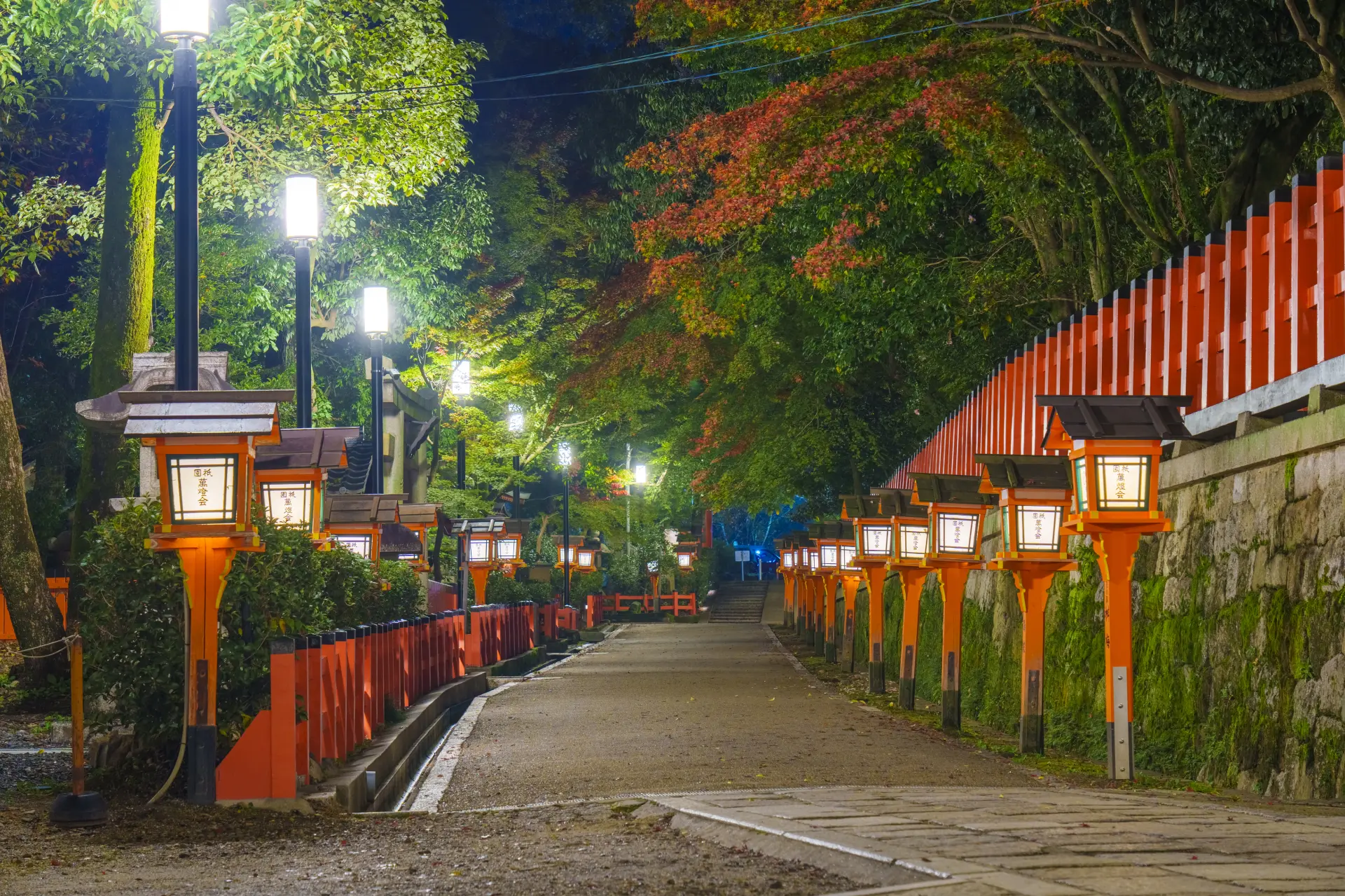
The 280 lanterns hanging under the roof were dedicated by okiya (maiko houses), traditional restaurants, and more where maiko live and work.
At night, they are lit and quietly illuminate the grounds, shining brightly.


The Gion Festival, One of Japan’s Three Great Festivals
The “Gion Festival” is known worldwide as one of Japan’s three great festivals.
This festival, visited by many people from Japan and abroad, began when epidemics spread widely in 869 in the capital and across Japan, and people prayed to the deities of Yasaka to ward off evil and purify the calamities.
Even today, as Yasaka Shrine’s annual festival, it is held for one month from July 1, with various Shinto rituals and events taking place.
The biggest highlight of the Gion Festival, which begins with “Kippu-iri” on July 1, is the procession of 34 floats and the mikoshi procession of Yasaka Shrine, held during the Saki Festival on the 17th and the Ato Festival on the 24th.
Along with the sound of the Gion-bayashi music—“Konchikichin”—the floats depart from Shijo-Karasuma during the Saki Festival, and from Karasuma-Oike during the Ato Festival, parading through Kyoto.

Make Your Trip Even More Fun: Yasaka Shrine’s Seven Mysteries
With its long history, “Yasaka Shrine” is home to many legends and folk tales.
Among them, here are seven famous mysterious episodes.
If you sightsee while keeping these stories in mind, you might even encounter something mysterious.
1. The “Nishiromon Gate,” Where Spiderwebs Never Appear
No one knows why, but spiderwebs have never appeared here even once.
Moreover, there are no drips from rainwater off the roof, so there are no drip marks on the stone steps, either.
It is said not that the drip marks dried and disappeared, but that it never drips in the first place.

2. The Well Said to Connect to the Dragon Palace: “Ryuketsu”
Beneath the main hall is a well called Ryuketsu, and it is said that the Azure Dragon that protects Kyoto lives there.
However, it is sealed with plaster, so it cannot be seen from the outside.
The Kamakura-period text “Shaku Nihongi” states that it is connected to the Dragon Palace, but no one knows whether this is true.

3. Clap Your Hands and a Dragon Roars? “Ryuko”
At the right pillar facing the main hall, clap once while facing west beneath it, and you can hear a loud echo. Clapping elsewhere does not echo.
At the junction between the pillar and a small roof is a carving called “Ryuko,” and it is said that the echo is the dragon responding to the clap.

4. “Tadamori Toro,” Named After a Tale of Seeing Through a Demon’s True Identity
The “Tadamori Lantern,” located between “Daijingu Shrine” and “Akuoji Shrine” to the east of the main hall, has a mysterious legend.
In the Heian period (794–1185), Emperor Shirakawa and Taira no Tadamori were walking through the grounds in the rain when they encountered a creature that looked like a demon.
Emperor Shirakawa ordered Taira no Tadamori to defeat the demon.
Taira no Tadamori captured it alive to determine its true identity, and it turned out to be a monk trying to raise a torch to the lantern.
It is said that it was named “Tadamori Lantern” in praise of Taira no Tadamori’s thoughtful judgment in seeing through what it really was.

5. “Futami-iwa,” Said to Be Long and Large Enough to Reach the Earth’s Axis
“Daijingu Shrine” to the east of the main hall is built so that its Inner Shrine and Outer Shrine face each other.
Between them is a rock called “Futami-iwa.” Only a small part is visible above ground, but it is said to extend underground long enough to reach the earth’s axis.
Not knowing why this legend exists is what makes it fun to imagine.

6. Sacred Water That Can Make You Beautiful: “Chikarimizu”
“Chikarimizu,” also called “Gion Shinsui,” is also considered one of the seven mysteries.
As introduced in the highlights, it is said that if you drink “Chikarimizu” and then visit Utsukushi-gozen Shrine, you will become “beautiful.”
Among Yasaka Shrine’s seven mysteries, it is the most famous episode and folk tale.

7. The Mysterious Stone Where You Can Hear Crying: “Yonaki-ishi”
At “Hie Shrine” northeast of the main hall, there is an old tree, and at night, crying can be heard from there.
Even when you approach the old tree, no one is there, and it is said the crying comes from a large stone at its base.
If you have a chance to visit “Hie Shrine” after sunset, why not check for yourself?

Savor Kyoto Cuisine and Culture: 3 Popular Places to Eat Near Yasaka Shrine
There are many restaurants around “Yasaka Shrine.”
Among them, let’s introduce popular spots where you can enjoy Kyoto cuisine and Kyoto culture.
If you’re sightseeing in Kyoto, it would be a shame not to try Kyoto cuisine.
1. Maruyama Park Kyoto Cuisine Shigure
A renowned Kyoto cuisine restaurant located inside Maruyama Park, one of Kyoto’s best scenic spots, known for its elegant weeping cherry trees.
Since its founding in Taisho 2 (1913), it has preserved the tradition and flavors of Kyoto cuisine for 110 years. Dishes that make the most of seasonal ingredients and carefully selected foods are also a feast for the eyes, beautifully reflecting the colors of the four seasons.
The “Shigure Bento,” packed with colorful seasonal flavors, is popular for letting you casually enjoy Kyoto cuisine from a long-established restaurant.

2. Gion Gyuzen
A popular spot where you can enjoy all-you-can-eat shabu-shabu and sukiyaki right near the popular sightseeing spot “Yasaka Shrine.”
It’s known for its wide variety of courses you can choose from depending on your budget and group, featuring carefully selected domestic beef and premium Japanese Black wagyu, among others.
Classic favorites include the “Premium Beef Shabu-shabu All-You-Can-Eat” and the “Domestic Beef Sukiyaki All-You-Can-Eat,” both with Approx. 20 kinds of vegetables, udon noodles, tofu, and mochi, all-you-can-eat for 120 minutes.
If you can’t decide between shabu-shabu and sukiyaki, try the “Sukishabu” course, where you can enjoy both at the same time.

3. Tsudarou
Operating as an ochaya teahouse since the late Edo period, it relocated to its current location in the early Taisho era.
While keeping the refined setting unique to a luxurious teahouse, it now operates as a restaurant bar where you can enjoy seasonal kaiseki cuisine and drinks.
With a spacious dance area designed for enjoying geiko and maiko performances, and transoms depicting the Higashiyama Sanjurokubo mountains, the space reflects Gion’s spirit of hospitality and feels luxurious just to spend time in.

3 Tourist Spots to Visit Along with Yasaka Shrine
Around “Yasaka Shrine,” you’ll find sightseeing spots where you can feel rich nature and history.
After exploring the highlight-filled “Yasaka Shrine,” be sure to visit the spots introduced next as well.
1. Maruyama Park
Kyoto’s oldest park, created by developing land once owned by temples and shrines.
It is located straight ahead after crossing Shijo Ohashi Bridge from Kawaramachi and continuing straight through the Gion shopping street on Shijo Street. As you pass Keihan Gion-Shijo Station from Shijo Ohashi Bridge and continue through the shopping street, Yasaka Shrine comes into view straight ahead.
The area to the east from here is Maruyama Park, lined with restaurants and teahouses around a strolling-style garden.
The Gion weeping cherry tree, often said to be Kyoto’s most famous cherry blossom, is the second generation standing here since Showa 24 (1949), grown from seeds taken from the first tree. It is especially known for its beauty at night, and when illuminated, the area becomes lively with crowds of people hoping to catch a glimpse.

2. Chion-in Temple / Yuzen-en Garden
Chion-in, the head temple of the Jodo sect, was built on a site associated with Honen Shonin, the founder of the sect.
Yuzen-en Garden, located within its grounds, is a garden renovated and landscaped in 1954 to commemorate the 300th anniversary of the birth of Miyazaki Yuzensai, a mid-Edo-period painter known as the originator of yuzen dyeing.
It consists of a pond-strolling garden that draws in spring water from Higashiyama and a dry landscape garden called “Rokuya-en.”
Within the garden stand the tea house “Karoku-an,” relocated from the former villa of Tokutaro Osawa, a famous Kyoto entrepreneur, and the tea house “Hakuju-an,” relocated to commemorate the 99th birthday of the 86th head priest, Yasutaka Nakamura.
Both are tea houses associated with Urasenke, where you can enjoy the atmosphere of a renowned garden.

3. Kiyomizu-dera Temple
Founded in 778 and registered as a UNESCO World Cultural Heritage site in 1994.
Within its 130,000 m² grounds spreading across the hillside of Mt. Otowa, there are over 30 halls and monuments, including National Treasures and Important Cultural Properties. Kiyomizu-dera is also worth seeing for how it looks against the changing seasons—cherry blossoms in spring, lush green in summer, fall foliage in autumn, and snow in winter.
After climbing the slope, the vermilion Niomon Gate welcomes you. Climb the stairs further, and you’ll see the approx. 31 m-tall “Three-Story Pagoda.” One of the largest in Japan, it’s a spectacular viewpoint where you can see far out over the city of Kyoto.

3 Recommended Places to Stay Near Yasaka Shrine
Yasaka Shrine, standing at the entrance to Gion, is a popular spot where you can experience Kyoto’s streetscapes and traditional culture.
Nearby, you’ll find stone-paved alleys and preserved machiya townhouses, and one of the area’s charms is how different it feels in the daytime and at night.
We’ll introduce accommodations where you can enjoy a distinctly Kyoto atmosphere, so we hope you’ll enjoy a relaxing stay wrapped in Kyoto’s charm.
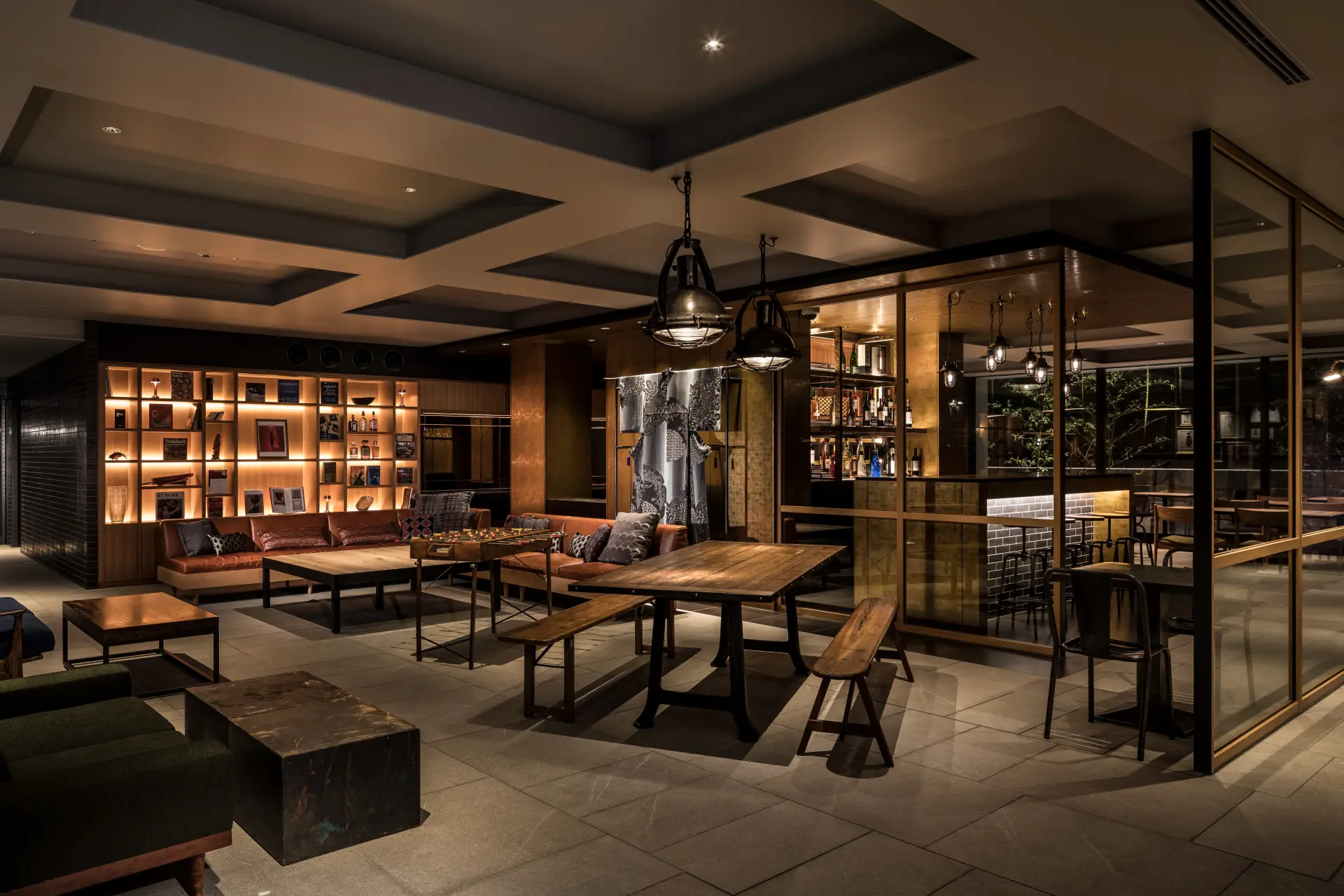
1. Kyoto Granbell Hotel
A designer hotel located a 2-minute walk from Keihan “Gion-Shijo” Station.
Situated right in the heart of Gion, an area filled with the ambiance of Kyoto culture, it’s a place where you can stay while feeling Kyoto’s unique atmosphere.
Another reason for its popularity is that, unlike many hotels in central Kyoto, it has a large communal bath.
2. Kiyomizu Koji Saka no Hotel Kyoto
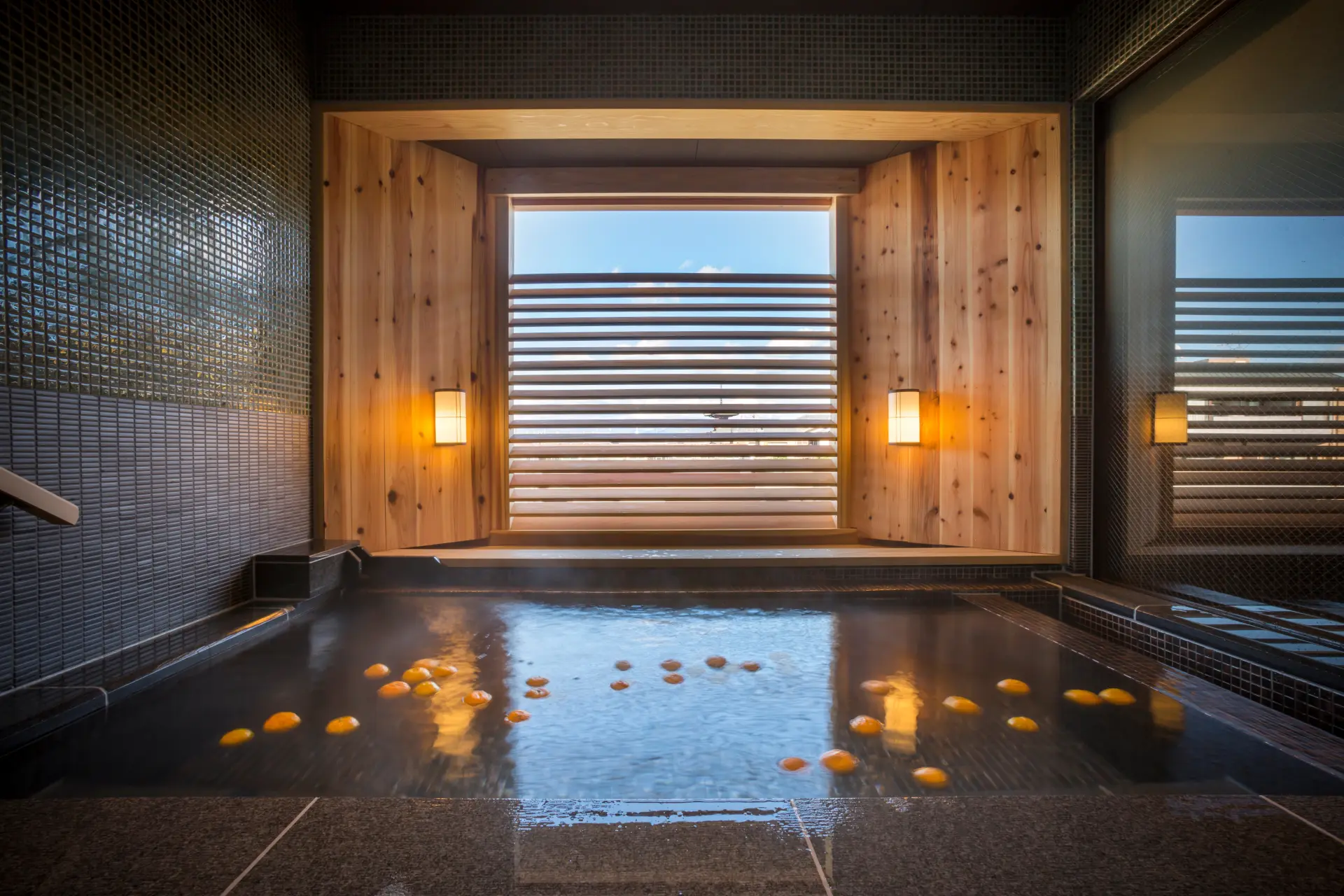
A Japanese-style hotel with 38 rooms, located along the approach to Kiyomizu-dera Temple in Kyoto’s Higashiyama area.
Surrounded by five slopes, it offers a relaxing time while you soak up the charm of Higashiyama.
It’s a 5-minute walk to Kiyomizu-dera Temple, and another nice point is being able to visit the temple early in the morning, wrapped in a quiet calm.
3. Hotel Wing International Premium Kyoto Sanjo
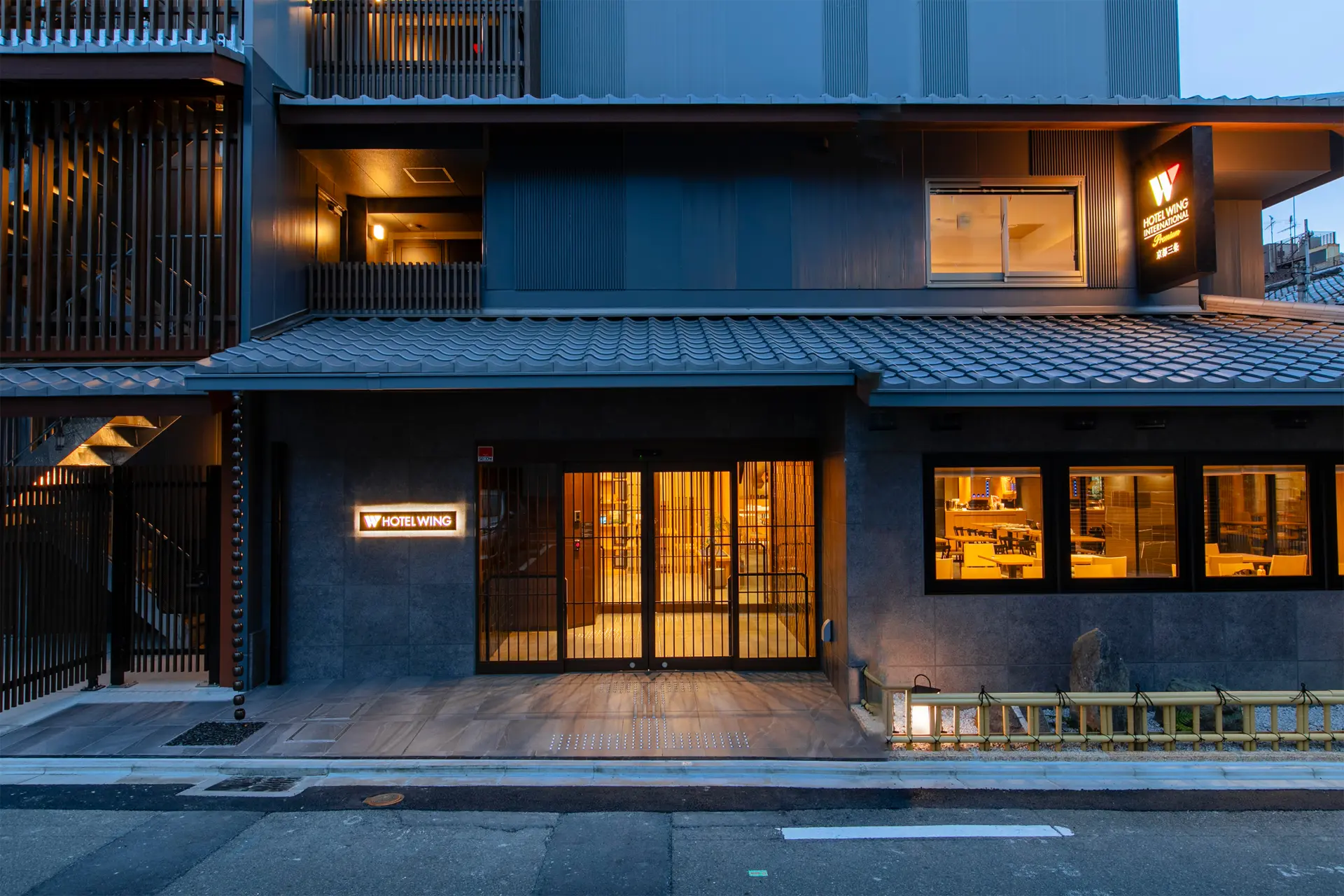
A hotel in a convenient location for sightseeing in Kyoto, a 3-minute walk from the subway “Sanjo Keihan” Station.
With Gion and Pontocho nearby—areas that capture Kyoto’s charm—as well as Kawaramachi, known for shopping spots and many restaurants, it’s an ideal base for efficiently getting around Kyoto City.
All 88 rooms have separate bath and toilet areas, and you can choose from a wide range of room types, from spacious Premium King rooms to compact Standard Twin rooms.
Reviews
4.56
Some reviews are AI-translated.
-
The buildings inside the shrine are really well preserved. The main hall's gorgeous decorations and intricate carvings show off the artistic beauty of traditional Japanese architecture.
-
Kiyomizu-dera, Chion-in, Maruyama Park, and Hanamikoji are all in the same area, so you can visit them all in one go.
FAQ about Yasaka Shrine
Q
Which deities are enshrined at Yasaka Shrine?
A
The three main deities are Susanoo-no-Mikoto, Kushinadahime-no-Mikoto, and Okuninushi-no-Kami.
Q
What blessings can you receive at Yasaka Shrine?
A
Warding off evil, matchmaking, success in studies, abundant harvests, household safety, prosperity in business, and prayers for beauty.
Q
How long does it take to visit Yasaka Shrine?
A
If you take your time walking around, it takes 2–3 hours.
Summary
With a National Treasure, many Important Cultural Properties, and a variety of smaller shrines within the grounds, “Yasaka Shrine” is a venerable place rich in history and tradition.
If you visit using this article as a reference, you’ll not only enjoy the main highlights, but also receive its blessings without missing a thing.
If the timing works out, we hope you’ll also join the “Gion Festival,” which represents Kyoto’s summer.
Head to “Yasaka Shrine,” a place that welcomes visitors year-round, to learn about Japan’s culture and history.
Beyond “Yasaka Shrine,” Kyoto has many other sightseeing spots where history and tradition live on.
If you’re planning to travel in Kyoto, please also use this article as a reference, which summarizes Kyoto’s classic sightseeing spots.