
![[Sanuki Manno Park Visitor Guide] Fill Your Sense of Fun with Shikoku’s Nature and Culture](https://static.gltjp.com/glt/data/article/21000/20605/20240129_103835_a344628e_w1920.webp)
[Sanuki Manno Park Visitor Guide] Fill Your Sense of Fun with Shikoku’s Nature and Culture
Sanuki Manno Park is the only national park in Shikoku, blessed with rich nature and colored by seasonal flowers such as nemophila and hydrangeas.
Set across a vast space filled with a variety of leisure attractions, it is one of Kagawa Prefecture’s recommended sightseeing spots.
This article focuses on specific highlights and ways to enjoy the park so even first-time visitors can make the most of Sanuki Manno Park.
Its charm is sure to impress you and make you want to visit at least once, so be sure to read to the end.
What Is Sanuki Manno Park Like?
Located in Nakatado District, Kagawa Prefecture, Sanuki Manno Park is the only national park in Shikoku.
It covers a vast 350 hectares and stretches along the shore of Manno Pond, a designated Place of Scenic Beauty.
One of the park’s biggest draws is that you can enjoy interacting with nature and culture all day without getting bored, making it perfect for outdoor fun.
The grounds are colored by seasonal flowers and trees, and are packed with attractions including large playground equipment popular with children, one of Japan’s largest lawn plazas, and an auto camping ground.
At the Nature Ecology Garden, which preserves the satoyama environment, you can observe scenery from around 1955 to 1964 and the unique plants and animals found there.
With a variety of events and hands-on workshops held throughout the year, it is also a great place to make memories with family and friends.

Access to Sanuki Manno Park
Here is how to get to Sanuki Manno Park starting from Takamatsu Station, a key transportation hub for sightseeing in Kagawa.
Only during the illumination event period, shuttle buses run from JR Kotohira Station and Kotoden Kotohira Station.
If you plan to visit Sanuki Manno Park to see the illumination, consider taking the shuttle bus as well.
- Route
-
1. Take the limited express on the JR Yosan Line from JR Takamatsu Station
2. Transfer at Tadotsu Station to the JR Yosan Line bound for Kotohira, and get off at JR Kotohira Station
3. Take the Kotosan Bus at the Kotohira Ekimae bus stop, and arrive at Manno Park-guchi in Approx. 15 minutes - Travel Time
- Approx. 1 hour 15 minutes
Sanuki Manno Park Hours and Admission
Please refer to the table below for Sanuki Manno Park’s hours and admission fees.
- Hours
-
・March 1–July 19 9:30am–5:00pm
・July 20–August 31 9:30am–6:00pm
・September 1–October 31 9:30am–5:00pm
・November 1–the last day of February 9:30am–4:30pm - Admission
-
・Adults (ages 15 and over): ¥450
・Seniors (ages 65 and over): ¥210
・Children (junior high school age and younger): Free
The Seasonal Appeal of Sanuki Manno Park
With a different face in every season, Sanuki Manno Park is sure to impress no matter when you visit during the year.
In particular, the beautiful seasonal flower displays are sure to soothe your heart.
So, let’s take a closer look at the seasonal highlights and attractions.
Use the information below to help decide the best time for your visit to Sanuki Manno Park.
Please note that blooming times vary each year depending on weather conditions, so be sure to check the official website as well.
Spring at Sanuki Manno Park: Spectacular scenery filled with colorful flowers
Spring at Sanuki Manno Park is especially recommended for flower lovers.
The season begins with cherry blossoms (11 varieties, 400 trees) and daffodils (70 varieties, 200,000 flowers) reaching their best viewing time in mid-March, followed one after another by tulips (32 varieties, 40,000 flowers).
Like a flower relay, you can enjoy Approx. eight kinds of flowers and the differences in shape and color among each variety.
The beautifully designed tulip flower beds are so stunning they recall the flower fields of the Netherlands.
You should also enjoy the scenery of 550,000 nemophila, which can be seen from early to late April.
The sight of a blue carpet stretching as far as the eye can see is exceptionally beautiful.
It is the perfect setting for a stroll along the paths while enjoying the pleasant warmth of spring.

Come see flowers that capture the unique charm of summer! Summer at Sanuki Manno Park
The highlights of summer at Sanuki Manno Park can be divided into two main attractions.
First are the hydrangeas, which reach their best viewing time from early to late June.
At the Hydrangea Garden, Approx. 20,000 colorful hydrangeas of 40 varieties bloom in full glory, and the rain of the rainy season adds the perfect touch.
It is recommended to walk around the area carrying a traditional Japanese umbrella, available to rent for free.
Then, from late July to early August, Approx. 8,000 sunflowers put on a powerful display that seems unfazed by the summer heat and will leave you feeling energized.
Be sure to also notice the scenery of round, charming kochia coloring the park in green.
Approx. 6,000 kochia plants, grown to around 90 cm, are lined up at even intervals, and when they sway in the wind, they look like living animals and create a soothing scene.
The light-up, held at night in mid-August, is also a must-see, creating a dreamlike space softly illuminated by light.

Autumn at Sanuki Manno Park, where you can feel the changing of the seasons
When it comes to symbols of autumn, cosmos flowers come to mind.
At Sanuki Manno Park, there are Approx. 280,000 cosmos flowers of six varieties, including chocolate cosmos and yellow cosmos, where you can enjoy differences in color, white, red, and yellow, as well as their fragrance.
Because each variety blooms at a different time, the flowers and trees gradually begin to color the park in autumn shades.
Being able to witness the changing of the seasons firsthand is one of the park’s highlights as well.
The kochia mentioned above also change during this season, shifting from green to red with gradations in between, and finally turning a wheat-like color.
In addition, from mid-September to late October, the Autumn! Colorful Festa is held, bringing the park to life with a wide variety of events, including gourmet food, music, and sports. It is also nice that the contents are planned differently each year.

Shikoku’s largest illumination is held here! Winter at Sanuki Manno Park
Sanuki Manno Park is also famous as an illumination spot, and during the season when the large-scale Winter Fantasy event is held, visitors gather from all over Japan.
From late November, when park hours are extended, through the New Year holiday event period, the grounds are filled with a variety of displays, and the nighttime scenery, so different from the daytime, is sure to surprise you.
At the entrance, a 10-meter-tall symbolic tree appears, and the lawn area is wrapped in an elegant world of light created by Approx. 650,000 LED bulbs.
The Tunnel of Light and the illumination reflected on the surface of the decorated Shoryu Waterfall are also deeply atmospheric.
Because the concept changes every time, one of the event’s features is being able to enjoy the differences from year to year.
After the illumination ends and late January arrives, winter flowers such as Christmas roses and plum blossoms once again brighten the park as it waits for spring.

5 Ways to Enjoy the Diverse Attractions of Sanuki Manno Park
The phrase “treasure trove of play areas” suits Sanuki Manno Park perfectly, as attractive facilities can be found all around the grounds.
Surrounded by nature as far as the eye can see, the park offers endless highlights, from relaxing in beautiful scenery and getting active in open spaces to joining hands-on events.
Among them, here are five carefully selected must-see points.
One day may not be enough to enjoy it all at a leisurely pace.
1. Stroll through beautiful grounds where nature and man-made features are in harmony
One reason for Sanuki Manno Park’s popularity is that, despite its vast grounds, it is thoroughly maintained and lets visitors enjoy a wide variety of beautiful scenery in comfort.
The balance between nature and man-made design is exquisite, so simply strolling through the park can be enjoyable enough on its own.
At the entrance, Dora-mu, a flower-shaped object that is both the symbol of Manno Town and the park’s mascot character, welcomes visitors.
Pass through Vista of Green and Stone, lined with stone walls on both sides, and when you move from the entrance toward the plaza, it feels like the beginning of a world where nature spreads out before you.
By the way, don’t miss the clever design of Vista of Green and Stone: the farther you go, the narrower the path becomes, creating a fascinating sense of depth.
As you continue, you will likely be overwhelmed by the power of the artificial Shoryu Waterfall, with a drop of Approx. 9 meters and dramatic splashes of water.
These are only a small glimpse of what the park offers, and there are many more scenic spots besides.
Please come and experience this wonderful space for yourself, as photos alone cannot fully capture it.


2. Enjoy the vast natural scenery
Sanuki Manno Park is characterized not only by its seasonal flowers and trees, but also by its rich natural scenery.
Hiryu Pond, where you can view Shoryu Waterfall across the water, creates an outstanding atmosphere with fresh greenery reflected on the pond and a sense of quiet all around.
Take your time and enjoy it from the wooden deck at the viewpoint, which seems to invite you to fully immerse yourself in nature.
It is especially recommended around May, when carp streamers swim above the pond and the red Rhododendron simsii add vibrant color.
Also not to be missed is Sanuki Forest, where learning and play coexist.
From the Miharashi no Yama Observatory, located at an elevation of 277 meters, you can enjoy wonderful views of Manno Pond and the Seto Inland Sea.
At Hagakure Pass, where trees spread all around, you can breathe in the fresh, pleasant air and relax.

3. Play on large playground equipment that excites children
Sanuki Manno Park has many large-scale playground structures that offer experiences you would not usually find in everyday life, and they quickly capture children’s hearts.
Among them, the Fuwafuwa Dome, for elementary school age and younger only, is especially popular, letting children bounce like on a trampoline and enjoy the mysterious feeling of walking on clouds.
Also recommended is the large dragon-shaped net jungle, where children can climb toward the top, run through tunnels, and develop their free imagination.
Also, don’t forget about the X Slider located in another area.
It is a slide where 65-meter and 50-meter rollers cross in the shape of an X, and the exhilarating thrill of descending an Approx. 14-meter drop will likely make you want to ride it again and again.
Only three attractions are introduced here, but the park is packed with many other appealing attractions as well, and it is known as a place families can enjoy together.


4. Experience a variety of Japanese culture
At Sanuki Manno Park, different hands-on events that make use of its rich natural setting are held every month.
Examples include a herb workshop where you make flower baskets and wreaths using plants harvested in the park, and a charcoal-making experience where you place thinned wood, timber cut during the forest growth process, into and out of the kiln.
There are also exchange events where local experts teach traditional games and bamboo crafts, and the udon-making workshop, where you knead dough from flour to make Kagawa’s local dish, udon, allows you to experience the region’s history and culture as well.
The wide variety of programs is another nice point, letting visitors enjoy the park in many different ways.
If you plan to join a hands-on event, be sure to check the official website in advance for what will be held on the day of your visit and whether an application is required.

5. Enjoy camping with excellent facilities
The park also includes the auto camping ground Hot! Stay Manno.
This camping ground has received the highest five-star rating from the Japan Auto Camping Federation and is highly regarded for its excellent services.
There are only 10 five-star facilities in all of Japan, and once you hear that it was the first in the Shikoku region to receive this certification, its impressive quality becomes clear.
With a variety of site types including car sites, free sites, and cabins, it can be enjoyed not only by experienced campers but also by beginners.
The facilities are also excellent, with hot-water sinks, washing areas, and toilets, as well as coin showers and even power outlets, so you should be able to fully enjoy camping without inconvenience.
At the nearby management center, you can rent camping essentials such as tents, sleeping bags, and lanterns, and also purchase firewood and seasonings, so even arriving empty-handed is no problem.

3 Sightseeing Spots Near Sanuki Manno Park
Lastly, here are three recommended sightseeing spots near Sanuki Manno Park.
Each has a long and deep history, allowing you to feel Japanese culture firsthand.
They offer spectacular views that rival those of Sanuki Manno Park itself, and each has its own distinct charm, so be sure to visit them as well.
1. Ritsurin Garden
Ritsurin Garden was completed nearly 300 years ago after successive lords of the Takamatsu Domain expanded and refined it as a villa for the Matsudaira family, the domain’s ruling clan.
The flat garden area alone is a very large 16 hectares, but including Mt. Shiun, which forms the backdrop, the total area reaches Approx. 75 hectares. Among cultural gardens designated as Special Places of Scenic Beauty by the nation, it is the largest in Japan.
It is a strolling garden made up of six ponds and 13 artificial hills, and as the phrase “one step, one view” suggests, you can enjoy different beautiful scenery with every step.

2. Kotohiragu Shrine
Built on Mt. Zozu, this is the head shrine of all Kotohira shrines and receives Approx. 4 million worshippers each year.
From the temple town to the main shrine, a long flight of stone steps continues, numbering 785 in total.
Climb them slowly, putting your thoughts and wishes into each step.
Along the way, it is also recommended to take a break at an art spot where you can view cultural properties and artworks owned by Kotohiragu Shrine, or at Cafe & Restaurant Kamitsubaki.

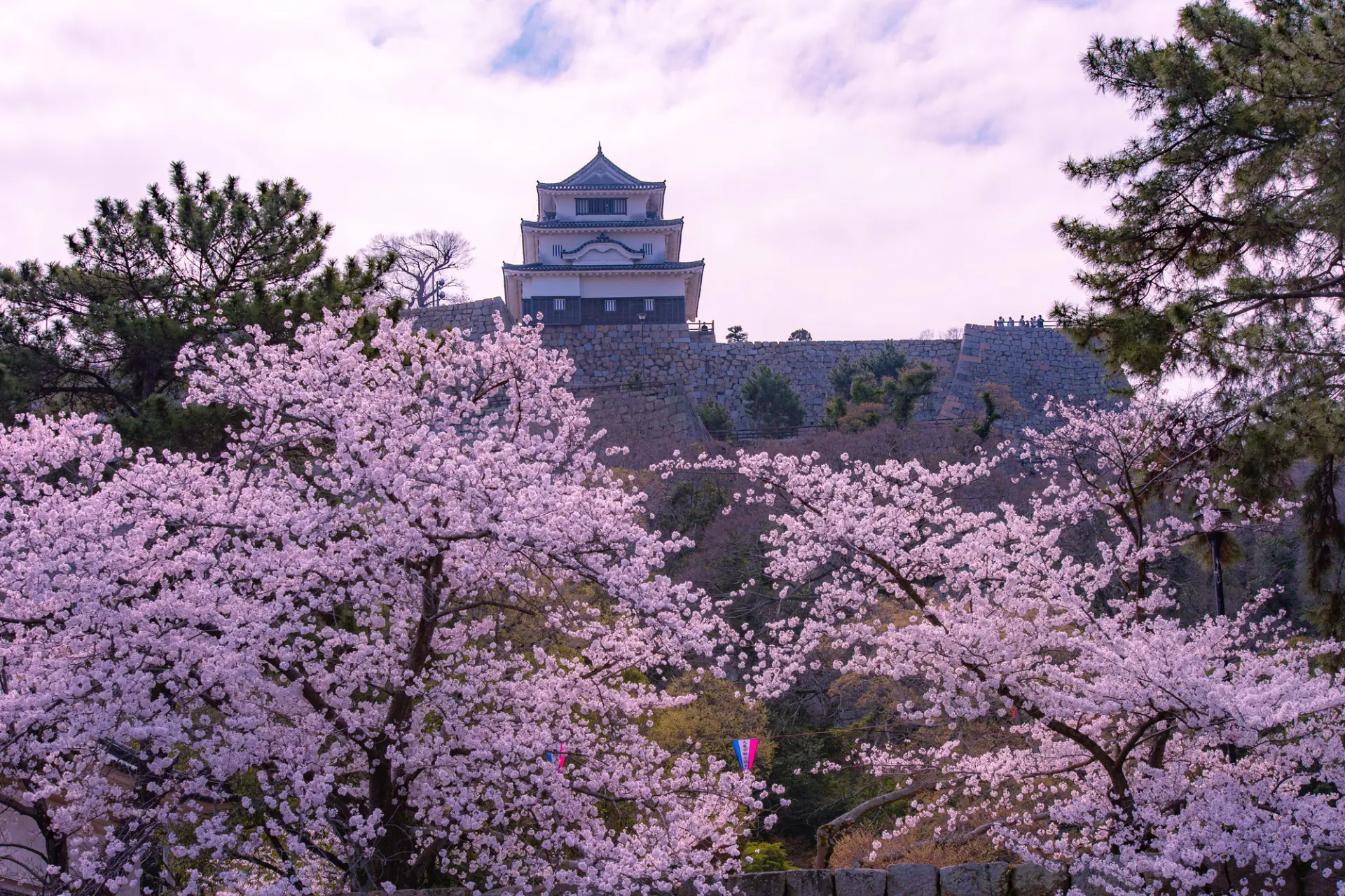
3. Marugame Castle
A symbolic presence in Marugame with a history of 400 years.
It is a hirayama-style castle built over five years by the warlord Ikoma Chikamasa together with his son Kazumasa.
The stone walls stacked from the inner moat to the castle keep boast Japan’s greatest height at Approx. 60 meters, and their distinctive curves have earned them the name “fan-shaped slope.”
Reviews
Some reviews are AI-translated.
-
The lawn is beautiful and really clean.
Perfect for a walk, just zoning out, or having a picnic.There are flowers in spring and autumn leaves in fall, so if you come in the right season, it’s a big plus.
But the park is huge, so make sure to wear comfortable walking shoes, or your feet will complain first 😂 -
This place is huge! There are different flowers to see every season—cherry blossoms and tulips in spring, and the autumn leaves are gorgeous too. The park is super clean and well-maintained, so it's really pleasant to walk around. There's a big lawn for picnics or flying kites. At night during the illumination season, it's so romantic—the whole park lights up like a fairy tale. Highly recommend for families, couples, or friends. You could easily spend the whole day here and never get bored!
-
It's not just about the flowers—there are huge lawns, forest trails, slides, and a camping area. It's awesome for families or couples. If you get tired, you can chill at the café in the park. Honestly, it's the perfect way to relax and recharge!


FAQ about Sanuki Manno Park
Q
How do I get from Sanuki Manno Park to Ritsurin Garden?
Take a taxi back to Kotohira Station, then board the Kotohira Line bound for Takamatsu-Chikko from Kotoden Kotohira Station and get off at Ritsurinkoen Station. It is Approx. a 10-minute walk from the station. (Travel time: Approx. 1 hour 30 minutes)
Q
How do I get from Sanuki Manno Park to Chichibugahama Beach?
Take a taxi back to Kotohira Station, then board the JR Dosan Line bound for Takamatsu from JR Kotohira Station and get off at Tadotsu Station. Transfer to the JR Yosan Line bound for Kanonji and get off at Takuma Station. From Takuma Station, take the Nio Line bus bound for Mitoyo General Hospital, get off at the Chichibugahama bus stop, and you will arrive. (Travel time: Approx. 1 hour 15 minutes)
Q
When is the illumination at Sanuki Manno Park held?
It is held from the fourth Saturday of November to early January.
Summary
We have introduced the highlights and ways to enjoy Sanuki Manno Park, where the natural scenery and flowers change beautifully with the seasons.
The park’s major appeal is its wide range of attractions, making it enjoyable no matter when you visit.
First of all, we recommend visiting Sanuki Manno Park at least once, but it is also worth coming back a second or third time in different seasons to enjoy the changes.
This article also rounds up classic recommended sightseeing spots and gourmet food in Kagawa to help you plan your trip, so be sure to check it out as well.