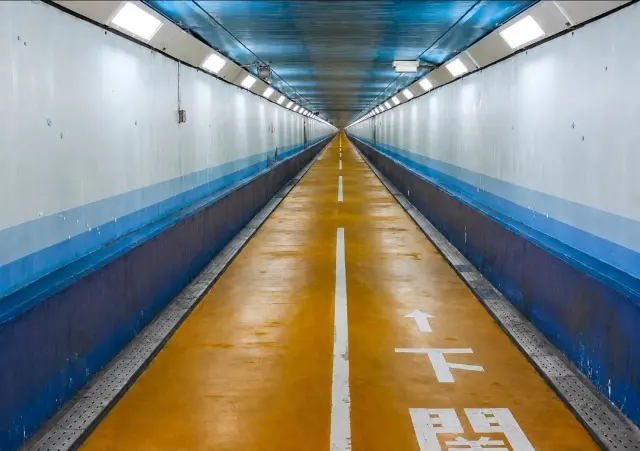
The Kanmon Straits Tunnel was more interesting than I expected!
I thought it would just be a walk through a tunnel, but I didn't expect to be able to walk from Honshu to Kyushu. It was a truly special experience. The route is a little over 700 meters long and takes about 15 minutes to complete. It's flat and easy to walk, like taking a stroll under the sea.
The one thing you shouldn't miss is the marker at the border between Yamaguchi and Fukuoka Prefectures. Standing in the middle with one foot in Honshu and the other in Kyushu, many people take photos here as a souvenir.
No boat or car needed—just a short walk lets you cross between two islands and two prefectures. I highly recommend experiencing this unique Kanmon Straits walk for yourself and making a different kind of travel memory.
Kanmon Straits | Review by 王小鈞
Other Reviews by 王小鈞
-
JR Mojiko Station
JR Mojiko Station, facing the Kanmon Straits in Moji, is the starting point of the JR Kagoshima Main Line. The wooden two-story station building, designed in a Neo-Renaissance style, is characterized by a symmetrical exterior said to represent a "gate," and it has been beloved as a landmark of Moji Port for many years.
Mojiko Station was one of my favorite stations on this trip to Kyushu.
The entire wooden building has a retro feel, and stepping inside is like going back a hundred years. What stands out most is its symmetrical design, which is said to be based on the concept of a “gate.” It’s simple but distinctive.
Even though it’s just a station, I couldn’t help stopping to take more photos and look around every corner. Together with the nostalgic streets of Mojiko Port, it really has the atmosphere of an old Japanese port town.
If, like me, you enjoy old buildings and traveling at a leisurely pace, Mojiko Station is sure to leave a lasting impression. -
-
Former Moji Mitsui Club
Built in 1921, it served as a social club for Mitsui Bussan. The building showcases the half-timbered style, a traditional European wooden architectural technique, where the wooden structure, like beams and pillars, are exposed on the exterior. This design, combined with the dark brown wooden elements emphasizing its vertical and horizontal lines against the contrast of the white window frames, characterizes its distinctive appearance.
While strolling around Mojiko, I was unexpectedly drawn to this century-old Western-style building. The Former Moji Mitsui Club was built in 1921, and the entire building has a European feel. The dark wood paired with white window frames gives it an elegant look, and it looks great in every photo. It used to be a place where Mitsui Bussan entertained guests, and even Einstein stayed here when he visited Japan!
What I like most is that this old building doesn't feel overly commercial and just stands quietly on a street corner. Taking your time to walk around and look at it, it has more character than you'd expect. When you visit Mojiko, don't just focus on taking pictures of the harbor—this building is also worth stopping by. -
-
Mifuneyama Rakuen
Mifuneyama is the symbol of Takeo Town. With its cliff in the background, Nabeshima Domain’s 28th Takeo lord, Nabeshima Shigeyoshi spent three years building a garden. This garden with a path encircling a big pond was completed in 1845. It can contain 10 Tokyo domes, boasting a vast 123-acre ground.
Mifuneyama Rakuen is really so large that it feels like a forest park. It's very pleasant to take a leisurely stroll along the flower-viewing paths, surrounded by greenery the whole way. It feels very relaxing.
The timing of this visit was a little unfortunate, since it was neither cherry blossom season nor fall foliage season, so it was a little less impressive. Still, it was well worth it just to enjoy the garden scenery and take a leisurely walk. If I can come again when the cherry blossoms are in full bloom in spring or when the mountain is covered in red leaves in fall, I'm sure it will be so beautiful that I won't want to leave. -