

Japanese National Holidays and Long Vacations to Know to Avoid Crowds
If you're visiting Japan for sightseeing, you probably want to travel comfortably and make the most of your trip.
However, not many people know the details of Japan's high and low travel seasons.
In this article, we'll introduce Japanese national holidays and long vacation seasons when tourist spots tend to get crowded.
We'll also share recommended times when there are fewer travelers.
If you're unsure when to visit Japan or want to plan a trip while keeping costs and crowds as low as possible, be sure to read to the end.
2026 Holiday Calendar
First, here is the 2026 holiday calendar.
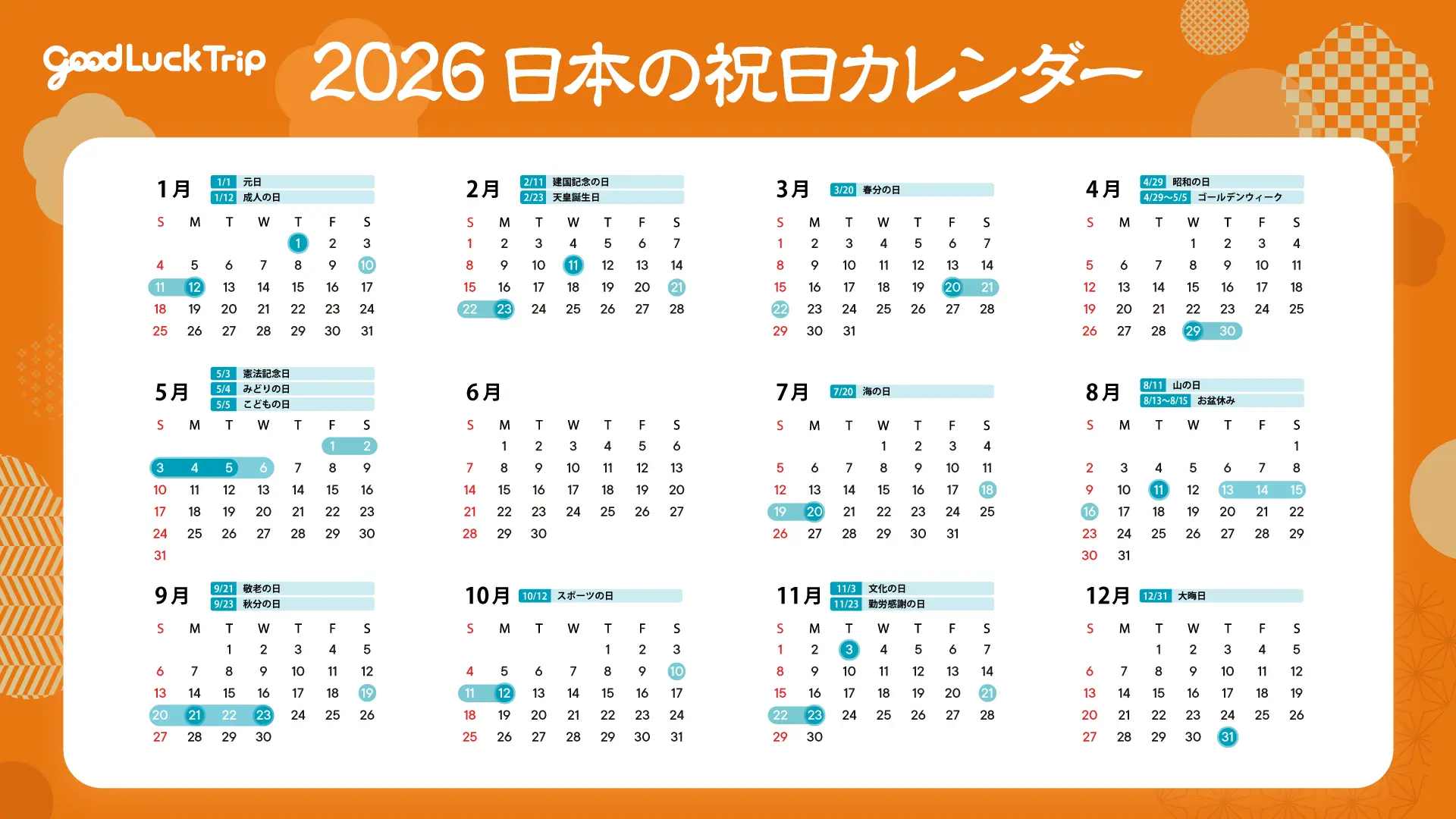
Japan's 16 National Holidays Each Year
Under Japan's Public Holiday Law, 16 "national holidays" are designated each year.
National holidays are defined as days for the people to celebrate, appreciate, and commemorate together, and they are made holidays so people can spend a day away from their usual routine.
For the specific dates, please refer to the table below.
- New Year's Day
- January 1
- Coming of Age Day
- Second Monday of January
- National Foundation Day
- February 11
- Emperor's Birthday
-
February 23
※If the emperor changes, the date also changes - Vernal Equinox Day
-
March 20
※The vernal equinox day (the day the vernal equinox occurs based on astronomical observation, usually March 20 or March 21) - Showa Day
- April 29
- Constitution Memorial Day
- May 3
- Greenery Day
- May 4
- Children's Day
- May 5
- Marine Day
- Third Monday of July
- Mountain Day
- August 11
- Respect for the Aged Day
- Third Monday of September
- Autumnal Equinox Day
-
September 22
※The autumnal equinox day (the day the autumnal equinox occurs based on astronomical observation, usually September 22 or September 23) - Sports Day
- Second Monday of October
- Culture Day
- November 3
- Labor Thanksgiving Day
- November 23
National holidays fall into the following three types.
- The date is fixed regardless of the year
- Set on a Monday every year to create a long weekend
- No fixed month or day, selected based on astronomical observation
If a national holiday falls on a Sunday, a substitute holiday is set on the nearest weekday, usually Monday.
Looking at the 2024 calendar, February 12, May 6, August 12, September 23, and November 4 are substitute holidays.
If a holiday falls on a Saturday, no substitute holiday is given, so the actual number of holidays each year can increase or decrease.
Next, we'll also look at why each holiday became a holiday and what it means.

New Year's Day (January 1), Celebrating the Start of a New Year
"New Year's Day" is a day for the people to celebrate and give thanks for the beginning of a new year.
In the past, it was called "Shihosetsu" and has long been a special day with a history of various celebrations and rituals.
When the Public Holiday Law was enacted, it received overwhelming public support of 99.9% and was included from the beginning in 1948.
There is also the term "Gantan," which refers to the beginning of the year, but this specifically means the morning of January 1.

Coming of Age Day (Second Monday of January), Celebrating Young People Becoming Adults
The purpose of "Coming of Age Day" is to "congratulate and encourage young people who have become adults and are trying to live independently."
Behind its creation was the strong hope of those involved in postwar Japan for children and young people who would lead the next era.
It also reflects the wish that young people will become independent as members of society and recognize their responsibility to contribute to the nation, society, and humanity.
When first established, it was January 15, but it was changed to the second Monday of January in 2000 following a revision to the Public Holiday Law.

National Foundation Day (February 11), Looking Back on the Origins of Japan
"National Foundation Day" was established to commemorate the founding of Japan and foster love for the country.
February 11 comes from "Kigensetsu," the accession day of Emperor Jimmu, who is described as Japan's first emperor in the Nihon Shoki and Kojiki, Japan's oldest historical texts.
Although it was once abolished after the war at the direction of the GHQ, it was later restored as a national holiday after deliberation in the Diet.
It also carries the wish that each citizen will reflect on the origins of Japan, give thanks to their predecessors, and hope for the nation's future development.
Like Independence Day in the United States or National Day in China, it is an important day for Japanese people.

Emperor's Birthday (February 23), Celebrating the Emperor's Birthday
The purpose of "Emperor's Birthday" is simply to celebrate the emperor's birthday, and the holiday changes when the emperor changes.
Its history is very old, dating back as far as 775, when the birthday of Emperor Konin was celebrated.
Until 1948, it was a holiday called "Tenchosetsu," derived from the phrase "tencho chikyu," meaning that just as heaven and earth are eternal, things, or the emperor's reign, continue forever.
It remained a holiday when the Public Holiday Law was enacted, and originally fell on April 29, the birthday of Emperor Showa.
By the way, the current February 23 marks the birthday of the 126th emperor, Emperor Naruhito.

Vernal Equinox Day (March 20), Marking a Seasonal Turning Point
The purpose of "Vernal Equinox Day" is to "admire nature and cherish living things."
It is one of the holidays without a fixed date, and the target is the astronomical vernal equinox day, usually March 20 or March 21.
At the time it was established, it was regarded as the day when day and night are almost equal in length, and it has long been valued as a seasonal turning point, though the timing is now slightly different.
It also falls in the middle of the spring equinoctial week, so the holiday was created with meanings that include respect for the blessings of nature as well as remembrance and gratitude for ancestors.

Showa Day (April 29), Reflecting on the Showa Era and Thinking About the Future
The purpose of "Showa Day" is to "look back on the Showa era, which achieved recovery after turbulent days, and think about the future of the country."
The Showa era, which lasted for Approx. 62 years from 1926 to 1989, experienced unprecedented upheaval, including war and recovery, and overcame great hardships.
It was an important period that laid the foundation for modern Japan, and it became a holiday in honor of the efforts and achievements of the people who built peace and prosperity.
It also carries the meaning of looking back on Showa, not forgetting the lessons of history, and learning guidance for the future.
Until 1988, April 29 was the "Emperor's Birthday," but after Emperor Showa passed away it was renamed "Greenery Day," and Showa Day was newly established in 2007.


Constitution Memorial Day (May 3), Reaffirming the Value of the Constitution and Celebrating Its Enforcement
The purpose of "Constitution Memorial Day" is to "commemorate the enforcement of the Constitution of Japan and hope for the nation's growth."
The Constitution of Japan, which reflected the lessons of World War II, was established on the basic principles of popular sovereignty, respect for fundamental human rights, and pacifism.
This holiday provides an opportunity to reaffirm these contents and values and encourages reflection and celebration by the people.
It was considered beyond question as a holiday and was designated from the beginning when the Public Holiday Law was enacted.
However, the date itself was decided after various discussions.

Greenery Day (May 4), Giving Thanks for Nature's Blessings
The purpose of "Greenery Day" is to "be close to nature, give thanks for its blessings, and nurture a rich spirit."
When the Emperor's Birthday changed following the death of Emperor Showa, April 29 became a new national holiday called "Greenery Day" in 1989.
The name comes from combining affection and respect for Emperor Showa, who loved nature and had deep knowledge of plants, with gratitude for nearby nature and forests.
Another reason it remained a holiday was concern over the effect on people's lives if the Emperor's Birthday moved and shortened Golden Week.
When "Showa Day" was established in 2007, Greenery Day was moved to May 4 that same year.

Children's Day (May 5), a Holiday Unique to Japan
The purpose of "Children's Day" is to "respect children's personalities, promote their happiness, and express gratitude to mothers."
Like Coming of Age Day, it also reflects high hopes for the people who will lead the next generation.
It is a holiday unique to Japan and is notable for having no real equivalent elsewhere in the world.
In Japan, "Hinamatsuri" on March 3 celebrates the growth of girls, while "Tango no Sekku" on May 5 celebrates the growth of boys, and both are well-known customs related to children.
There was also a proposal to combine the two on May 3, but because that overlaps with Constitution Memorial Day, May 5 was chosen instead, also because it falls in a pleasant season.

Marine Day (Third Monday of July), a Holiday Giving Thanks for the Blessings of the Sea
The purpose of "Marine Day" is to "give thanks for the blessings of the sea and hope for the prosperity of Japan as a maritime nation."
Japan is surrounded by sea on all sides and has long depended on it in many aspects of life, including cultural exchange and transportation.
It would not be an exaggeration to say that modern Japan was built alongside the sea, and Japan is one of the countries that benefits greatly from the sea.
This holiday was established to help people recognize and appreciate the relationship between the sea and the Japanese people and to foster a spirit of caring for the sea.
When first established, it fell on July 20 and had long been recognized as "Marine Memorial Day," but it was changed to the third Monday of July in 2003 following a revision to the Public Holiday Law.

Mountain Day (August 11), a Holiday Giving Thanks for the Blessings of the Mountains
The purpose of "Mountain Day" is to "create opportunities to become familiar with mountains and give thanks for their blessings."
Approx. 70% of Japan's land is mountainous, and Japanese people receive many benefits from the mountains in daily life.
Because facing the mountains, the source of nature, and seeking coexistence with them is highly meaningful, the holiday was established as a day to become familiar with mountains and think about them.
Another background factor was that after "Marine Day" became a holiday in 1995, many voices from mountain-related groups and local governments called for a holiday related to mountains as well.
Against this backdrop, discussions advanced and the bill was passed and enacted by the Diet.
It is the newest of Japan's current 16 national holidays, established in 2014 and first observed in 2016.

Respect for the Aged Day (Third Monday of September), Showing Respect to Older People Who Have Contributed to Society
The purpose of "Respect for the Aged Day" is to "respect elderly people who have contributed to society over many years and celebrate their longevity."
It was established to express gratitude to older people who have contributed to society over a long period and to wish for their peace of mind in later life.
Its origins lie in a gathering called "Keirokai" held in Hyogo Prefecture in 1947 to express gratitude and respect to parents who had sent their children off to war during the difficult postwar years.
At first it began on September 15 under the name "Toshiyori no Hi," and as events spread nationwide, it officially became a national holiday in 1966.
For that reason, it was September 15 until 2002, but it changed to the third Monday of September in 2003 following a revision to the Public Holiday Law.

Autumnal Equinox Day (September 22), Remembering Ancestors and Those Who Have Passed Away
The purpose of "Autumnal Equinox Day" is to "respect ancestors and remember those who have passed away."
One of its characteristics is that it has no fixed date and instead falls on the astronomical autumnal equinox day, usually September 22 or September 23.
On this day, the sun is positioned above the equator, and because it marks a seasonal turning point when day and night are almost equal in length, it was established as the counterpart to the previously mentioned "Vernal Equinox Day."
It is also a day to feel the changing of the seasons and give thanks for the harvest.

Sports Day (Second Monday of October), Established to Commemorate the Tokyo Olympics
The purpose of "Sports Day" is to "enjoy sports, foster a spirit of respect for others, and wish for the realization of a healthy and energetic society."
It was established in 1964 to commemorate the Tokyo Olympics.
Originally called "Health and Sports Day," it was set on October 10, the date of the Tokyo Olympics opening ceremony, from 1966 to 1999.
It was changed to the second Monday of October in 2000 following a revision to the Public Holiday Law, and renamed to its current title in 2020.
This change reflects the hope that people will develop healthy minds and bodies through the spirit of sports and help create a comfortable society to live in.
Another notable point is that it is Japan's first national holiday name written in katakana based on an English word.

Culture Day (November 3), a Holiday That Encourages Engagement with Culture
The purpose of "Culture Day" is to "love freedom and peace, and promote culture."
Originally, November 3 was the birthday of Emperor Meiji and was a holiday called "Meijisetsu."
This date was also the day the Constitution of Japan was promulgated in 1946, and Japan declared the renunciation of war in the constitution.
Because of its internationally significant cultural meaning and its association with promoting peace and culture, it was named "Culture Day."

Labor Thanksgiving Day (November 23), a Holiday Giving Thanks for All Forms of Work
The purpose of "Labor Thanksgiving Day" is to "value labor, celebrate production, and give thanks to one another as citizens."
Before the Public Holiday Law was enacted, there was a holiday called "Niinamesai," a ritual in which crops harvested safely that year were offered to the gods in thanks and prayers were made for a good harvest the following year.
While preserving this long-standing custom, the holiday was newly established under a different name when the Public Holiday Law was enacted so that it would become a day to appreciate not only a good harvest but all kinds of labor.
Today, it is positioned as a day to express gratitude and respect to people in all professions.

"Citizens' Day," Which Varies by Prefecture in Name and Date
Separate from national holidays, some prefectures and metropolitan areas, such as Tokyo, Osaka, Hokkaido, and Kagoshima, also have commemorative days established by the local government.
These are often based on the date the prefecture was established, but not always.
As a result, the dates vary, and many prefectures do not have such a commemorative day at all.
The names also differ by prefecture, but they are generally referred to as "Citizens' Day."
In some prefectures, schools are closed on Citizens' Day, so tourist spots, restaurants, and other places may be busier than on a normal weekday.
Please refer to the table below for each prefecture's Citizens' Day.
| Prefecture | Name | Date |
|---|---|---|
| Hokkaido | Hokkaido Everyone's Day | July 17 |
| Akita Prefecture | Prefectural Memorial Day | August 29 |
| Fukushima Prefecture | Fukushima Citizens' Day | August 21 |
| Ibaraki Prefecture | Citizens' Day | November 13 |
| Tochigi Prefecture | Citizens' Day | June 15 |
| Gunma Prefecture | Gunma Citizens' Day | October 28 |
| Saitama Prefecture | Citizens' Day | November 14 |
| Chiba Prefecture | Citizens' Day | June 15 |
| Tokyo | Tokyo Citizens' Day | October 1 |
| Yamanashi Prefecture | Citizens' Day | November 20 |
| Shizuoka Prefecture | Citizens' Day | August 21 |
| Aichi Prefecture | Aichi Citizens' Day | November 27 |
| Toyama Prefecture | Hometown Day for Citizens | May 9 |
| Fukui Prefecture | Hometown Day | February 7 |
| Wakayama Prefecture | Hometown Birthday | November 22 |
| Mie Prefecture | Citizens' Day | April 18 |
| Tottori Prefecture | Tottori Citizens' Day | September 12 |
| Ehime Prefecture | Prefectural Government Foundation Day | February 20 |
| Kagoshima Prefecture | Citizens' Day | July 14 |
Japan's Long Vacations, the High Season for Travel
From here, we'll introduce the long vacation seasons when tourist attractions and shopping malls get crowded.
Regardless of national holidays, some periods become long vacations for many people, and popular spots fill up with visitors.
These times are also lively thanks to seasonal events and limited-edition items, so if you're traveling to Japan during one of these periods, be prepared for large crowds and fully booked facilities.
Please also note that transportation tends to get crowded, and prices for Shinkansen tickets, flights, hotels, and more are often set at their highest.
If you are not visiting for a specific event and your schedule is flexible, it's best to avoid these long vacation seasons.
Spring Break, the Long Spring Vacation for Students
"Spring break" is, in principle, a vacation given only to students, and the number of days varies by region, category (public or private), and school.
In general, elementary, junior high, and high schools often have break from March 25 to April 5, Approx. 10 days, while universities often have break from late February to early April, Approx. 2 months.
In Japan, the year runs from April 1 to March 31 of the following year, so spring break serves as a preparation period for the new school and fiscal year.
As a result, tourist spots are crowded with many students during spring break.

Golden Week, Japan's Major Spring Holiday Period
"Golden Week" (commonly abbreviated as GW) refers to the period from late April to the first week of May when holidays continue, including the weekdays in between, and it is also called a major spring holiday period.
Of the holidays explained above, it includes Showa Day, Constitution Memorial Day, Greenery Day, and Children's Day, meaning this period alone accounts for one-quarter of Japan's yearly national holidays.
In addition to weekends and substitute holidays, if people take paid leave on the weekdays in between, some years, or some people, can have up to 10 consecutive days off. Some companies also treat May Day as a holiday.
There are several theories about the origin of the name, but the broadcasting industry term "golden time" is considered the most likely.
A film distribution company also named it "Golden Week" for promotional purposes, originally calling it "Golden Week" in the sense of "a wonderful week," and the term gradually became widely recognized by the public.

Summer Break, the Long Summer Vacation for Students
"Summer break" covers different periods for students and working adults.
In general, elementary, junior high, and high school students are given time off from late July to the end of August, Approx. 40 days, while university students usually have time off from late July to early September, Approx. 50 days.
However, as with spring break, the exact length varies by region and by school.
Japan's summers are known for intense heat, and many schools do not have air conditioning, which is one reason classes are difficult during this period and a long vacation is given.
The vacation is also intended to let students rest mentally and physically, develop independent lifestyles, and try activities they cannot usually experience at school.
Working adults, on the other hand, may receive any 3 to 5 days off between July and September, or the Obon holiday mentioned below. ※Depending on the company or profession, some may not receive this break or may take it at another time.

Obon Holiday, Rooted in Traditional Japanese Culture
Obon is a traditional Japanese cultural observance for honoring the spirits of ancestors, and the term comes from the Buddhist expression "Urabon-e."
Various customs and events take place, including welcoming and sending fires, spirit horse offerings, memorial offerings, and visits to family graves to express gratitude to ancestors.
The timing differs by region, but it mainly refers to August 13 to August 16, and vacations taken during this period are called the "Obon holiday."
For students, this falls during summer break, but companies are not required to give time off for Obon, so working adults do not necessarily get a holiday.
That said, many companies set it as summer leave or special leave, and many people also take time off to return to their hometowns.

Silver Week, Japan's Major Fall Holiday Period
"Silver Week" (commonly abbreviated as SW) refers to a major fall holiday period of at least 5 days created by combining weekends with Respect for the Aged Day and Autumnal Equinox Day in September.
The name was inspired by Golden Week in May, but it does not refer to a fixed period every year.
For example, in 2024 there are two separate three-day weekends, September 14–16 and September 21–23, so strictly speaking, that year does not qualify as Silver Week.
Because of the relationship between the autumnal equinox and the Public Holiday Law, it generally occurs in years when Autumnal Equinox Day falls on a Wednesday, and it first happened in 2009.

Year-End and New Year Holidays, When Both Students and Working Adults Have Extended Time Off
"Year-end and New Year holidays" refers to the period from the end of one year to the beginning of the next.
There is no strict definition, and the exact period varies depending on the situation and how the term is used.
Generally, "year-end" means from December 25 to December 31, and "New Year" means from January 1 to January 7.
During this time, students have winter break, and working adults may receive year-end and New Year holidays.
Government offices, banks, and many private companies, mainly from December 29 to January 3, except for some businesses, are often closed as well, making this one of the busiest times of the year for transportation and tourist spots.
In Japan, the year-end and New Year period, especially New Year's Eve and New Year's Day, is considered precious time to spend with family and relatives, which is why students are given time off.
Companies also often set year-end and New Year holidays as part of employee benefits to improve employee satisfaction.

Cherry Blossom and Fall Foliage Seasons That Get Crowded Aside from Holidays and Long Vacations
Beyond the holidays and long vacation periods explained above, there are also other busy seasons.
In Japan, where beautiful four seasons and seasonal changes are part of the appeal, there is a culture of enjoying flowers and trees when they reach their best viewing time.
Especially popular are cherry blossom viewing and the fall foliage season.
If you are planning a trip for these, be prepared for a certain level of crowding.
Let's take a closer look at these two seasons.
Cherry Blossom Viewing Season for Enjoying Beautiful Sakura
Because cherry blossom season varies by area, we have summarized it in the table below.
Blooming begins earliest in southern regions such as Okinawa, starting in late January, and the season arrives later as you go farther north.
The best viewing time changes from year to year, so if you are planning to see them, it is a good idea to check weather forecasts and other updates so you do not miss peak bloom.
Cherry blossom viewing is one of Japan's iconic spring traditions, with many ways to enjoy it, including food stalls lining approach paths, illuminated night blossoms, and cherry blossom festivals.
Particularly scenic sakura spots draw large numbers of people who want to see them, so crowds are inevitable.
Best Time to See Cherry Blossoms by Area
- Hokkaido
- Early May to mid-May
- Tohoku Region (Aomori, Akita, Iwate, Miyagi, Yamagata, Fukushima)
- Mid-April to early May
- Kanto Region (Ibaraki, Tochigi, Gunma, Saitama, Chiba, Tokyo, Kanagawa)
- Late March to early April
- Chubu Region (Yamanashi, Nagano, Gifu, Shizuoka, Aichi)
- Late March to early April
- Hokuriku Region (Niigata, Toyama, Ishikawa, Fukui)
- Early April to mid-April
- Kansai Region (Osaka, Kyoto, Hyogo, Shiga, Nara, Wakayama, Mie)
- Late March to early April
- Chugoku Region (Tottori, Shimane, Okayama, Hiroshima, Yamaguchi)
- Late March to early April
- Shikoku Region (Tokushima, Kagawa, Ehime, Kochi)
- Late March to early April
- Kyushu Region (Fukuoka, Saga, Nagasaki, Oita, Kumamoto, Miyazaki, Kagoshima)
- Late March to early April
- Okinawa
- Late January to early February

Fall Foliage Season, When Trees Turn Color Across Japan
Because fall foliage season also varies by area, we have summarized this in a table as well.
Unlike cherry blossom season, the best viewing time begins in Hokkaido, and it can be enjoyed from mid-September to early December.
Because timing may shift depending on temperature changes, be sure to check the latest information before visiting.
Autumn leaves are a classic symbol of fall and a beautiful natural phenomenon that shows Japan's changing seasons.
The sight of many varieties of maple and other trees turning color attracts large numbers of tourists, which naturally leads to crowds in many places.
Best Time to See Fall Foliage by Area
- Hokkaido
- Mid-September to late October
- Tohoku Region (Aomori, Akita, Iwate, Miyagi, Yamagata, Fukushima)
- Late September to mid-November
- Kanto Region (Ibaraki, Tochigi, Gunma, Saitama, Chiba, Tokyo, Kanagawa)
- Early October to early December
- Chubu Region (Yamanashi, Nagano, Gifu, Shizuoka, Aichi)
- Late September to early December
- Hokuriku Region (Niigata, Toyama, Ishikawa, Fukui)
- Mid-October to early December
- Kansai Region (Osaka, Kyoto, Hyogo, Shiga, Nara, Wakayama, Mie)
- Mid-October to early December
- Chugoku Region (Tottori, Shimane, Okayama, Hiroshima, Yamaguchi)
- Mid-October to late November
- Shikoku Region (Tokushima, Kagawa, Ehime, Kochi)
- Early October to late November
- Kyushu Region (Fukuoka, Saga, Nagasaki, Oita, Kumamoto, Miyazaki, Kagoshima)
- Late October to early December

When Is Japan's Off-Season for Travel?
Finally, let's look at the off-season, when tourist spots and shopping malls are relatively less crowded.
Simply put, these are the times outside the periods explained above.
To make that easier to understand, please refer to the table below.
These seasons are also recommended for budget-friendly travel, as airfare and travel packages tend to be cheaper.
Main Off-Seasons for Traveling in Japan
- After New Year's through early February
-
Many people travel from Christmas through the year-end and New Year holidays.
Once the New Year holidays are over, work and school begin again and Japan as a whole gets busy, so travel enters the off-season. - Early April to before Golden Week
-
In Japan, the new school and fiscal year starts in April, so many people focus on their new routines and do not travel much.
However, this is a pleasant season, and spots near cherry blossom viewing areas can still get crowded, so be careful. - Mid-May to late June
-
After Golden Week, the peak season for travel and sightseeing, ends, the rainy season begins, so the number of travelers decreases.
At present, June has no national holidays, and the fact that there are no three-day weekends or longer is another reason this is considered the off-season. - Late November to early December
-
Some areas are in the fall foliage season, but aside from that, fewer people travel for other purposes.
As the final month of the year approaches, working adults and students focus on work and school, so this period tends to be the off-season. (Prices rise and places gradually get more crowded as Christmas approaches.)
FAQ about Japanese National Holidays and Long Vacations
Q
How many national holidays are there in Japan each year?
There are 16 national holidays each year.
Q
When are long school vacations for students in Japan?
Spring break is from late March to early April for elementary, junior high, and high school students (Approx. 10 days), and from late February to early April for university students (Approx. 2 months). Summer break is from late July to early September (Approx. 40 to 50 days), and winter break is from late December to early January (Approx. 15 days).
Summary
This article has explained the times when tourist attractions and popular spots in Japan tend to get crowded, focusing on national holidays and long vacation seasons.
During the high season, not only are facilities crowded, but transportation and roads are also packed with people.
Hotels and various services are also priced higher, so if possible, traveling in the off-season is recommended.
This article provides a broad overview of Japan's appeal, including classic foods and sightseeing spots.
It is full of useful information for creating a travel plan and for first-time visitors to Japan, so be sure to check it out as well.