

The Essential Guide to Fall Foliage in Japan
Japan is renowned for having some of the most spectacular fall foliage among the few countries where it can be seen.
True to its reputation, Japan has so many places with colorful autumn scenery that deciding where to go can be difficult.
To help you choose, this guide introduces Japan’s Three Great Fall Foliage Destinations, as well as three carefully selected popular spots in each region.
What Makes Japan’s Fall Foliage Special
Many fall foliage destinations overseas are dominated by a single color, such as yellow or red. In Japan, however, red and yellow leaves often appear alongside green trees.
This rich variety of colors is one of the defining features of fall foliage in Japan. Another is the elegant scenery created by autumn leaves and historic structures such as temples and shrines. The opportunity to view the foliage in many different settings—from a hot spring bath or aboard a ropeway—is also part of the appeal.

Best Times to See Fall Foliage Around Japan
The best time to see fall foliage varies by region, so keep this in mind when planning your visit.
Refer to the table below for the typical viewing period in each region of Japan.
- Hokkaido
-
Late September to late October
(Throughout Hokkaido) - Tohoku
-
Late September to mid-November
(Aomori, Akita, Iwate, Miyagi, Yamagata, and Fukushima Prefectures) - Kanto
-
Early October to early December
(Ibaraki, Tochigi, Gunma, Saitama, Chiba, Tokyo, and Kanagawa Prefectures) - Chubu
-
Late September to early December
(Yamanashi, Nagano, Gifu, Shizuoka, and Aichi Prefectures) - Hokuriku
-
Mid-October to early December
(Niigata, Toyama, Ishikawa, and Fukui Prefectures) - Kansai
-
Mid-October to early December
(Osaka, Kyoto, Hyogo, Shiga, Nara, Wakayama, and Mie Prefectures) - Chugoku
-
Mid-October to late November
(Tottori, Shimane, Okayama, Hiroshima, and Yamaguchi Prefectures) - Shikoku
-
Early October to late November
(Tokushima, Kagawa, Ehime, and Kochi Prefectures) - Kyushu
-
Late October to early December
(Fukuoka, Saga, Nagasaki, Oita, Kumamoto, Miyazaki, and Kagoshima Prefectures)
The actual viewing period may be earlier or later than the typical dates shown in the table, depending on weather conditions and the specific location.
Best Viewing Times at Fall Foliage Destinations Around Japan
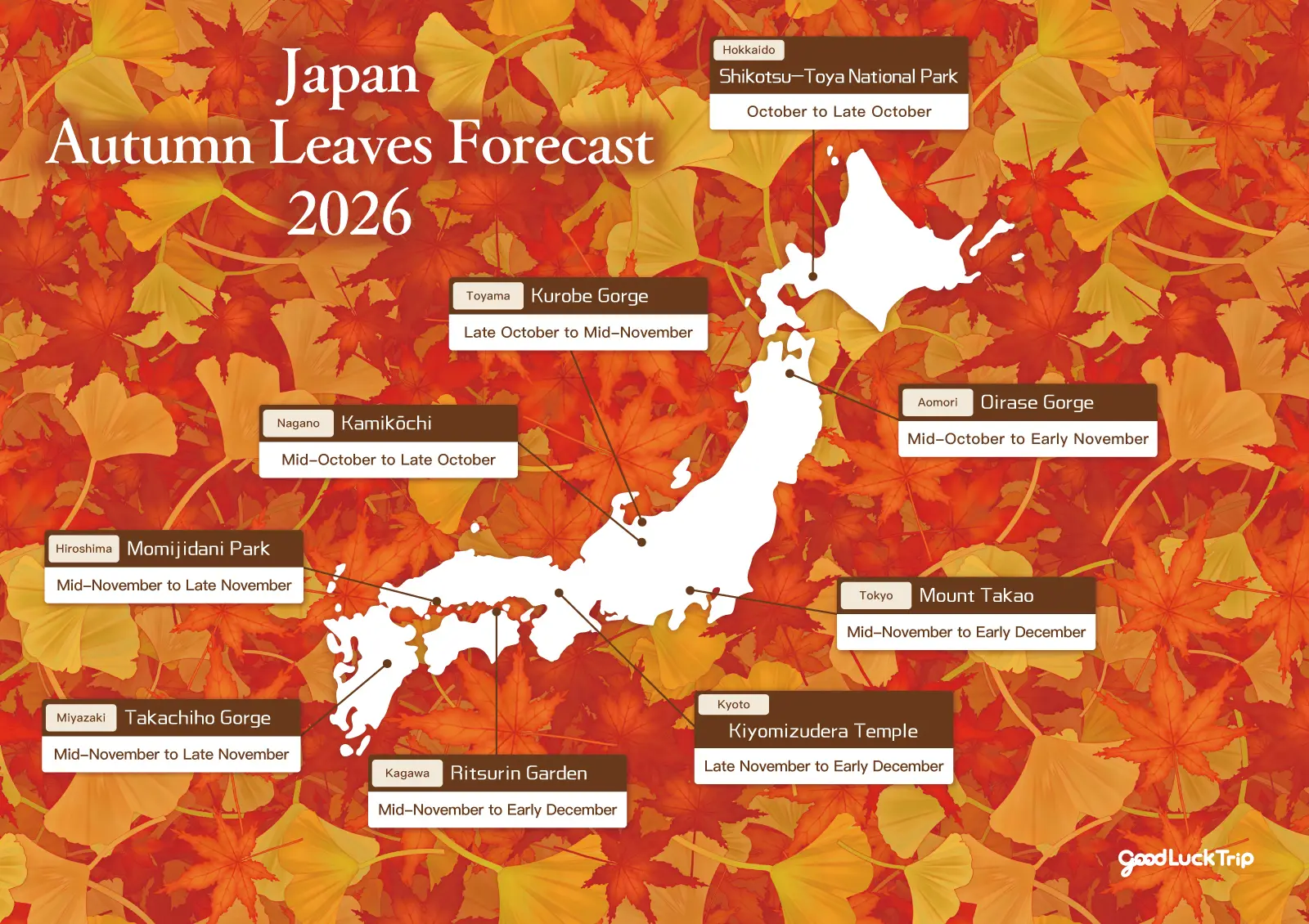
The fall foliage map below shows the typical viewing periods at destinations around Japan.
The timing can differ even within the same region, so check the information for each individual location.
Websites With Real-Time Fall Foliage Updates
For real-time updates on how the leaves are changing color, refer to the following websites operated by a Japanese weather information company and the Japan Weather Association.
Japan’s Three Great Fall Foliage Destinations
Here are Japan’s Three Great Fall Foliage Destinations, which are particularly famous among the country’s many autumn viewing spots.
If fall foliage is a major focus of your trip, consider visiting at least one of these three destinations.
1. Arashiyama, Kyoto Prefecture
Arashiyama in Kyoto offers scenery in which fall foliage blends harmoniously with historic architecture.
The area has many spots that evoke the atmosphere of Japan, including Japanese gardens set against colorful mountains and carefully arranged rock gardens framed by autumn leaves.
Tenryu-ji Temple, a UNESCO World Cultural Heritage Site, and Togetsukyo Bridge, one of Arashiyama’s best-known scenic landmarks, are especially popular during the fall foliage season.


2. Nikko, Tochigi Prefecture
Nikko City covers approximately one-quarter of Tochigi Prefecture and is home to numerous popular fall foliage spots. These include Irohazaka, where you can admire the leaves while driving; Lake Chuzenji, one of the Kanto region’s foremost autumn destinations; and Ryuzu Falls, where waterfalls and colorful foliage form a striking scene.
The area also has hot spring resorts, allowing visitors to view the leaves while bathing. Since many of Nikko’s fall foliage attractions are best explored by car, consider renting one to make the most of your visit. (Irohazaka becomes congested during the fall foliage season, so travel in the early morning or evening is recommended.)


3. Yabakei, Oita Prefecture
Yabakei in Nakatsu City, Oita Prefecture, has been designated as one of the New Three Views of Japan, a Japan Heritage site, and one of Japan’s Three Great Unusual Landscapes. Here, colorful fall foliage contrasts with clusters of rocky peaks.
Across this vast area measuring 32 km from north to south and 36 km from east to west, cliffs, caves, mountain streams, and unusual rock formations create distinctive scenery.
Among its many autumn viewing spots, the best known is Hitome Hakkei Observatory in the center of Shin-Yabakei.
The unusual landscape visible from Hitome Hakkei Observatory can be seen nowhere else.

Grand Landscapes in Red and Gold: 3 Fall Foliage Spots in Hokkaido
These fall foliage destinations offer impressive views of Hokkaido’s vast landscapes transformed by red and golden leaves.
If you want to see fall foliage in Hokkaido, start with these three locations.
1. Jozankei Onsen
This historic hot spring town is located in Minami Ward, Sapporo, Hokkaido, and is often described as Sapporo’s private retreat.
With a history spanning more than 150 years, it lies within Shikotsu-Toya National Park and extends along riverbanks carved by the Shiraigawa and Toyohiragawa Rivers.
From Jozankei Ohashi Bridge in the center of town, visitors can look out over hotels nestled within a vast gorge covered in fall foliage.
Several other fall foliage destinations are located nearby, making the town an ideal base for exploring the area.
- Best Time to Visit
-
Early to mid-October
The Koyo Kappa Bus operates from October 1–21, 2026. Other fall foliage buses operate through October 31, depending on the destination.

- Name in Japanese
- 定山渓温泉街
- Postal Code
- 061-2303
- Address
-
Minami-ku, Sapporo City, Hokkaido
Google Maps - Telephone
- 011-598-2012 (Jozankei Tourism Association)
- Closed
- Depend on facilities
- Hours
- Depend on facilities
- Admission
- Depend on facilities
- Directions
- From Sapporo Station on the Subway Namboku Line/Toho Line/JR Line, take the Jotetsu Bus to the Jozankei Yunomachi stop. You will be right there.
- Website
- Official Website (English)
2. Hokkaido University
Hokkaido University has an expansive campus with plenty of open space.
It is conveniently located within walking distance of Sapporo Station. In addition to students and faculty, members of the public may enter the campus to look around or take a walk.
The Poplar Avenue area offers views of tall poplar trees and the broad scenery associated with Japan’s northern island.
Kita 13-jo Street is lined with ginkgo trees on both sides. In autumn, they turn golden and create an impressive sight.
- Best Time to Visit
- Late October to early November

- Name in Japanese
- 北海道大学
- Postal Code
- 060-0808
- Address
-
5 Kita8jonishi, Kita-ku, Sapporo City, Hokkaido
Google Maps - Telephone
- 011-716-2111(Main number)
- Admission
-
Free
※Depend on facilities - Closed
- Depend on facilities
- Hours
- Depend on facilities
- Direction
- A 7-minute walk from JR Sapporo station.
- Official Website
- Official Website (English)
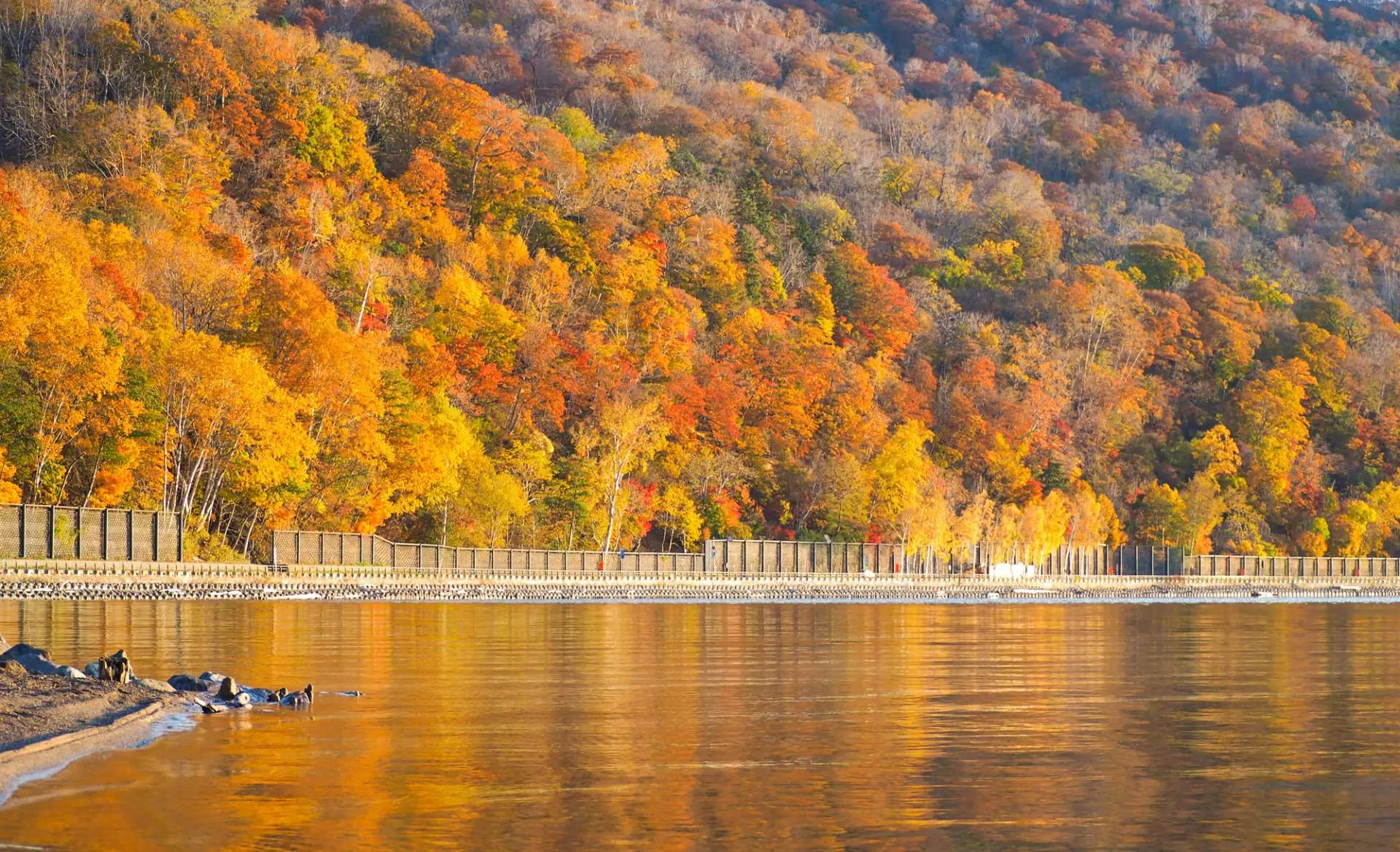
3. Shikotsu-Toya National Park
Shikotsu-Toya National Park is located in southwestern Hokkaido and covers a total area of 995 km².
In addition to Lake Toya and Lake Shikotsu, two major caldera lakes formed when volcanic craters filled with water, the park features various volcanoes and volcanic landforms, including Mount Yotei, Mount Usu, and Mount Tarumae.
There are many fall foliage spots throughout the park. Noboribetsu Onsen’s Jigokudani and the area around Lake Shikotsu are particularly well known.
- Best Time to Visit
- Mid- to late October
- Name in Japanese
- 支笏洞爺国立公園
- Postal Code
- 066-0281
- Address
-
Shikotsu Onsen, Chitose City, Hokkaido
Google Maps - Telephone
- 011-299-1950(Hokkaido Regional Environment Office)
- Admission
- Free
- Holiday
- Open every day
- Directions
- About a 55-minute ride on Hokkaido Chuo Bus from the New Chitose Airport and get off at “Lake Shikotsu” station.
- Official Website
- Official Website (English)
For more recommended fall foliage spots in Hokkaido, refer to the article below.

3 Fall Foliage Spots Showcasing Tohoku’s Abundant Natural Scenery
The defining feature of Tohoku’s fall foliage destinations is the region’s abundant natural scenery.
Mountains draped in colorful leaves and vividly colored valleys can also be found elsewhere, but Tohoku stands apart for the sheer scale of its landscapes.
Here are three carefully selected fall foliage destinations where the scenery is both extensive and impressive.
1. Oirase Gorge, Aomori Prefecture
The Oirase River flows out of Lake Towada. Oirase Gorge refers to the approximately 14-km stretch that runs through the valley from Nenokuchi on the shore of Lake Towada to Yakeyama.
Together with Lake Towada, it has been designated a national Special Place of Scenic Beauty and Natural Monument. The area is known for its varied natural scenery, including clear streams, waterfalls of many shapes, and rocks of different sizes surrounded by trees.
The combination of waterfalls, streams, and colorful trees is particularly striking. Sights such as Samidare Stream, Ishigedo Rapids, Ashura Stream, and Lake Towada offer scenery found only in autumn.
A maintained nature trail also makes the area suitable for exploring on foot.
- Best Time to Visit
- Mid-October to early November

- Name in Japanese
- 奥入瀬渓流
- Postal Code
- 034-0301
- Address
-
Okuse, Towada City, Aomori
Google Maps - Telephone
- 0176-75-2425 (Lake Towada National Park Association)
- Closed
- Open every day
- Hours
- Walk anytime
- Admission
- Free
- Directions
- Take the JR Bus from JR Shin-Aomori Station or Hachinohe Station and get off at "Yakeyama".
- Official Website
- Official Website (English)
2. Naruko Gorge, Miyagi Prefecture
Naruko Gorge features sheer cliffs reaching depths of 100 m and extending for approximately 2.5 km.
Deciduous broadleaf trees, including maples and Mongolian oaks, cover the sharply rising white cliffs. In autumn, their red and yellow leaves create scenery resembling a painting.
Crossing Ofukasawa Bridge over Naruko Gorge provides a full sense of the valley’s height and surrounding landscape. This thrilling yet picturesque viewpoint may also offer a glimpse of a train crossing the gorge if the timing is right.
- Best Time to Visit
- Late October to early November
- Important Information
-
The Naruko Gorge Walking Trail cannot be followed from end to end. In 2026, only the following short out-and-back sections are open:
- Nakayamadaira side: approximately 350 m
- Naruko side: approximately 230 m
- Central section: permanently closed due to rockfalls and other hazards

- Name in Japanese
- 鳴子峡
- Postal Code
- 989-6827
- Address
-
Shitomae to Hoshinuma, Naruko Onsen, Osaki City, Miyagi Prefecture
Google Maps - Telephone
- 0229-87-2050(Naruko Gorge Resthouse)
- Open period
- From Late April to Mid November(From Late November to Late April closed during the winter)
- Business Hours
- 9:00am - 4:00pm
- Admission
- Free
- Access
-
1) About a 60-minute walk from JR Naruko Onsen Station to the entrance on the Nakayama-daira side
2) About a 30-minute walk from JR Nakayama-daira Onsen Station to the entrance on the Nakayama-daira side
*During the autumn leaves season, a temporary bus "Autumn Leaves-go" operates from either Naruko Onsen Station or Nakayama-daira Onsen Station (please confirm operation / Miyako Bus 0229-22-1781) - Official Website
- Official Website (Japanese)
3. Mount Hakkoda, Aomori Prefecture
Mount Hakkoda is the collective name for a group of mountains rising south of Aomori City and is recognized as one of Japan’s 100 Famous Mountains.
Mount Odake, the highest peak at 1,585 m, is joined by nine other peaks, including Mount Takada-Odake, Mount Ido, and Mount Akakura, which together form North Hakkoda. Six peaks, including Mount Kushigamine, make up South Hakkoda.
At the height of the season, the entire mountain range is covered in foliage resembling colorful brocade.
The first snow may fall in late October, sometimes allowing visitors to see autumn leaves amid the snow.
The Hakkoda Ropeway offers 360-degree panoramic views of the fall foliage.
- Best Time to Visit
- Late September to late October

- Name in Japanese
- 八甲田山
- Postal Code
- 030-0955
- Address
-
Fukazawa, Komagome, Aomori City, Aomori
Google Maps - Telephone
- 017-734-5153 (Aomori Tourist Information Center)
- Closed
- Open every day
- Hours
- Walk anytime
- Admission
- Free
- Directions
- From JR Aomori Station of any line, ride the JR Bus, get off at the Hakkoda Ropeway Ekimae Stop (The boarding place for the ropeway)
- Official Website
- Official Website (English)
For more recommended fall foliage spots in Tohoku, refer to the article below.

Easy to Reach and Explore: 3 Fall Foliage Spots in Kanto
Although Kanto is often associated with urban areas, it is also home to many well-known fall foliage destinations.
Easy access from major cities is one of the region’s key advantages.
1. Mount Takao, Tokyo
Mount Takao is a 599-meter mountain located in Hachioji, Tokyo.
Its convenient location and relatively easy climb make it a popular sightseeing destination.
Visitors range from families with small children to older adults, and approximately 3 million people come here each year. It is also known as the world’s most-climbed mountain.
Mount Takao is one of Tokyo’s best-known fall foliage spots. In autumn, the mountain is covered in a varied mixture of red, yellow, and green.
With several easy trails available, even first-time hikers can take in the autumn scenery while walking.
- Best Time to Visit
- Mid-November to early December

- Name in Japanese
- 高尾山
- Postal Code
- 193-0844
- Address
-
Takao-machi, Hachioji City, Tokyo
Google Maps - Telephone
- 042-664-7872
- Closed
- No holidays
- Hours
- Open 24 hours
- Access
- The trail entrance is about 5 minutes on foot from Takaosanguchi Station on the Keio Line
- Official Website
- Official Website (Japanese)

2. Meiji Jingu Gaien, Tokyo
Meiji Jingu Gaien is the outer precinct of Meiji Jingu Shrine, established in 1926. Centered around the Meiji Memorial Picture Gallery, the grounds contain various sports facilities, including Meiji Jingu Stadium, as well as natural scenery that changes with the seasons.
The approximately 300-meter avenue of ginkgo trees extending from Aoyama-dori Avenue to the Meiji Memorial Picture Gallery is particularly famous. In autumn, it forms a striking golden tunnel.
When the leaves reach their peak, the Jingu Gaien Ginkgo Festival is held, offering food from across Japan alongside views of the avenue.
The ginkgo trees are also illuminated, making this an attractive destination after dark.
- Best Time to Visit
- Mid-November to early December

- Name in Japanese
- 明治神宮外苑
- Postal Code
- 160-0013
- Address
-
1-1 Kasumigaoka-machi, Shinjuku-ku, Tokyo
Google Maps - Telephone
- 03-3401-0312
- Closed
- Depend on facilities
- Hours
- Depend on facilities
- Admission
- Free (charges apply for using facilities)
- Access
-
(1) JR Chuo/Sobu Line at Shinanomachi Station or Sendagaya Station
(2) Tokyo Metro Ginza Line at Gaiemmae Station or Aoyama-itchome Station
(3) Tokyo Metro Hanzomon Line at Aoyama-itchome Station
(4) Toei Oedo Line at Kokuritsu-Kyogijo Station or Aoyama-itchome Station
*For the nearest station to each facility, please check the information of the facility you plan to visit. - Official Website
- Official Website (English)
3. Showa Kinen Park, Tokyo
Across grounds equivalent in area to approximately 40 Tokyo Domes, the park features lawns, fountains, sports courts, gardens filled with seasonal flowers, and ponds where visitors can observe waterside vegetation.
It also has various facilities where visitors can learn about plants and coexistence with nature, along with numerous events and hands-on programs.
Two ginkgo viewing areas offer different golden landscapes: the 300-meter-long Ginkgo Avenue, lined with 98 trees, and the 200-meter Canal Avenue, lined with 106. Visitors can take a leisurely walk through both golden tunnels.
- Best Time to Visit
- Late October to late November

- Name in Japanese
- 国営昭和記念公園
- Postal Code
- 190-0014
- Address
-
3173 Midori-cho, Tachikawa City, Tokyo
Google Maps - Telephone
- 042-528-1751
- Admission
-
Adults (15 and over) 450 yen; Children (under 15) free; Silver (65 and over) 210 yen
*Facilities are separately charged.
*There are free park entrance days (posted on the Official Website). - Parking
- Available at 900 yen
- Closed
- New Year’s Eve and Day; From The 3rd Monday To Friday Of January
- Opening Hours
-
March-October: 9:30 am to 5:00 pm
November-February: 9:30 am to 4:30 pm
April-September: 9:30 am to 6:00 pm (Saturdays, Sundays & Holidays)
*The Green Cultural Zone (free area) opens at 8:30 am.
From Spring Equinox Day to March 31, the Zone closes at 5:30 pm.
*Due to events or performances, the schedule is subject to change.
*Opening and closing hours may vary, depending on the facility. - Access
-
*All on foot:
(1) About 10 minutes (to the Akebono Entrance) or 15 minutes (to the Tachikawa Gate) from Tachikawa Station on the JR Chuo Line
(2) About 8 minutes (to the Akebono Entrance) or 13 minutes (to the Tachikawa Gate) from Tachikawa-Kita Station on the Tama Monorail
(3) About 2 minutes (to the Nishi Tachikawa Gate) from Nishi-Tachikawa Station on the JR Ome Line
(4) About 10 minutes (to the Akishima Gate) from Higashi-Nakagami Station on the JR Ome Line
(5) About 25 minutes (to the Tamagawa Josui Gate) or 20 minutes (to the Sunagawa Gate) from Musashi-Sunagawa Station on the Seibu Haijima Line - Official Website
- Official Website (English)
For more recommended fall foliage spots in Tokyo, refer to the article below.

3 Popular Fall Foliage Spots for Hiking in the Chubu Region
Many of the Chubu region’s popular fall foliage destinations can be explored while hiking.
Options range from serious hiking routes to easy walking trails, making the region suitable even for visitors who are less confident in their physical stamina.
1. Kamikochi, Nagano Prefecture
Kamikochi is one of Japan’s leading mountain destinations. Its scenery has earned it two national designations: Special Place of Scenic Beauty and Special Natural Monument.
Maintained walking trails provide close-up views of mountains reaching approximately 3,000 m, including the Hotaka mountain range. Kamikochi is also one of the gateways to climbing routes for peaks such as Mount Yari, so many serious hikers carrying large backpacks visit the area.
Kamikochi has many scenic fall foliage spots, particularly around Kappa Bridge, Myojin Pond, and Taisho Pond.
The opportunity to combine serious hiking with fall foliage is one of Kamikochi’s distinctive autumn attractions.
- Best Time to Visit
-
Mid- to late October
The 2026 season runs from April 17 to November 15.

- Name in Japanese
- 上高地
- Postal Code
- 390-1516
- Address
-
Azumikamikochi, Matsumoto City, Nagano
Google Maps - Tel
- 0263-95-2433 (Kamikochi Information Center)
- Admission
- Free
- Regular Holidays
- None
- Hours of operation
- None specified
- Access
- One hour bus ride from Shin-Shimashima station on Matsumoto railways.
- Official Website
- Official Website (English)
2. Korankei Gorge, Aichi Prefecture
Korankei is an approximately 1-km gorge formed by the Tomoe River and is part of Aichi Kogen Quasi-National Park.
A deciduous broadleaf forest extends from 254-meter Mount Iimori down to the river, and approximately 4,000 maple trees change color in autumn.
The Korankei Maple Festival is held during the peak viewing season. At night, the golden illumination of Mount Iimori and its reflection among the trees along the Tomoe River create an atmospheric setting.
Other highlights include Korankei Bridge, which offers 360-degree views of the foliage, and the approach to Kojaku-ji Temple, covered by trees in shades of red, yellow, and orange.
- Best Time to Visit
- Mid- to late November

- Name in Japanese
- 香嵐渓(こうらんけい)
- Postal Code
- 444-2424
- Address
-
Iimori, Asukecho, Toyota City, Aichi
Google Maps - Telephone
- 0565-62-1272(Toyota City Asuke Tourism Association)
- Closed
- Free to walk
- Business Hours
- Walk anytime
- Admission
- Free ※Fees are subject to change.
- Access
-
1) From Jyosui Station on the Meitetsu Toyota Line, change to the Toyota Oiden Bus Sanage Asuke Line and get off at the "Korankei" bus stop, a short walk away.
2) From Toyota City Station on the Meitetsu Mikawa Line/Toyota Line, change to the Meitetsu Bus Yanami Line bound for Asuke, get off at the "Korankei" bus stop, and walk a short distance.
3) From Higashi Okazaki Station on the Meitetsu Main Line, change to the Meitetsu Bus Okazaki/Asuke Line bound for Asuke, get off at the "Korankei" bus stop, and walk a short distance. - Official Website
- Official Website (English)
3. Senjojiki Cirque, Nagano Prefecture
Senjojiki Cirque is a bowl-shaped valley carved by glaciers 20,000 years ago. It lies directly below Mount Hoken in the Central Alps, spanning Komagane City and Miyada Village in Nagano Prefecture.
Many hikers and sightseers come from across Japan to see its grand landscape change dramatically with the seasons.
The area is also known for its abundance of alpine plants. In autumn, the grasses and low-growing vegetation turn a range of colors.
Ride the Chuo Alps Komagatake Ropeway to look down over mountain slopes covered in red, yellow, and orange.
- Best Time to Visit
- Late September to early October

- Name in Japanese
- 千畳敷カール
- Postal Code
- 399-4117
- Address
-
Akaho, Komagane City, Nagano
Google Maps - Telephone
- 0265-83-3107 (Chuo Alps Kanko Tourist)
- Holiday
- The ropeway is closed in case of stormy weather and for maintenance.
- Hours
- 8:00am - 5:00pm (varies according to the season)
- Admission
- Free to walk (accessible by bus and ropeway from Suganodai Bus Center; a round-trip ticket that includes both rides costs 4,200 yen)
- Directions
- About 30 minutes by local bus from Suganodai Bus Center to Shirabidaira Station, about 7 minutes and 30 seconds by Komagatake Ropeway, and a short walk from Senjojiki Station
- Credit Cards
-
Cards are accepted only at Suganodai Bus Center and Senjojiki Station
(VISA, JCB, Mastercard) - Website
- Official Website (Japanese)
Beyond the Classics: 3 Fall Foliage Spots in the Hokuriku Region
The Hokuriku region offers fall foliage in a range of settings, including views from trolley trains and gondolas.
Travelers looking for something different from the standard autumn destinations should consider these locations in Hokuriku.
1. Kurobe Gorge, Toyama Prefecture
Kurobe Gorge is a vast V-shaped valley carved deeply by the Kurobe River.
Water originating at Mount Washiba in the central Northern Alps flows for 86 km between the Tateyama and Ushiro-Tateyama mountain ranges, descending steep slopes with an elevation difference of up to 3,000 m. The only way to access this rugged valley is by trolley train.
From the train, passengers can admire the contrast created by evergreen trees, red autumn foliage, and yellow autumn foliage.
The route also passes scenic attractions such as Sarutobi Gorge, a Special Natural Monument; Okukane Bridge, which crosses the Kurobe River 34 m above the water; and Hitokui-iwa, an imposing natural rock formation. The variety of scenery extends well beyond the colorful leaves.
- Best Time to Visit
- Late October to mid-November

- Name in Japanese
- 黒部峡谷
- Postal Code
- 938-0293
- Address
-
11 Kurobekyokokuguchi, Kurobe City, Toyama
Google Maps - Telephone
- 0765-62-1011 (Kurobe Gorge Railway Customer Center)
- Period when the trolley is closed
- December to mid-April
- Trolley Train Operation Hours
- Depends on the season *For details, please refer to the timetable on the official website.
- Trolley Train Fare
-
Varies By Section Please Refer To The Official Website For Details.
Relaxed vehicles are charged extra. - Directions
- A short walk from Toyama Chiho Railway Unazuki Onsen Station
- Credit Cards
- Accepted
- Official Website
- Official Website (English)

2. Yahiko Park, Niigata Prefecture
Yahiko Park covers approximately 13 hectares and features streams, waterfalls, and many places that evoke the atmosphere of Japan.
A variety of trees grow throughout the grounds, creating scenery that changes with each season.
Momiji Valley, near Kangetsukyo Bridge—the symbol of Yahiko Park—is planted with maples and other trees whose leaves turn red and yellow in autumn.
The combination of the vermilion Kangetsukyo Bridge and the colorful foliage is especially striking.
At night, the illuminated leaves make the scene even more vivid.
- Best Time to Visit
- Late October to mid-November

- Name in Japanese
- 弥彦公園
- Postal Code
- 959-0323
- Address
-
667-1 Yahiko, Yahikomura, Nishikambaragun, Niigata
Google Maps - Telephone
- 0256-94-3154(Yahiko Tourism Association)
- Closed
- Free to walk
- Business Hours
- Walk anytime
- Admission
- Free
- Access
- A short walk from Yahiko Station on JR Yahiko Line
- Official Website
- Official Website (English)
3. Naeba Dragondola
Naeba Dragondola, Japan’s longest gondola lift, connects the Naeba and Tashiro highlands.
The approximately 25-minute journey covers 5.5 km and an elevation difference of about 430 m, creating a thrilling ride shaped by both the changing height and surrounding landscape.
In autumn, the trees around the gondola change color, creating a picturesque contrast with the emerald-green waters of Lake Futai.
At Tower No. 14, a particularly scenic point along the route, the gondola appears to plunge directly into mountains covered in autumn colors.
- Best Time to Visit
- Mid-October to early November

- Name in Japanese
- 苗場ドラゴンドラ
- Postal Code
- 949-6292
- Address
-
202 Mikuni, Yuzawamachi, Minamiuonumagun, Niigata
Google Maps - Telephone
- 025-789-4117
- Closed
- No closures during the business season between October 10(Saturday) - November 8(Sunday), 2026
- Business Hours
- 9:00am - 3:00pm(last down service at 4:00pm)
- Admission
-
Naeba Dragondola Round-Trip Adults 4,000yen, Elementary school children 2,300yen
※SPGR Members: Adults:3,700yen / Elementary school students:2,100yen - Access
- From JR Echigo-Yuzawa Station, take the bus "Naeba Crystal Line" for about 50 minutes. Get off at the "Naeba Ski Resort Shunee Mae" bus stop, and then take the Dragondola shuttle bus for 5 minutes. Walk shortly from the "Naeba Dragondola Foothill" station.
- Credit Cards
- Accepted
- Notes
- Pets may ride in a pet carrier that fits inside the Dragondola(maximum width:40cm,maximum height:80cm).
- Official Website
- Official Website (Japanese)

Experience the Atmosphere of Autumn in Japan: 3 Fall Foliage Spots in Kansai
The Kansai region has many destinations where historic architecture and colorful leaves come together to create a distinctly Japanese autumn atmosphere.
Here are three carefully selected locations that reflect Japanese aesthetic concepts such as elegance and wabi-sabi.
1. Otowasan Kiyomizu-dera Temple, Kyoto Prefecture
Otowasan Kiyomizu-dera Temple was founded in 778 and registered as a UNESCO World Cultural Heritage Site in 1994.
Its 130,000-m² grounds extend across the slopes of Mount Otowa and contain more than 30 temple buildings and monuments, including National Treasures and Important Cultural Properties.
In autumn, the trees throughout the grounds turn red, creating scenes in which the foliage complements the historic architecture.
Particularly notable are the Main Hall, associated with the Japanese expression “to jump off the stage of Kiyomizu,” meaning to make a bold decision, and the vermilion three-story pagoda. The sight of these structures surrounded by deep-red foliage is a major highlight.
- Best Time to Visit
- Late November to early December

- Name in Japanese
- 音羽山 清水寺
- Postal Code
- 605-0862
- Address
-
1-294 Kiyomizu, Higashiyama-ku, Kyoto City, Kyoto
Google Maps - Telephone
- 075-551-1234
- Holiday
- Open every day
- Business Hours
- 6:00am - 6:00pm
- Admission
- Adults 500 yen, Elementary/ Middle School Students 200 yen
- Directions
-
1) Ride the Keihan Main Line to Kiyomizu Gojo Station, then walk 25 minutes.
2) Ride the Kyoto Municipal Transportation Bureau (City Bus) Line 206 "Higashiyama-Dori Kitaoji Bus Terminal" or Line 100 "Kiyomizudera Gion Ginkakuji" from Keihan Main Line Nanajo Station, get off at "Gojo Zaka" bus stop, then walk 10 minutes. - Credit Cards
- Not accepted
- Official Website
- Official Website (Japanese)
For more recommended fall foliage spots in Kyoto, refer to the article below.

2. Nara Park, Nara Prefecture
Nara Park combines valuable historical and cultural sites—including Kasuga Taisha Shrine, Kofuku-ji Temple, Todai-ji Temple, the Nara National Museum, and the Shosoin Repository—with expansive natural scenery.
Many features of the park have been designated Natural Monuments, including the Kasugayama Primeval Forest, itself a Special Natural Monument, as well as the Nara deer, the nagi forest within the grounds of Kasuga Taisha, the Nara-no-yaezakura cherry tree at Chisoku-in Temple, and the habitat of the Loomis hairstreak butterfly.
In autumn, the area is transformed as colorful trees complement its historic cultural sites and Natural Monuments.
Since trees with colorful foliage grow throughout the park, visitors can walk around and find their own favorite viewing spots.
- Best Time to Visit
- Late October to early December

- Name in Japanese
- 奈良公園
- Postal Code
- 630-0000
- Address
-
Kasugano-cho, Nara City, Nara Prefecture
Google Maps - Tel
- 0742-22-0375 (Nara Park Office)
- Admission
-
Free
*Please refer to the official website for information on admission fees for each facility. - Regular Closures
-
None
*Please check the official website for the regular closing days of each facility. - Access
- About 5 minutes walk from Kintetsu Nara Station
- Official Website
- Official Website (Japanese)
3. Katsuo-ji Temple, Osaka Prefecture
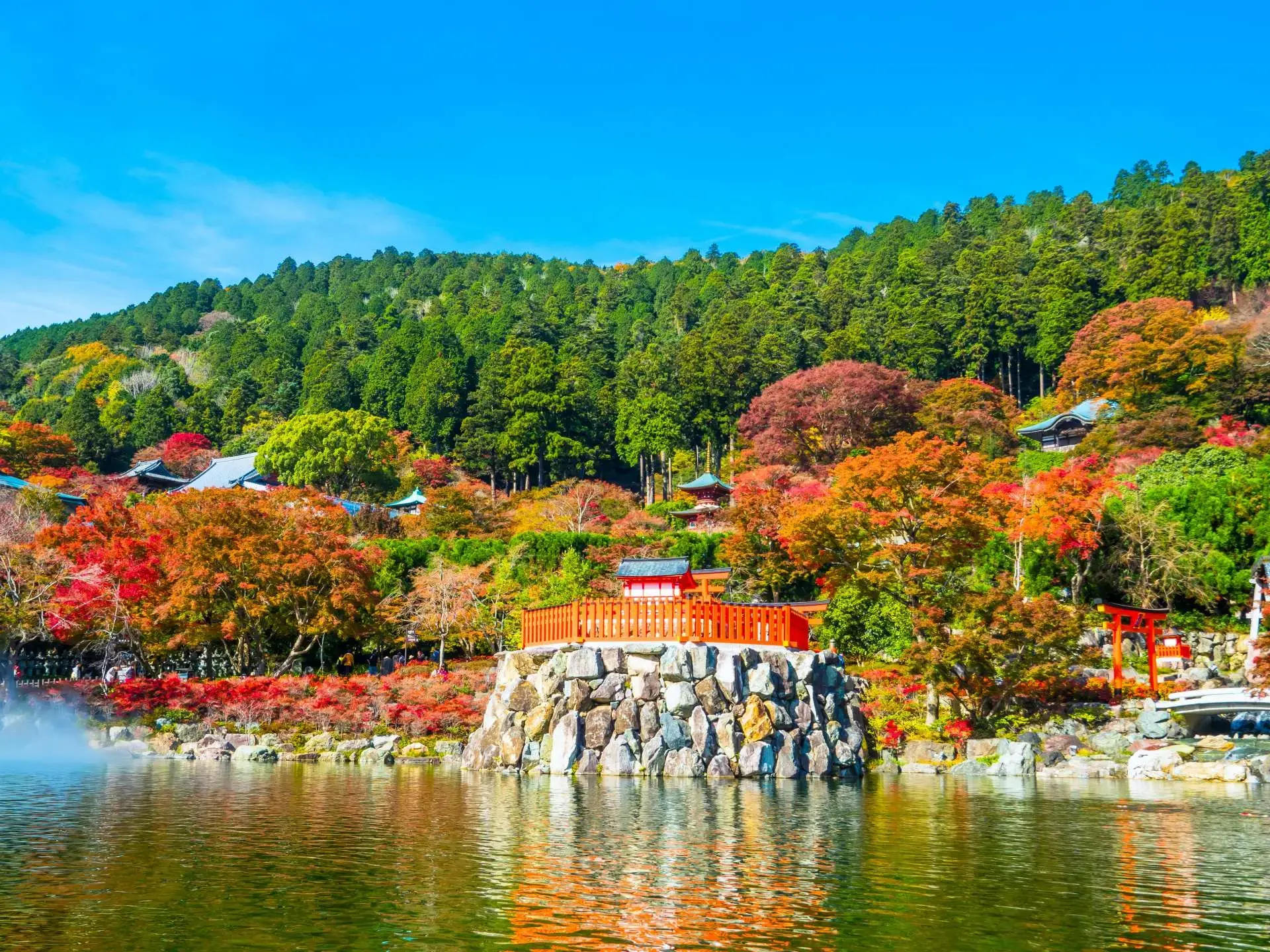
Katsuo-ji Temple in Minoh City, Osaka Prefecture, is an ancient temple founded during the Nara period, with a history spanning approximately 1,300 years. Surrounded by a quasi-national park, its approximately 26-hectare grounds contain the Main Hall and temple gate reconstructed by Toyotomi Hideyori, as well as Sanbo Kojin Shrine, considered Japan’s first shrine dedicated to the deity Kojin.
It is one of the most popular fall foliage destinations in Minoh, an area already known for its autumn scenery. During this season, the grounds turn red and yellow, and arches of maple leaves cover the temple approach. Evening illuminations are also held during the fall foliage season, creating an atmosphere different from the solemn character of the temple by day.
- Best Time to Visit
- Mid-November to early December
- Name in Japanese
- 勝尾寺
- Postal Code
- 562-8508
- Address
-
2914-1 Aomadani, Minoh City, Osaka
Google Maps - Telephone
- 072-721-7010
- Closed
- Irregular holidays
- Hours
-
Weekdays & Sun/Public Holidays: 8:00 am - 5:00 pm
Saturdays: 8:00 am - 6:00 pm
(Temple visits accepted until 15 minutes before closing) - Admission
- Adults (high school students and older): 500 yen, elementary and junior high school students: 400 yen, preschool children: 100 yen, children under 2 years old: free
- Directions
- 33 min. by Hankyu Bus from Senri-Chuo Station. on the Osaka Metro Midosuji Line, alight at "Katsuo-ji" bus stop, and walk shortly.
- Credit Cards
- Not accepted
- Official Website
- Official Website (English)
For more recommended fall foliage spots in Osaka, refer to the article below.

Stroll Through Serene Autumn Scenery: 3 Fall Foliage Spots in the Chugoku Region
The Chugoku region has many destinations where colorful foliage creates memorable scenery in peaceful surroundings.
Travelers who prefer to appreciate the leaves in a quiet, contemplative setting should consider these locations.
1. Momijidani Park, Hiroshima Prefecture
Momijidani Park is located on Miyajima in Hiroshima Bay. It is a developed walking area in a valley at the foot of Mount Misen.
In autumn, approximately 700 trees change color throughout the park.
About 560 of these are Japanese maples, creating a striking contrast between deep-red foliage and surrounding greenery.
At the park entrance, the crimson Momiji Bridge and nearby maple trees create a scene that embodies traditional Japanese elegance.
- Best Time to Visit
- Mid- to late November

- Name in Japanese
- 紅葉谷公園
- Postal Code
- 739-0588
- Address
-
Miyajimacho, Hatsukaichi City, Hiroshima
Google Maps - Telephone
- 0829-44-2011(Miyajima Tourist Association)
- Closed
- Open every day
- Business Hours
- Walk anytime
- Admission
- Free
- Access
- About a 10-minute ride on the JR West Miyajima Ferry or the Miyajima Matsudai Kisen Ferry from JR Miyajimaguchi Station or Hiroshima Electric Railway Hirosima-Miyajimaguchi Station. Then, about a 15-minute walk from "Miyajima Sanbashi" (Miyajima Pier).
- Official Website
- Official Website (Japanese)

2. Okayama Korakuen Garden, Okayama Prefecture
Okayama Korakuen is a feudal lord’s garden recognized as one of the Three Great Gardens of Japan, alongside Kairakuen in Mito and Kenrokuen in Kanazawa. It was designated a national Special Place of Scenic Beauty in 1952. Ponds and waterways run through the spacious lawns, while Yuishinzan Hill and Enyotei House, once the feudal lord’s residence, offer views incorporating Mount Misao beyond the garden as borrowed scenery.
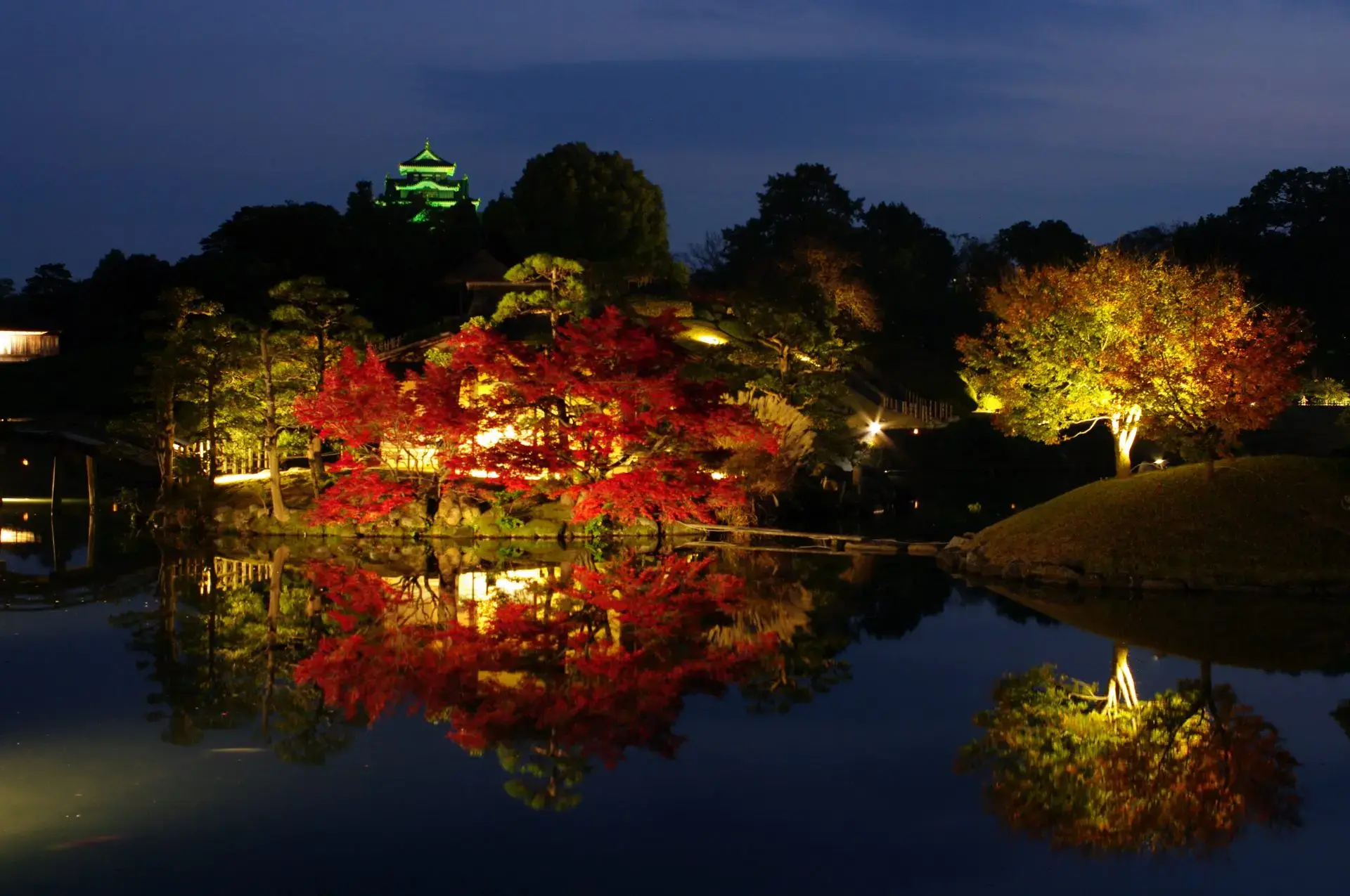
The main fall foliage area is Chishio-no-Mori Grove in the southeastern part of the garden. Its approximately 100 maple trees reach their peak from mid-November to early December, their red leaves standing out against the green lawns and reflecting on the pond. Ginkgo and cherry trees also change color throughout the grounds. The sight of the leaves against the black keep of Okayama Castle creates scenery not found at the other two Great Gardens.
When the foliage reaches its deepest colors, the garden also holds a special nighttime opening known as the Autumn Fantasy Garden.
- Best Time to Visit
- Mid-November to early December
- Name in Japanese
- 岡山後楽園
- Postal Code
- 703-8257
- Address
-
1-5 Korakuen, Kita-ku, Okayama City, Okayama
Google Maps - Telephone
- 086-272-1148
- Business Hours
-
March 20th - September 30th: 7:30am - 6:00pm (Admission allowed until 5:45pm)
October 1st - March 19th: 8:00am - 5:00pm (Admission allowed until 4:45pm)
※Opening hours may vary based on events, please check our official website for inquiries. - Closed
- Open every day
- Admission
-
Adults (15-64 yrs old) - 500 yen
Seniors (65 yrs and up) - 200 yen
※Admission free for disabled persons
※Please check our official website for more information. - Access
-
10-15 minute bus ride from JR Okayama Station
or depart the train from JR Okayama Station, get off at “Jouka”, walk 10 minutes. - Credit Cards
- Accepted
- Official Website
- Official Website (English)
3. Kintaikyo Bridge, Yamaguchi Prefecture
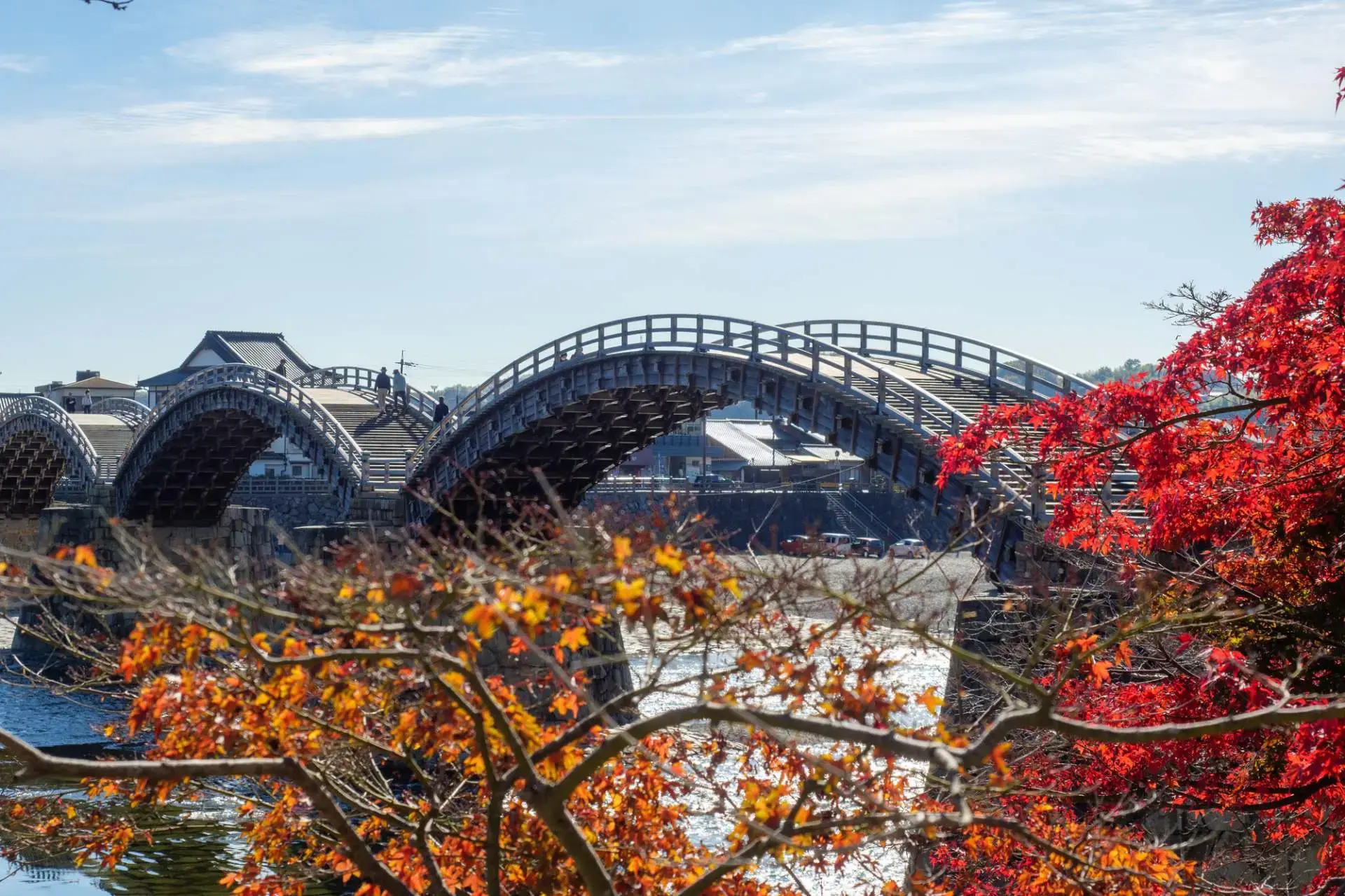
Kintaikyo Bridge is counted among Japan’s Three Famous Bridges alongside Nihonbashi Bridge in Tokyo and Meganebashi Bridge in Nagasaki. It is also recognized as one of Japan’s Three Great Unusual Bridges. Its substantial arches possess a refined appearance, while its distinctive construction is another notable feature. The bridge also forms a harmonious landscape with the surrounding natural scenery.
From mid- to late November, the nearby trees turn vivid shades of red and orange, adding rich color to the imposing bridge. The scene resembles a picture postcard and conveys a strong sense of traditional Japan. Approximately a 10-minute walk from Kintaikyo Bridge is Kikko Park, selected as one of Japan’s 100 Best Fall Foliage Spots. The park has around 1,000 trees with colorful leaves, allowing visitors to appreciate the season amid abundant natural scenery.
- Best Time to Visit
- Mid- to late November
- Name in Japanese
- 錦帯橋
- Postal Code
- 741-0062
- Address
-
1 Iwakuni, Iwakuni city, Yamaguchi
Google Maps - Tel
- 0827-41-1477 (Nishikikawa Railroad Company, Iwakuni Administration Office)
- Business Hours
- Bridge accessible 24 hours a day (lights shut off at 22:00)
- Closed
- Open every day
- Admission
-
12 years and up 310 yen. Elementary school students 150 yen.
(When no personnel are in the toll booth, please put the toll into the nighttime toll box before crossing) - Access
- About 20 minutes by bus from Iwakuni Station, or about 12 minutes by bus from Shin-Iwakuni Station
- Official Website
- Official Website (English)
See Fall Foliage in a Variety of Settings: 3 Spots in Shikoku
Shikoku offers fall foliage in many different settings. Visitors can view illuminated leaves and gardens from a boat, see the sky, sea, and colorful valleys from a ropeway, or admire the contrast between clear rivers and autumn foliage.
Travelers looking for something beyond the standard fall foliage experience should visit the following destinations in Shikoku.
1. Ritsurin Garden, Kagawa Prefecture
Ritsurin Garden was developed as a villa for the Matsudaira family, the lords of the Takamatsu Domain. Successive generations expanded and improved it until its completion nearly 300 years ago.
It is the largest of Japan’s gardens designated as Special Places of Scenic Beauty.
This strolling garden contains six ponds and 13 landscaped hills. It is described as offering “a different view with every step,” with the scenery changing as visitors walk through the grounds.
During the fall foliage season, illuminated leaves are reflected on the garden’s ponds, creating an atmospheric nighttime scene.
The Nanko Pond Japanese Boat Ride offers views of both the garden and illuminated foliage from the water and is well worth taking during the autumn season.
- Best Time to Visit
- Mid-November to early December

- Name in Japanese
- 栗林公園
- Postal Code
- 760-0073
- Address
-
1-20-16 Ritsurincho, Takamatsu City, Kagawa
Google Maps - Telephone
- 087-833-7411
- Closed
- Open year-round
- Hours
-
Mostly from sunrise to sunset
*Hours vary by season. Please check the official website for details. - Admission
-
Adults: 500yen
Children: 170yen
Preschoolers: Free - Access
- About 3 minutes on foot from JR Ritsurin Koen Kitaguchi Station
- Official Website
- Official Website (English)
2. Kankakei Ropeway, Kagawa Prefecture
Kankakei is a gorge on Shodoshima Island in Kagawa Prefecture, located in the central area of Setonaikai National Park.
Andesite, agglomerate, and other rocks formed by volcanic activity approximately 13 million years ago were gradually shaped by tectonic movement and erosion, producing the towering and unusual rock formations seen today.
The gorge has been selected for numerous national lists and designations, including Japan’s Three Most Beautiful Gorges, Japan’s Three Great Scenic Wonders, the 100 Landscapes of Japan, and the 100 Natural Landscapes to Preserve for the 21st Century.
A ropeway runs through the deep gorge, offering panoramic views of the Seto Inland Sea and the valley covered in fall foliage.
It is the only ropeway in Japan where passengers can view the sky, sea, and an autumn-colored gorge at the same time.
- Best Time to Visit
- Early to late November

- Name in Japanese
- 寒霞渓
- Postal Code
- 761-4433
- Address
-
327-1 Kankakedori, Shodoshima-cho, Shozu-gun, Kagawa Prefecture
Google Maps - Tel
- 0879-82-0904
- Business Hours
-
March 21st through October 20th 8:30 - 17:00. October 21st through November 30th 8:00 - 17:00. December 1st through December 20th 8:30 - 17:00. December 21st through March 20th 8:30 - 16:30.
※Ropeway departs in 12-minute intervals - Closed
- No regular closures. Check the official website before visiting.
- Ropeway Fee
-
[ Round Trip ] Adults 2,340 yen, Children 1,170 yen
[ One Way ] Adults 1,300 yen, Children 650 yen
※ Fares May Vary Depending On The Period. - Access
- 15 minutes by bus from Kusakabe Port towards Kountei (get off at the last stop)
- Official Website
- Official Website (Japanese)
3. Omogo Gorge, Ehime Prefecture
Omogo Gorge extends along the foot of Mount Ishizuchi and is designated as a national Place of Scenic Beauty.
One of its main attractions is the exceptionally clear stream, whose riverbed can be seen even from walking trails some distance away.
The contrast between the emerald-green water and the red and yellow leaves creates memorable scenery with an almost mystical atmosphere.
The gorge also contains waterfalls and unusual rock formations, offering a varied range of views.
- Best Time to Visit
- Late October to mid-November

- Name in Japanese
- 面河渓(おもごけい)
- Postal Code
- 791-1710
- Address
-
Wakayama, Kumakogencho, Kamiukenagun, Ehime
Google Maps - Telephone
- 0892-21-1192(Kumakogen Tourism Association)
- Closed
- Free to walk
- Business Hours
- Walk anytime
- Admission
- Free
- Access
- About a 20-minute walk from the "Omogo" bus stop.
- Official Website
- Official Website (English)
Classic Autumn Scenery: 3 Fall Foliage Spots in Kyushu
Kyushu’s fall foliage destinations feature classic combinations such as temples framed by autumn leaves and colorful trees lining scenic valleys.
The region is also home to an unusual destination where the landscape turns entirely golden.
If you visit Kyushu in autumn, consider adding the following locations to your itinerary.
1. Nomiyama Kannonji Temple, Fukuoka Prefecture
Nomiyama Kannonji Temple stands at the foot of Mount Hokotate and is a special head temple of the Koyasan Shingon school, a status equivalent to that of a major head temple.
Believed to offer significant spiritual blessings, it receives more than 1 million worshippers each year.
It also serves as a place of study and training where many Buddhist monks gather.
The grounds contain many points of interest, including more than 3,000 Jizo statues dedicated to children who died before birth, Daishido Hall dedicated to Kobo Daishi, and an Inari shrine dedicated to Inari Daimyojin.
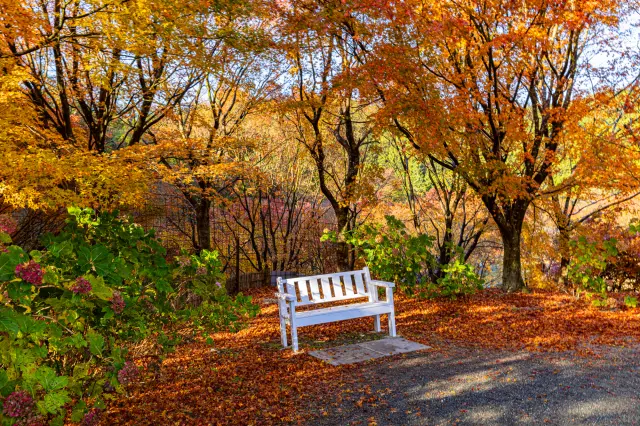
More than 1,000 maple trees and 1,000 azalea shrubs line the grounds and temple approach, adding autumn color to the temple’s solemn atmosphere.
Although there are many scenic places to see the leaves, the approximately 1,000 enkianthus shrubs behind Hyakukannondo Hall are particularly impressive when they turn the entire area deep red.
- Best Time to Visit
- Late October to mid-November

- Name in Japanese
- 呑山観音寺
- Postal Code
- 811-2403
- Address
-
227-4 Hagino, Sasagurimachi, Kasuyagun, Fukuoka
Google Maps - Telephone
- 092-947-4423
- Business Hours
- 6:00am - 5:00pm
- Admission
- Free
- Access
- Approximately 15 minutes by car from JR Fukuhoku Yutaka Line's Sasaguri Station.
- Official Website
- Official Website (English)
For more recommended fall foliage spots in Fukuoka, refer to the article below.
2. Kikuchi Gorge, Kumamoto Prefecture
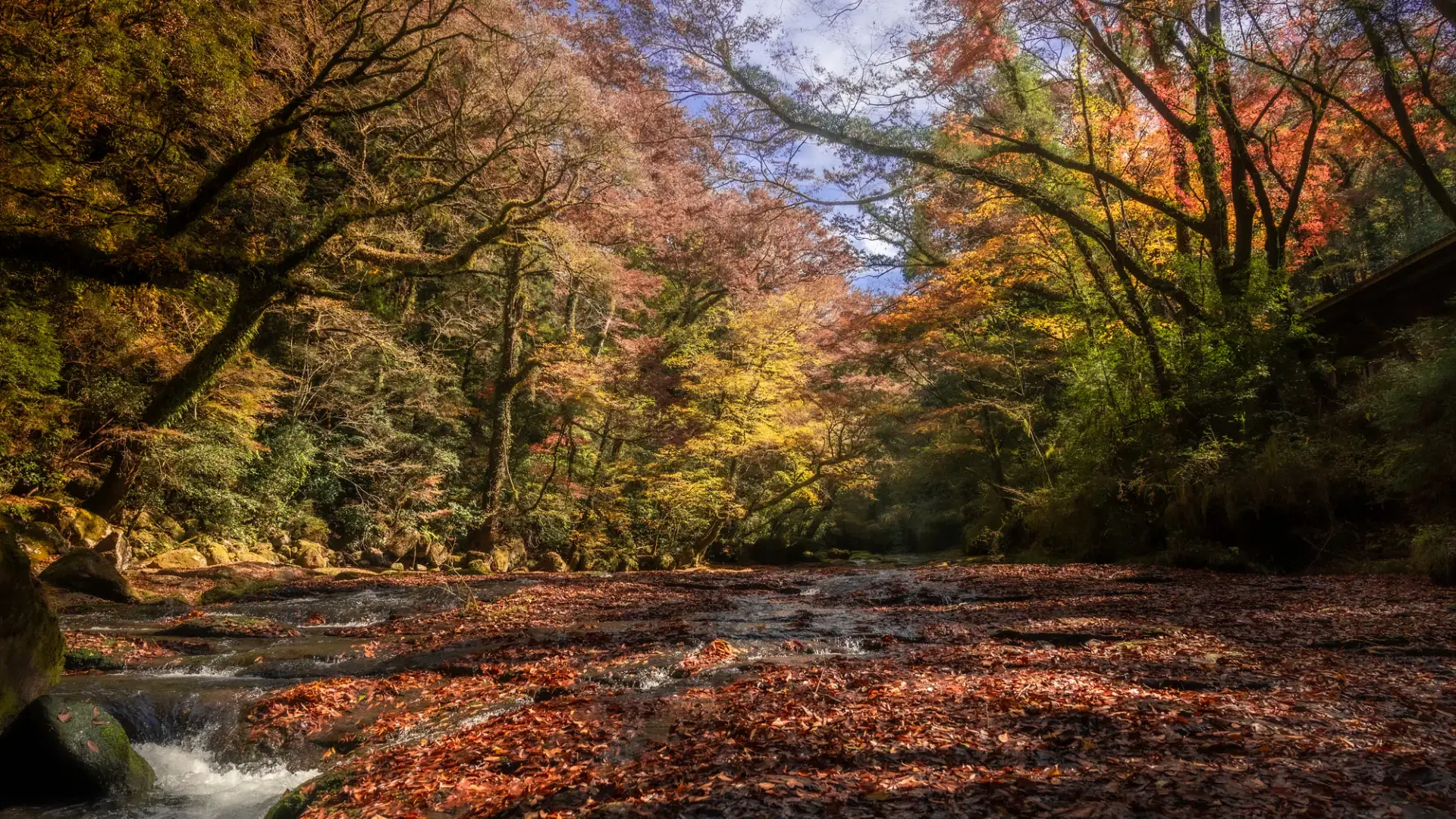
Kikuchi Gorge in Kikuchi City, Kumamoto Prefecture, is a scenic valley located at the headwaters of the Kikuchi River. It has been selected as one of Japan’s 100 Best Forest Bathing Spots and one of Japan’s 100 Best Waterfalls, and is known for scenery formed by primeval forest and clear flowing water.
In autumn, Japanese maples, Japanese zelkovas, and other trees change color, creating an impressive contrast with the emerald-green river. The views from areas such as Momijigase and Hirokawara are particularly noteworthy. As you walk along the trail, the sound of the river and birdsong allows you to experience the autumn landscape with all five senses.
- Best Time to Visit
- Early to mid-November
- Name in Japanese
- 菊池渓谷
- Postal Code
- 861-1441
- Address
-
5026 Haru, Kikuchi City, Kumamoto
Google Maps - Telephone
-
0968-25-7223 (Kikuchi City Tourism Promotion Division)
0968-27-0210 (Kikuchi Gorge Conservation Management - Closed
-
Opening period from April 1st to November 30th
(Entry is allowed outside the open season, but no staff are on-site; the gorge closes during weather warnings.) - Business Hours
-
Opening hours 8:30am - 5:00pm
(Entry is allowed outside these hours, but no staff are on-site.) - Admission
- Maintenance cooperation fee: 300 yen for high school students and above
- Access
- About 1 hour and 30 minutes by taxi from JR Kyushu Shinkansen, Kagoshima Main Line or Hōhi Main Line’s Kumamoto Station.
- Credit Cards
- Not accepted
- Official Website
- Official Website (English)
3. Takachiho Gorge, Miyazaki Prefecture
Takachiho Gorge is a V-shaped valley created when pyroclastic flows from Mount Aso cooled and hardened before being eroded by the Gokase River over tens of thousands of years.
The landscape is defined by cliffs reaching up to 100 m high, with an average height of 80 m, extending for 7 km.
The gorge has been designated both a national Place of Scenic Beauty and a Natural Monument.
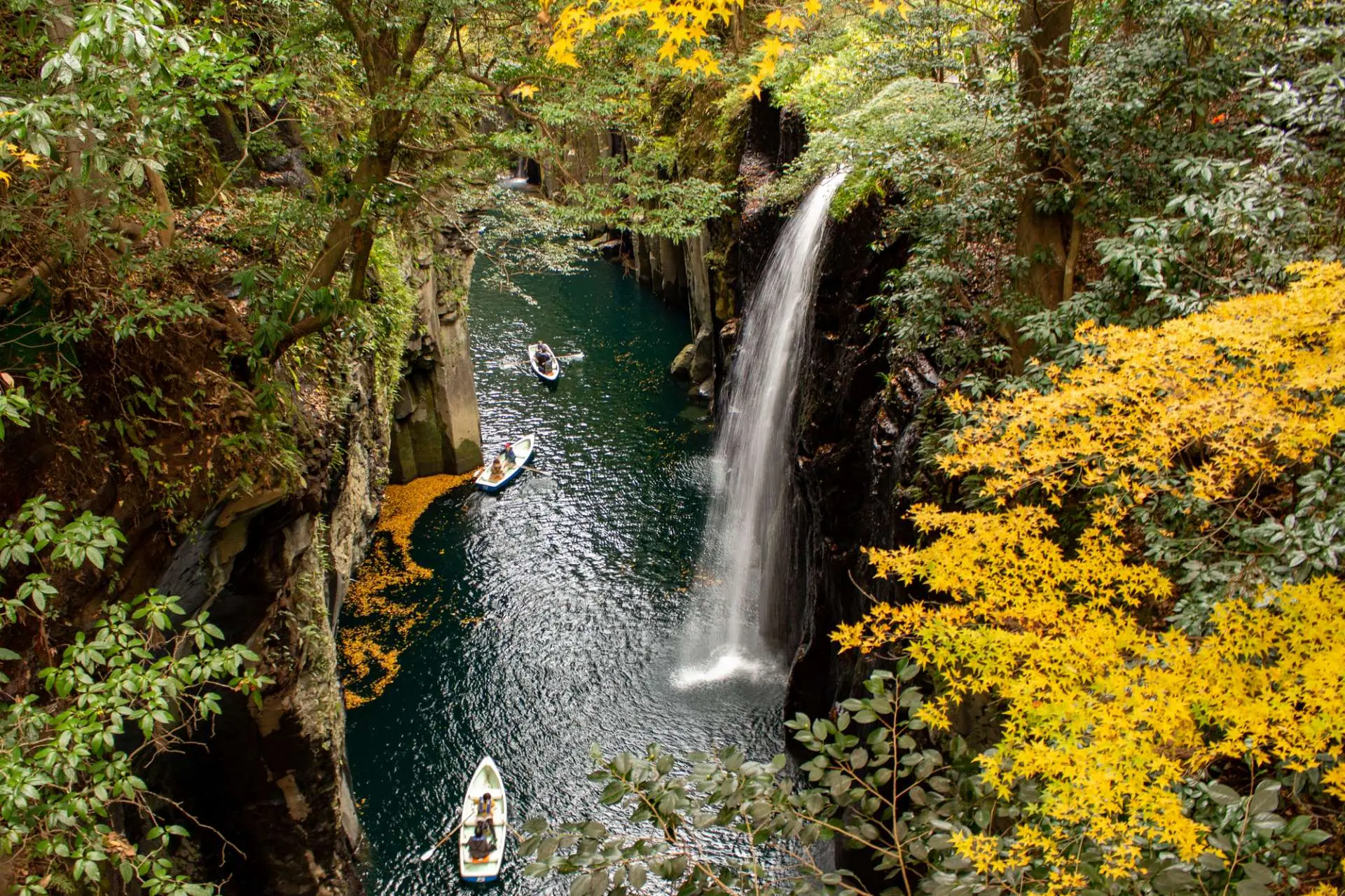
Its main highlight is Manai Falls, selected as one of Japan’s 100 Best Waterfalls.
When the autumn leaves reach their peak, the area around the waterfall also changes color. Visitors can view both the falls and foliage from a boat.
Colorful leaves can also be found beyond the immediate area around Manai Falls, so consider walking along the Takachiho Gorge trail.
- Best Time to Visit
- Mid- to late November
- Name in Japanese
- 高千穂峡
- Postal Code
- 882-1103
- Address
-
Mitai oshioi, Takachiho-cho, Nishiusuki-gun, Miyazaki
Google Maps - Tel
- 0982-73-1213 (Takachiho-cho Tourism Association)
- Boat Rentals
- 8:30am - 5:00pm (last rentals at 4:30pm)
- Access
- 7 minutes by car from Takachiho Bus Center
- Official Website
- Official Website (English)
For more recommended fall foliage spots in Kyushu, refer to the article below.

Can You See Fall Foliage in Okinawa?
Unfortunately, Okinawa does not have the colorful fall foliage seen elsewhere in Japan.
This is because its climate does not meet the conditions required for vivid autumn colors, and its tree species differ from those found on Japan’s main islands.
If seeing fall foliage is a priority, choose a destination outside Okinawa.
Frequently Asked Questions About Fall Foliage in Japan
Q
When is the best time to see fall foliage?
The timing varies by region, but fall foliage reaches its peak in many areas between early October and early December.
Q
What does “momijigari” mean?
It means visiting a fall foliage destination during the peak season to admire the colorful leaves.
Q
What are some famous fall foliage destinations?
Arashiyama in Kyoto, Nikko in Tochigi, and Yabakei in Oita are known as Japan’s Three Great Fall Foliage Destinations and are among the country’s most famous places to see autumn leaves.
Summary
This guide has covered what makes Japan’s fall foliage special, the best viewing periods by region, and a selection of destinations from across the country.
If you are visiting Japan to see the autumn leaves, use the locations introduced here as the basis for planning your itinerary.
Doing so will help you experience the full appeal of Japan’s fall foliage.