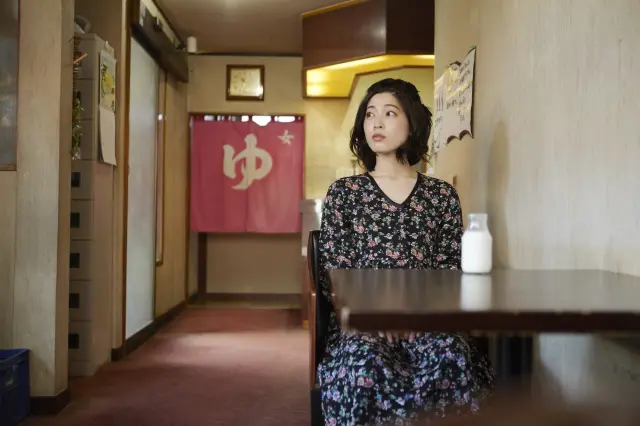
This public bath, Funaoka Onsen, is in Murasakino, Kita-ku, Kyoto City, near the Golden Temple at the foot of Mt. Funaoka. In 1923 when the restaurant inn Funaokaro was opened, the attached bathhouse began operating. Since then, it has been running for nearly one century. The changing room and the bath have retro designs from the early 1900s. It was designated as a national tangible cultural property in July 2003 as the 3rd operating bathhouse in Japan and the 1st in Kyoto.
The ceiling of the changing room has a zelkova grid with the dramatic goblin and the hero Minamoto no Yoshitsune at the center. The transom surrounding the changing room is decorated with masterful openwork carving, depicting the Aoi Festival, the horse race at Kamigamo Shrine, Imamiya Shrine's ceremony, Shanghai Incident, etc.
The washing room connecting the changing room and the bathing area has walls decorated in Majorca style derived from Mallorca Island, Spain. Museum-worthy expensive tiles are not curated, but put to use on the bathouse’s walls. The exterior hallway is Kikusui Bridge transferred from Senbon-Kuramaguchi, under which fine Koi fish are swimming in the pond. Even in the bathing area,
Even in the bathing area, there are lots to amaze you. The electric bathtub was set up in 1933 for the 1st time in Japan, which was introduced by the 2nd owner to be certified as a special Funaoka Onsen in Kyoto where there is no hot spring. For the outdoor bath, expensive garden rocks called Kibune-ishi, which curiously change colors when wetted.
Everywhere you see, it is luxurious and hard to believe it is a public bath. The bathing sections for male and female swap daily. You can visit multiple days and see the different ambience.
Highlights
-
The changing room and bathing area are registered as a national tangible cultural property.
-
The ceiling of the changing room has wooden carvings and the transom is openwork.
-
The washing room walls are decorated in Majorca style.
-
Japan’s 1st electric bathtub.