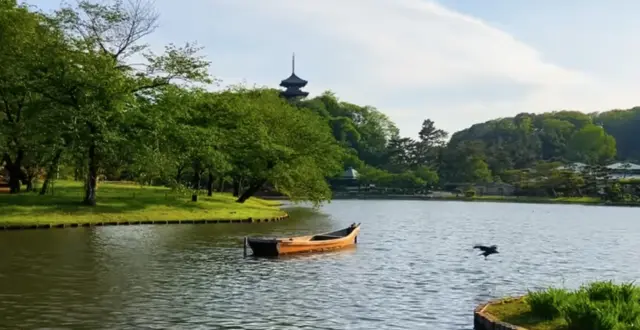
I originally thought I was just visiting a Japanese garden, but the moment I entered Sankeien Garden, I was blown away by its grandeur!
This isn't simply a place to “see some flowers and trees.” Historic buildings from Kyoto, Kamakura, and other places were relocated here and combined with lakes, mountains, forests, and flowers to create a massive classical Japanese painting.
What impressed me most wasn't actually the scenery, but founder Hara Sankei's vision and boldness. Back in 1906, he dared to undertake such a huge “relocating historic buildings + landscaping a garden” project. It seems wild even now, let alone back then!
The grounds are far too large to describe as “taking a quick stroll.” Along the way, there are historic buildings such as the three-story pagoda and Rinshunkaku, and you'll find yourself constantly stopping to take pictures. Each season offers different scenery, with cherry blossoms, lotus flowers, and fall foliage each having their own charm.
If you enjoy traditional Japanese architecture, gardens, and traveling at a leisurely pace while taking pictures, Sankeien Garden is definitely worth setting aside half a day to fully experience this “historic garden that changes with the seasons.”
Sankeien Garden | Review by wendy
Other Reviews by wendy
-
ENOSHIMA AQUARIUM
Facing Sagami Bay, this aquarium takes full advantage of its amazing location overlooking Mt. Fuji and Enoshima.
Besides shopping and enjoying the ocean views on Enoshima, I also highly recommend visiting ENOSHIMA AQUARIUM! There are so many marine animals, including dolphins, penguins, sea turtles, and seals, and it's nice to take your time walking around. I especially loved the dolphin show. It was exciting and cute, and the atmosphere was lively. The aquarium also has a great location facing Sagami Bay, and on clear days, you can see Enoshima and Mt. Fuji. After the aquarium, you can enjoy the sea breeze nearby. It's just right for a half-day trip〜
-
-
Ishigakiyama Ichiya Castle
Ishigakiyama Ichiya Castle was built in 1590 by Toyotomi Hideyoshi during the Siege of Odawara. The name "Overnight Castle" comes from a legendary story: Hideyoshi constructed a skeletal frame of the castle covered with white paper within a forest. He then ordered the surrounding trees to be cleared, making the castle suddenly visible, causing shock and a drop in morale among the opposing forces at Odawara Castle.
When visiting Odawara, don't miss these mountain castle ruins full of history! Ishigakiyama Ichiya Castle was the headquarters built by Toyotomi Hideyoshi during the Siege of Odawara. Although only the stone walls and ruins remain today, from the top you can still look out over Odawara and Sagami Bay. The view is very expansive.
It's also one of the Continued Top 100 Japanese Castles, so anyone interested in Japanese history will definitely find it fascinating. On holidays, you can take a day bus. On weekdays, you can rent a bicycle at the tourist information center or take on the roughly 50-minute walk up the mountain. Taking your time along the way is also enjoyable! -
-
Tsurugaoka Hachimangu
Tsurugaoka Hachimangu is the symbol of Kamakura, located in the heart of the city. It is frequented by many worshipers as a shrine related to Minamoto no Yorimoto, the founder of the Kamakura shogunate. The current main shrine, which was built in 1828, has been designated as an Important Cultural Asset of Japan.
Of course, you can't visit Kamakura without stopping by Tsurugaoka Hachimangu! As one of Kamakura's landmarks, it offers different scenery in every season. It was really crowded when I visited, but the overall worship route was well organized, so it didn't feel too congested. You need to climb some stairs to reach the main shrine, but they aren't very long or steep, so most people can get up easily. Afterward, you can also browse amulets, goshuin stamps, and more, giving it a real Japanese shrine atmosphere. If you're taking a walk around Kamakura, I definitely recommend stopping by!
-