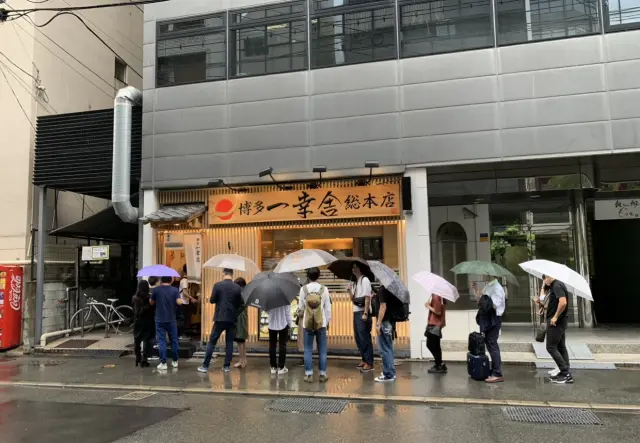
At the entrance to the Hakata Ikkousha Main Store, even with rain falling outside, the covered walkway was still packed with loyal foodies holding umbrellas and waiting in a long line. Its popularity is seriously unbelievable. The wooden decor and signature circular logo give the place an understated look and the solid feel of a long-established local restaurant.
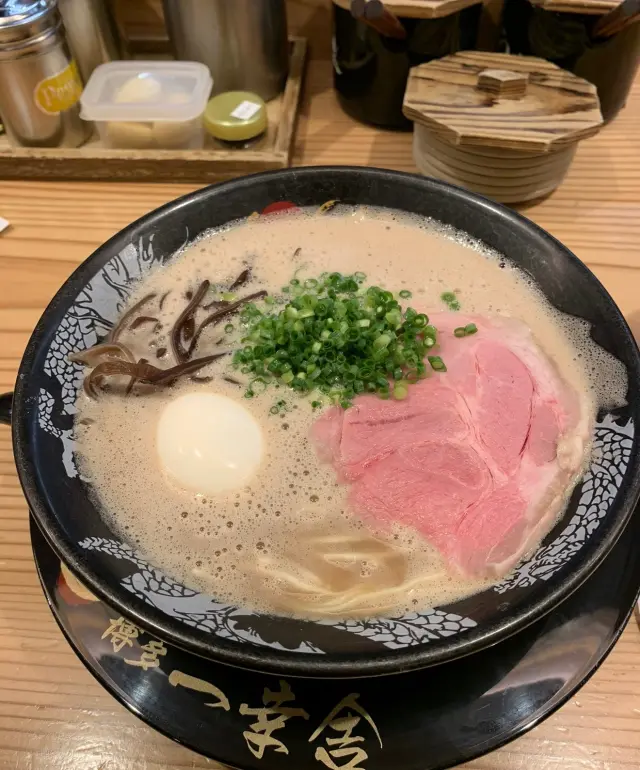
Once I sat down and their signature tonkotsu ramen arrived, the visual impact was immediate. The black bowl has “Hakata Ikkousha” printed around the rim, and the broth inside is a rich, smooth, milky white, with a layer of fine bubbles covering the surface. Topped with large slices of juicy-looking pink chashu, neatly arranged bright green onions, strips of wood ear mushrooms, and a perfectly boiled egg, it made my mouth water just looking at it.
Slurping up a big mouthful of noodles coated in the rich broth, the deep, intense pork bone aroma spread through my mouth. It was incredibly satisfying. The table is also thoughtfully stocked with various seasonings and minced garlic, so you can adjust the flavor to your liking at any time. From the rich broth to the generous toppings, every bite of this bowl of ramen delivers an authentic taste of Hakata. Making a pilgrimage to the main store for this bowl is absolutely worth it.
Hakata Ikkousha Main Store | Review by Jk
Other Reviews by Jk
-

Shirakawa-go (Gassho-Zukuri Village)
Shirakawa-go is a picturesque area where Japan’s traditional rural landscape remains intact. It has the largest concentration of gassho-zukuri buildings, with more than 100 structures of various sizes as of 2016. As Japan’s largest gassho-zukuri village, it has been designated a National Preservation District for Groups of Traditional Buildings.
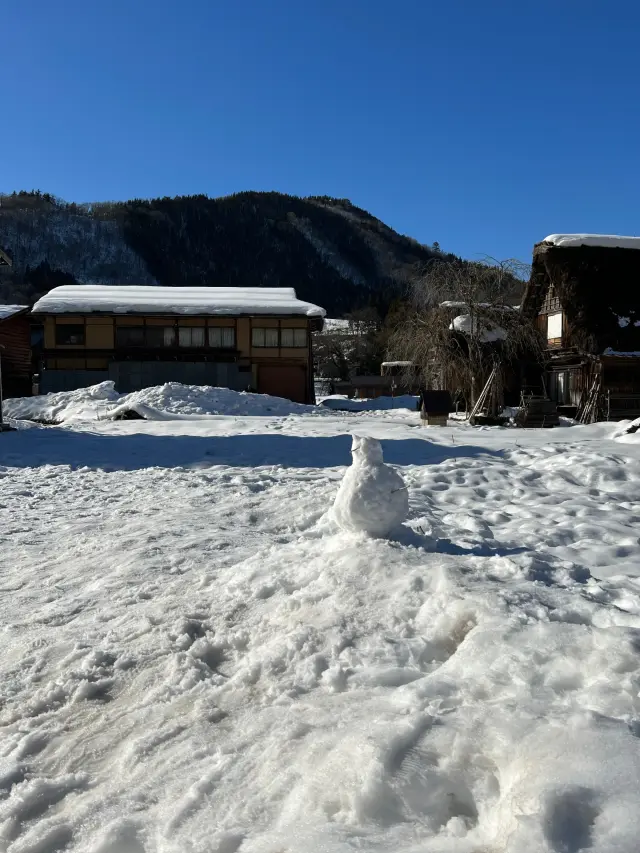
Visiting Shirakawa-go in winter, the entire village was covered in thick snow, and the steep, triangular thatched-roof houses looked like gingerbread houses dusted with frosting. Seeing it in person really felt like stepping into a fairy tale! It was freezing as I walked through the snow, which crunched underfoot, but every photo looked like a postcard. When I got cold, I could duck into a café in an old house, warm up beside a traditional irori hearth, and have a bowl of hot red bean soup. I warmed up instantly.
-
-

Deai Bridge
Deai Bridge is a 107-meter-long suspension bridge that leads to the Shirakawa-go gassho-zukuri village, a registered World Heritage site. The bridge connects the convenient public parking area, 'Village-Operated Sesaragi Park Parking Lot', to the village, and crossing the bridge brings you to the entrance of the village.
Once winter arrives and the snow starts pouring down, the entire Shirakawa-go gassho-zukuri village turns into a real-life fairy-tale snow country! The coolest things here are the triangular thatched roofs, built steep and pointed like hands pressed together in prayer, so the super-thick snow piled on top slides off by itself and doesn’t crush the houses. During the day, the whole village is completely covered in white snow. From a distance, it looks just like gingerbread houses covered in white icing. Step into one of the village’s little wooden cafés or traditional houses, and you can sit beside an atmospheric traditional irori hearth and warm yourself up with a steaming bowl of red bean soup!
-
-
Miyajima Ropeway
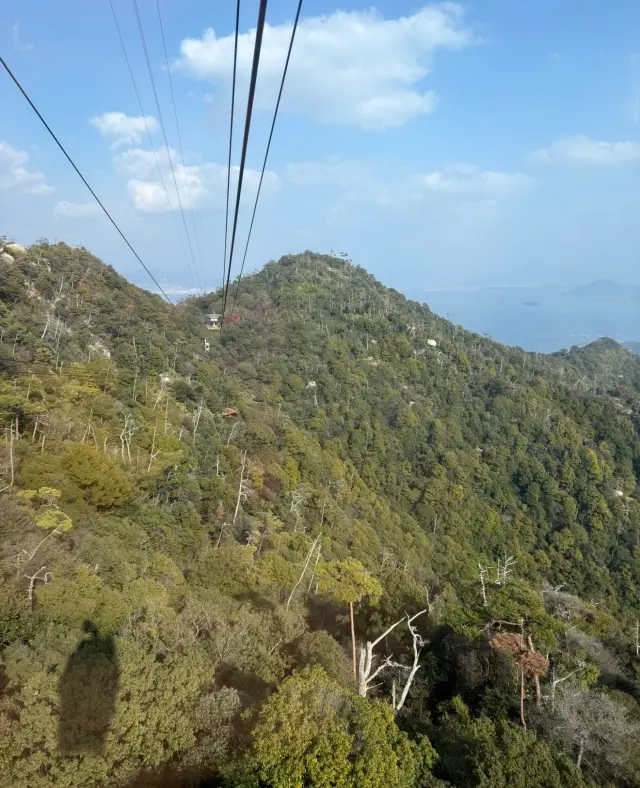
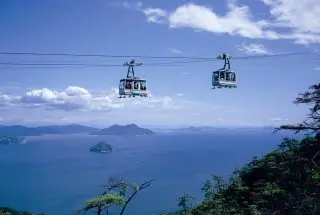
At 535 m, Mount Misen is the highest peak on Miyajima. The mountain has long been revered as an especially sacred place on an island historically regarded as an object of worship in its entirety. The Miyajima Ropeway takes you to Shishiiwa Station, located at an elevation of 433 m, in about 15 minutes of total travel time. Two ropeway lines cover the approximately 1.6 km between Momijidani Station at the foot of the mountain, the intermediate Kayatani Station, and Shishiiwa Station near the summit.
When visiting Miyajima, besides seeing the giant torii gate in the sea and eating grilled oysters, if you want to head straight to the highest point and take in the entire Seto Inland Sea, the Miyajima Ropeway is definitely the most exciting and effortless shortcut! The coolest thing about this ropeway is its rare two-stage transfer system, letting you experience two completely different types of gondolas in a single trip! First, you depart from Momijidani at the foot of the mountain and glide above the treetops of the primeval forest in a small, cute circulating gondola that looks like a little compartment. After arriving at the intermediate Kayatani Station, you seamlessly transfer to a large aerial tramway that holds 30 people and heads straight up toward the clouds. The scenery below instantly changes from dense green forest to a vast blue sea dotted with islands of all sizes—the view just blows you away!
-