

Make Sightseeing and Getting Around Easier! A Ueno Station Guide You Can Navigate with Confidence
Ueno is a multifaceted area where history, culture, nature, and shopping all come together.
Many travelers may be planning a trip with sights like Ueno Park, Ueno Zoo, and Ameyoko Shopping Street in mind.
It is also a major transportation hub, and Ueno Station is served by 11 lines in total, including conventional JR lines, the Shinkansen, private railways, and subways.
What’s more, when people say “Ueno Station,” there are actually six stations with “Ueno” in the name, which often causes confusion for visitors.
This article introduces the shortest routes from each exit to major sightseeing spots, so even first-time visitors getting off at “Ueno Station” can reach their destination without getting lost.
It also summarizes the features of each station and how to choose the right one, so read to the end and your sightseeing in Ueno should go much more smoothly.
Key points for choosing between JR, Keisei, and subway Ueno stations
“Ueno Station” has long served as Tokyo’s “northern gateway.”
Even today, it is a terminal station with trains running not only across the Tokyo metropolitan area, but also to the Tohoku region, the Hokuriku region, Narita Airport, and many other destinations.
There are also many famous sightseeing spots and landmarks nearby, so it is bustling with people every day.
There are several stations with “Ueno” in the name, but the following three are the main ones.
- JR Ueno Station
- Keisei Ueno Station
- Tokyo Metro Ginza Line and Hibiya Line Ueno Station
Because all of them are located close to one another, it can be confusing if you do not understand which one to use for your purpose and situation.
Below, we will introduce the features of each station and the main areas you can access from them so you know what to expect in advance.
Compare the information and use it as a guide to enjoy sightseeing in Tokyo and Ueno.
JR Ueno Station, the station you will use most often
JR Ueno Station is the main station in Ueno.
As shown below, conventional JR lines and the Shinkansen serve the station from many directions, making it accessible from a wide range of places.
The station building is very large and easy to spot, and it is also close to sightseeing spots such as Ueno Park and Ueno Zoo, so many people use it as a base for sightseeing and travel.
Another feature is the presence of the in-station shopping facilities ecute Ueno and atre Ueno, located inside and around the station.
The whole station feels like a commercial complex, where a retro atmosphere dating back to the Showa era blends with modern spaces to create a unique charm.
However, JR Ueno Station has multiple exits, and the nearest gate differs depending on your destination, so be careful.
- Lines
- Yamanote Line, Tokaido Main Line (Ueno-Tokyo Line), Keihin-Tohoku Line, Joban Line, Utsunomiya Line, Takasaki Line, Tohoku Main Line
- Shinkansen Lines
- Tohoku Shinkansen, Joetsu Shinkansen, Hokuriku Shinkansen
- Main accessible areas
- The greater Tokyo area, the entire Tohoku region, Niigata, Yokohama, Chiba, Saitama, and more
Travel time and access from major Tokyo stations to JR Ueno Station
- From JR Tokyo Station
-
Approx. 5 minutes via the JR Ueno-Tokyo Line
※Also accessible via the inner-loop JR Yamanote Line and the JR Keihin-Tohoku Line - From JR Shinjuku Station
- Approx. 26 minutes via the outer-loop JR Yamanote Line
- From JR Shinagawa Station
-
Approx. 15 minutes via the JR Tokaido Main Line (Ueno-Tokyo Line)
※Also accessible via the inner-loop JR Yamanote Line and the JR Keihin-Tohoku Line - From JR Shibuya Station
- Approx. 35 minutes via the outer-loop or inner-loop JR Yamanote Line

Excellent access to Narita Airport! Keisei Ueno Station
Keisei Ueno Station is known as a convenient station for getting to Narita Airport.
In particular, if you take the Keisei Skyliner, which runs directly between Narita Airport and Keisei Ueno Station, the trip takes Approx. 45 minutes.
It is also close to sightseeing spots such as Ueno Park and Ameyoko Shopping Street, making it an important hub for international visitors using Narita Airport.
It is especially recommended as a starting point for sightseeing in Tokyo or when heading to Narita Airport after visiting attractions around Ueno.
Another advantage of Keisei Ueno Station is that it is compact and easy to understand, and because it is above ground, it is easy to get out into the city without getting lost.
- Lines
- Keisei Electric Railway
- Main accessible areas
- Narita Airport, Nippori, Edogawa, Aoto, and more
Travel time and access from major Tokyo stations to Keisei Ueno Station
- From JR Tokyo Station
-
Take the JR Ueno-Tokyo Line to Ueno Station, then walk from Ueno Station’s Shinobazu Exit, Approx. 10 minutes
※Also accessible via the inner-loop JR Yamanote Line and the JR Keihin-Tohoku Line - From JR Shinjuku Station
- Take the outer-loop JR Yamanote Line to Ueno Station, then walk from Ueno Station’s Shinobazu Exit, Approx. 30 minutes
- From JR Shinagawa Station
-
Take the JR Tokaido Main Line (Ueno-Tokyo Line) to Ueno Station, then walk from Ueno Station’s Shinobazu Exit, Approx. 20 minutes
※Also accessible via the inner-loop JR Yamanote Line and the JR Keihin-Tohoku Line - From JR Shibuya Station
- Walk from JR Shibuya Station to Tokyo Metro Ginza Line Shibuya Station, take the Tokyo Metro Ginza Line bound for Asakusa, get off at Ueno Station, then walk from Exit 6, Approx. 40 minutes

Convenient access to Shibuya, Ginza, and Omotesando! Tokyo Metro Ginza Line Ueno Station
Tokyo Metro Ginza Line Ueno Station is a convenient station for sightseeing and getting around to major areas of Tokyo.
The Ginza Line connects directly to popular spots such as Shibuya, Ginza, and Omotesando, all reachable in around 30 minutes.
It is especially convenient for going to Asakusa (Approx. 5 minutes), so many travelers heading to Senso-ji Temple or Tokyo Skytree use it.
Of course, attractions such as Ameyoko Shopping Street and the Tokyo Metropolitan Art Museum are also located nearby, so the station also serves as a convenient base.
Another appeal is the line’s history: the Ginza Line was the first subway in Asia, opening in 1927, and the station still reflects nearly 100 years of that heritage.
- Lines
- Tokyo Metro Ginza Line
- Main accessible areas
- Asakusa, Shimbashi, Omotesando, Shibuya, and more
Travel time and access from major Tokyo stations to Tokyo Metro Ginza Line Ueno Station
- From JR Tokyo Station
-
Take the JR Ueno-Tokyo Line to Ueno Station, then walk from Ueno Station’s Central Gate, Approx. 10 minutes
※Also accessible via the inner-loop JR Yamanote Line and the JR Keihin-Tohoku Line - From JR Shinjuku Station
- Take the outer-loop JR Yamanote Line to Ueno Station, then walk from Ueno Station’s Central Gate, Approx. 30 minutes
- From JR Shinagawa Station
-
Take the JR Tokaido Main Line (Ueno-Tokyo Line) to Ueno Station, then walk from Ueno Station’s Central Gate, Approx. 20 minutes
※Also accessible via the inner-loop JR Yamanote Line and the JR Keihin-Tohoku Line - From JR Shibuya Station
- Walk from JR Shibuya Station to Tokyo Metro Ginza Line Shibuya Station, then take the Tokyo Metro Ginza Line, Approx. 30 minutes

Easy access to Roppongi and Nakameguro! Tokyo Metro Hibiya Line Ueno Station
Tokyo Metro Hibiya Line Ueno Station is a convenient station for sightseeing and getting around eastern Tokyo and the waterfront area.
Examples include Akihabara, famous for otaku culture, Roppongi and Nakameguro with their stylish shops and clubs, and Tsukiji, where you can enjoy fresh seafood.
Because it offers access to many different areas depending on how you want to spend your time, it is useful in a wide range of situations.
Like the Ginza Line, it also provides smooth access to major attractions such as Tokyo National Museum and the Tokyo Metropolitan Art Museum.
Popular Tokyo spots line both the Hibiya Line and Ginza Line, so Ueno also works well as a base for planning your Tokyo sightseeing itinerary.
- Lines
- Tokyo Metro Hibiya Line
- Main accessible areas
- Kita-Senju, Akihabara, Tsukiji, Roppongi, Ebisu, and more
Travel time and access from major Tokyo stations to Tokyo Metro Hibiya Line Ueno Station
- From JR Tokyo Station
-
Take the JR Ueno-Tokyo Line to Ueno Station, then walk from Ueno Station’s Central Gate, Approx. 10 minutes
※Also accessible via the inner-loop JR Yamanote Line and the JR Keihin-Tohoku Line - From JR Shinjuku Station
- Take the outer-loop JR Yamanote Line to Ueno Station, then walk from Ueno Station’s Central Gate, Approx. 30 minutes
- From JR Shinagawa Station
-
Take the JR Tokaido Main Line (Ueno-Tokyo Line) to Ueno Station, then walk from Ueno Station’s Central Gate, Approx. 20 minutes
※Also accessible via the inner-loop JR Yamanote Line and the JR Keihin-Tohoku Line - From JR Shibuya Station
- Take the outer-loop or inner-loop JR Yamanote Line to Ueno Station, then walk from Ueno Station’s Central Gate, Approx. 40 minutes

Two stations that are less commonly used for sightseeing in Ueno
There are two other stations with “Ueno” in the name: Tokyo Metro Ginza Line Ueno-Hirokoji Station and Toei Oedo Line Ueno-Okachimachi Station.
Both are located almost in the same area and are close to popular spots such as Ueno Frontier Tower and Nagatani Oedo Ueno Hirokojitei.
However, they are not very convenient for sightseeing in Ueno, and since the Toei Oedo Line does not provide easy access to Tokyo’s major areas, there are fewer situations where travelers will use them.
They are also separate from the three Ueno stations introduced above, so if you confuse them, you may need to continue on foot or by train.
In particular, be careful not to get off at Ueno-Hirokoji Station by mistake when your destination is Ueno Station.

The closest exits to Ueno’s most popular sightseeing spots
We have introduced the three main stations used for sightseeing in Ueno, but it is also worth remembering which exit is closest to your destination.
Each station has multiple exits leading in different directions, so using the wrong one can add extra time to your trip.
First-time visitors are especially likely to get confused, particularly at the large JR Ueno Station.
Here, we will introduce the best exits and walking times from the three stations for reaching Ueno’s most popular sightseeing spots by the shortest route.
Use this information to move around smoothly and make the most of your trip.
1. Ueno Zoo
Ueno Zoo is Japan’s oldest zoo, having opened in 1882.
It is one of Ueno’s leading attractions, where you can meet around 3,000 adorable animals from about 300 species. You can also see rare animals from around the world that can only be seen here.
For access, JR Ueno Station’s Park Exit or Shinobazu Exit, or Keisei Ueno Station’s Main Exit, are the quickest options, at Approx. 5 minutes on foot.
Ueno Zoo has three entrances divided between the East Garden and West Garden, each with different features as shown below, so it is recommended to decide in advance which entrance you want to use.
| Entrance | Features |
|---|---|
| Main Gate (East Garden) | The main entrance and easy to find, but often crowded / Home to a five-story pagoda designated as an Important Cultural Property of Japan / Close to polar bears, tigers, gorillas, and more |
| Benten Gate (West Garden) | Home to areas such as the Children’s Zoo Step and the Aye-Aye Forest / Shinobazu Pond occupies about half of the grounds |
| Ikenohata Gate (West Garden) | Opens at 10:00am, ticket sales begin / Less crowded than the other gates / Close to rhinos, giraffes, hippos, and more (※Nearest station: Nezu Station on the Tokyo Metro Chiyoda Line) |
For reference, the table below also summarizes the nearest station exits, gates, and walking times from the three stations to Ueno Zoo.
| Station | Closest exit | Walking time from exit |
|---|---|---|
| JR Ueno Station | Park Exit (Main Gate), Shinobazu Exit (Benten Gate) | Approx. 5 minutes |
| Keisei Ueno Station | Main Exit (Benten Gate) | Approx. 4 minutes |
| Tokyo Metro Ginza Line and Hibiya Line Ueno Station | Exit 7 (Benten Gate) | Approx. 8 minutes |

2. Ueno Park
Ueno Park, formally called Ueno Onshi Park, is a vast urban park and an attractive spot where nature and culture come together.
Often called an oasis in the city, the park is lively every day with locals and visitors enjoying its lush open spaces, rows of cherry trees, and gardens filled with seasonal flowers.
It is also recommended to take a cycle boat or swan boat out on Shinobazu Pond and relax while enjoying the scenery.
There are also many cultural facilities and historic buildings around the park, so you likely will not get bored even if you spend the whole day there.
The table below summarizes the nearest exits and walking times from the three stations to Ueno Park, so use it as a guide.
By the way, JR Ueno Station and Keisei Ueno Station are the easiest for access.
| Station | Closest station exit to a park entrance | Walking time from exit |
|---|---|---|
| JR Ueno Station | Park Exit | Approx. 2 minutes |
| Keisei Ueno Station | Main Exit | Approx. 1 minute |
| Tokyo Metro Ginza Line and Hibiya Line Ueno Station | Exit 7 | Approx. 2 minutes |

3. Ameyoko Shopping Street
Ameyoko Shopping Street (commonly called Ameyoko) is a lively shopping street stretching for about 500 to 600 meters between Ueno Station and Okachimachi Station.
Today, it is known as one of Tokyo’s leading markets, lined with around 400 shops and filled with a unique atmosphere that brings together the nostalgic charm of old-fashioned downtown Japan.
As you walk along the street, you will find all kinds of goods at great prices, including fresh seafood, meat, dried foods, fashion, everyday goods, and brand-name cosmetics.
The energetic calls from shop staff and the fun of price negotiation are part of what makes Ameyoko so special.
Another feature is that you can enjoy eating as you walk, with a wide range of foods such as yakitori, takoyaki, and kebabs.
The location is also easy to understand, right near JR Ueno Station’s Shinobazu Exit or Keisei Ueno Station’s Main Exit, so you are unlikely to get lost.
You can also access it from JR Okachimachi Station’s North Exit, and if you walk through Ameyoko from Okachimachi Station, you will arrive at JR Ueno Station.
For reference, the table below also summarizes the nearest station exits and walking times from the three stations to Ameyoko Shopping Street.
| Station | Closest exit | Walking time from exit |
|---|---|---|
| JR Ueno Station | Shinobazu Exit | Approx. 30 seconds |
| Keisei Ueno Station | Main Exit | Approx. 30 seconds |
| Tokyo Metro Ginza Line and Hibiya Line Ueno Station | Exit 7 | Approx. 2 minutes |


4. Tokyo National Museum
Tokyo National Museum is Japan’s oldest museum, established in 1872.
Made up of six exhibition buildings, it is known for both the quality and quantity of its collection, with Approx. 120,000 items, including many National Treasures and Important Cultural Properties.
You can explore a wide variety of works, from the Honkan (Japanese Gallery), where you can gain a deep understanding of Japanese history and traditional culture, to the Toyokan (Asian Gallery), which showcases cultural properties from across Asia.
Large-scale special exhibitions held around three to five times a year are also major highlights.
Each time, valuable artworks and crafts related to a specific theme are displayed.
The museum is located inside Ueno Park, and the shortest access is from JR Ueno Station’s Park Exit, taking Approx. 10 minutes.
For reference, the table below also summarizes the nearest station exits and walking times from the three stations to Tokyo National Museum.
| Station | Closest exit | Walking time from exit |
|---|---|---|
| JR Ueno Station | Park Exit | Approx. 10 minutes |
| Keisei Ueno Station | Main Exit | Approx. 15 minutes |
| Tokyo Metro Ginza Line and Hibiya Line Ueno Station | Exit 7 or Exit 9 | Approx. 15 minutes |

5. Tokyo Metropolitan Art Museum
Tokyo Metropolitan Art Museum is Japan’s first public art museum, opened in 1926.
Through special exhibitions and curated exhibitions introducing masterpieces from Japan and abroad, visitors can enjoy a wide range of works, from classic paintings to contemporary art.
With genres including Japanese painting, Western painting, sculpture, and crafts, it is a beloved spot for many art lovers.
It is also known as a “sanctuary for open-call exhibitions,” serving as a place where many artists present their work.
There are also many approachable displays, so even first-time art museum visitors can stop by casually.
The museum also has cafés and restaurants, making it easy to enjoy a meal or take a break between exhibitions.
The modern red-brick exterior designed by architect Kunio Maekawa is also stylish and perfect for photos.
Access from JR Ueno Station’s Park Exit is the quickest at Approx. 7 minutes, and the route is easy to follow as it is almost straight.
Since it is located inside Ueno Park and also close to Ueno Zoo and Tokyo National Museum mentioned above, you can visit them in whichever order you like.
For reference, the table below also summarizes the nearest station exits and walking times from the three stations to Tokyo Metropolitan Art Museum.
| Station | Closest exit | Walking time from exit |
|---|---|---|
| JR Ueno Station | Park Exit | Approx. 7 minutes |
| Keisei Ueno Station | Main Exit | Approx. 10 minutes |
| Tokyo Metro Ginza Line and Hibiya Line Ueno Station | Exit 7 | Approx. 10 minutes |

Two transfer routes from JR Ueno Station to Keisei Ueno Station
Keisei Ueno Station is about a 5 to 7-minute walk from JR Ueno Station via either the Shinobazu Exit or the Central Gate.
Which exit is better depends on the line you are using, so here we would like to introduce a simple route for each one.
There are also many multilingual signs along the way, so even first-time international visitors to Japan should be able to get there without getting lost.
If you are unsure of your current location, it is recommended to ask nearby station staff or use Google Maps.
Route from the Shinobazu Exit
- After passing through the Shinobazu Gate, go straight, take the escalator, then continue straight and exit through the Shinobazu Exit
- After exiting from the Shinobazu Exit, head to the right, cross the crosswalk when it appears, then walk to the left
- In about 1 minute, you will see the entrance to Keisei Ueno Station, then go down the escalator to reach the ticket gates

Route from the Central Gate
- After passing through the Central Gate, go straight for about 1 minute and exit through the Hirokoji Exit
- After exiting from the Hirokoji Exit, head to the right, and when you see the sign for “Keisei Ueno Station,” follow that passage
- Continue straight for a while until you come to a crosswalk, cross it and head to the left, and in about 1 minute you will see the entrance to Keisei Ueno Station

The Ueno Chuo-dori Underground Walkway that connects the different Ueno stations underground
The Ueno Chuo-dori Underground Walkway is an underground passage connecting JR Ueno Station, Keisei Ueno Station, and the Ueno stations on the Tokyo Metro Ginza Line and Hibiya Line.
The clean, spacious passage has no traffic lights, and it is not affected by the weather.
It also provides access to major sightseeing spots such as Ueno Park and Ameyoko Shopping Street.
Especially on rainy days or in extreme summer heat, it makes getting around smoother and more comfortable, so we highly recommend using the Ueno Chuo-dori Underground Walkway.
There are also restaurants, souvenir shops, and vending machines along the passage, so it is not just a way to get around, but also a place where you can enjoy a short break or some shopping.

Make the most of the convenient in-station shopping at JR Ueno Station
“Ekinaka” mainly refers to commercial facilities located inside or near JR East stations.
A major feature is the convenience of being able to take care of shopping, dining, and souvenir hunting all in one place, making good use of your time while on the move.
There are also many products aimed at tourists, and multilingual guidance and support are well prepared, making these spaces comfortable for international visitors as well.
JR Ueno Station is one of the stations with especially strong ekinaka offerings, and it is a place you can enjoy as a sightseeing spot in its own right.
Here, we will introduce two representative ekinaka facilities, so be sure to stop by.

ecute Ueno
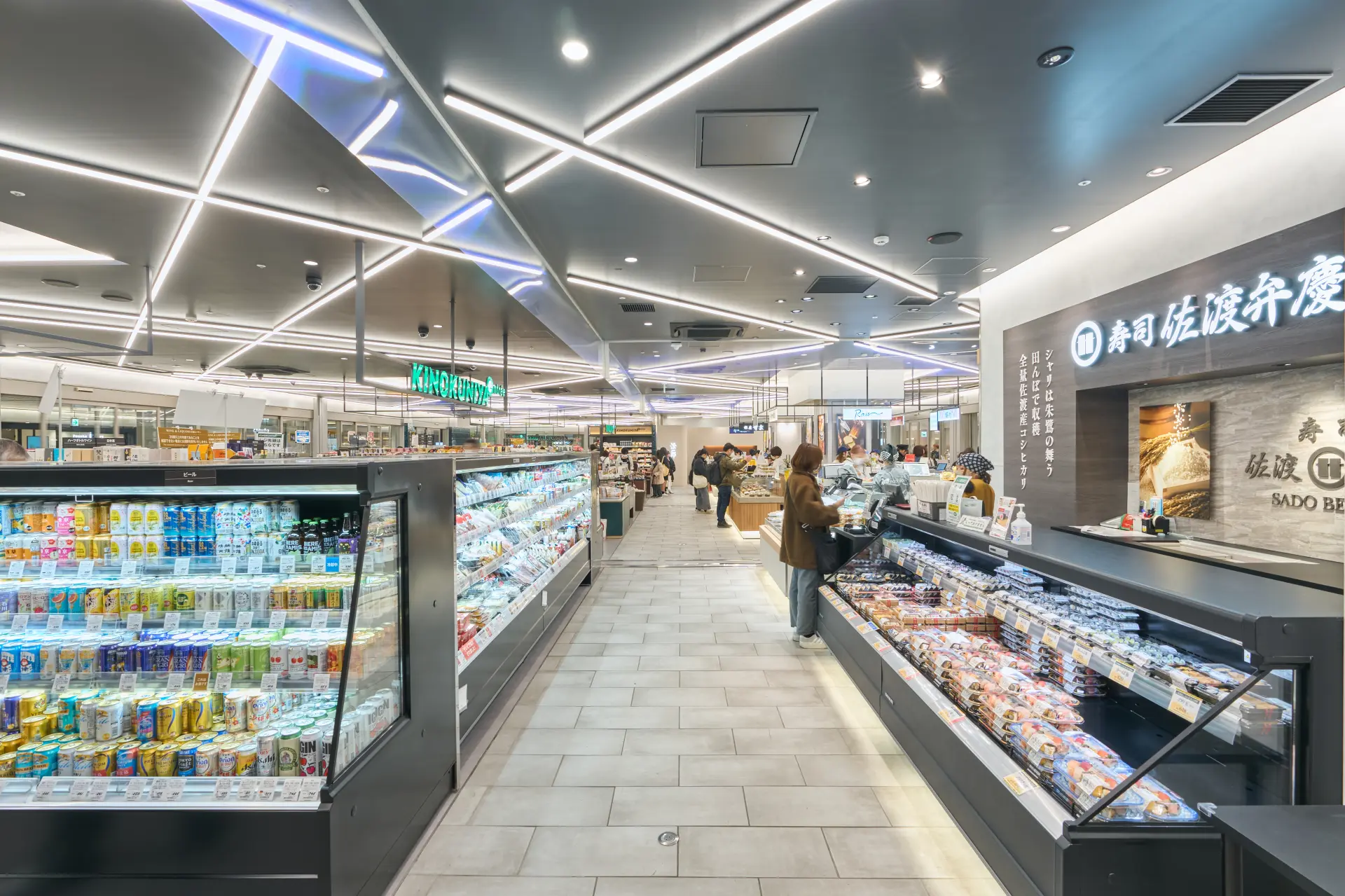
ecute Ueno is a station-connected shopping facility located in two places: on the 3rd floor inside the ticket gates of JR Ueno Station and outside the Park Gate.
It features a wide lineup of shops, including restaurants ranging from Japanese and Western cuisine to cafés, as well as bento shops, sweets stores, and bookstores.
One of its charms is the easy convenience unique to station shopping, making it simple to stop by during your trip for souvenirs, a meal, or a short break depending on your needs.
You can also find collaboration items available only at ecute Ueno with long-established Japanese confectionery shops and hugely popular brands, so it is enjoyable even just to walk around.
atre Ueno
atre Ueno is a shopping facility inside JR Ueno Station with an urban and refined atmosphere.
Its diverse mix of stores caters to a wide range of people, including commuters, tourists, and local residents, and it is known for carrying many trend-conscious products.
It is divided into Ueno EAST near the Central Gate (basement level 1, ground floors 1 and 2) and Ueno WEST around the Shinobazu Exit (ground floors 1 and 2).
Ueno EAST has restaurants, cafés, and variety shops, while Ueno WEST offers sweets, cafés, fashion, and convenience stores.
Its especially rich selection of cafés and restaurants is one of its biggest draws, with plenty of choices from casual lunches to relaxed dinners.
Regular events and exhibitions are also held, offering something new each time you visit.

FAQ about Ueno Station
Q
Which exit is closest to Ameyoko Shopping Street?
For the JR lines, it is right outside the Shinobazu Exit, and for Keisei Ueno Station, it is right outside the Main Exit. For the Tokyo Metro Ginza Line and Hibiya Line, it is a few minutes on foot from Exit 7.
Q
How many stations have “Ueno Station” in the name?
There are five in total: JR Ueno Station, Keisei Ueno Station, Tokyo Metro Ginza Line Ueno Station, Tokyo Metro Hibiya Line Ueno Station, Ueno-Hirokoji Station, and Ueno-Okachimachi Station.
Q
How long does it take to transfer from Keisei Ueno Station to JR Ueno Station?
It is about a 5 to 7-minute walk from the Main Exit of Keisei Ueno Station.
Summary
We have mainly introduced the features of the three “Ueno stations” most commonly used for sightseeing, how to choose between them, and which exits are the shortest routes to popular attractions.
It may seem difficult at first, but once you understand the information in this article, you should be able to reach your destination without getting lost.
Even if you use the wrong exit, it will only mean a slight detour, so there is no need to worry too much.
There are information counters at the ticket gates, and there are also many multilingual signs around the station area, so make active use of them whenever you need help.
Be sure to also check out this article, which introduces Ueno’s sightseeing spots, recommended restaurants, and shopping spots.