

It's one of Japan's three most famous scenic spots. From the observation deck, everyone looks at Amanohashidate from between their legs—the pose is super funny and makes everyone laugh.
Amanohashidate | Review by 張志祥
Other Reviews by 張志祥
-
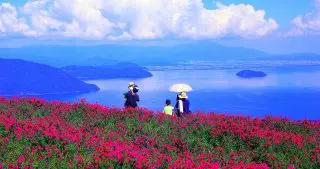
Biwako Hakodateyama
Renovated and reopened in 2020, Biwako Hakodateyama offers seasonal flowers in summer and skiing across a snowy landscape in winter. Take an approximately 8-minute gondola ride through the air while admiring views of northern Lake Biwa. At the summit, approximately 630 m above sea level, a spacious and open setting awaits.
The view is fantastic here. You can see everything all around you.
-
-

Hitachi Seaside Park
Hitachi Seaside Park is a large park that spans an area of about 215 hectares. During springtime, daffodils, tulips, and nemophila bloom. In early summer, there are roses, and in summer, there are zinnias and sunflowers. Autumn brings forth kochia and cosmos. During winter ice tulips, plum blossoms, and other seasonal flowers bloom. In particular, the nemophilia that bloom from mid-April through early May are lauded for their gorgeous blue color, blending the sky, sea, and flowers together into a vast expanse of blue.
This is one of the most famous spots in Ibaraki. In autumn, the hills are covered with kochia, and there's always something to see here no matter the season.
-
-

Shirakawa-go (Gassho-Zukuri Village)
Shirakawa-go is a picturesque area where Japan’s traditional rural landscape remains intact. It has the largest concentration of gassho-zukuri buildings, with more than 100 structures of various sizes as of 2016. As Japan’s largest gassho-zukuri village, it has been designated a National Preservation District for Groups of Traditional Buildings.
Shirakawa-go in winter is just magical. The heavy snow covering the gassho-style houses gives the whole village a unique and beautiful vibe.
-


